
 AU
AU
 UK
UK
 US
US
 NZ
NZ
 IND
IND

 CA
CA

 Share
Share
 X (Formerly Twitter)
 Whatsapp
 Facebook
 LinkedIn
 Telegram
 Email This Article
 Copy Link
 Summarize with AI
 Chat GPT
 Perplexity

Today, Friday, December 19, 2025, the Bank of Japan is concluding its final policy meeting of the year, and markets are bracing for what increasingly looks like a near-certain 25-basis-point rate hike, taking the short-term policy rate toward 0.75%.
This would not be just another incremental move. A hike of this magnitude would push Japanese interest rates to their highest level since 1995, marking a definitive break from nearly three decades of ultra-easy monetary policy.
For years, Japan’s zero-rate regime acted as the fuel line for global risk, powering the Yen carry trade that financed everything from U.S. tech stocks to emerging-market debt and crypto. Now, with the verdict imminent and policy normalization accelerating, that bridge is actively being dismantled, not repaired.
The signal is clear: capital is preparing to come home, and the global liquidity map is on the verge of a major redraw.
The Hard Numbers: What’s at Stake?
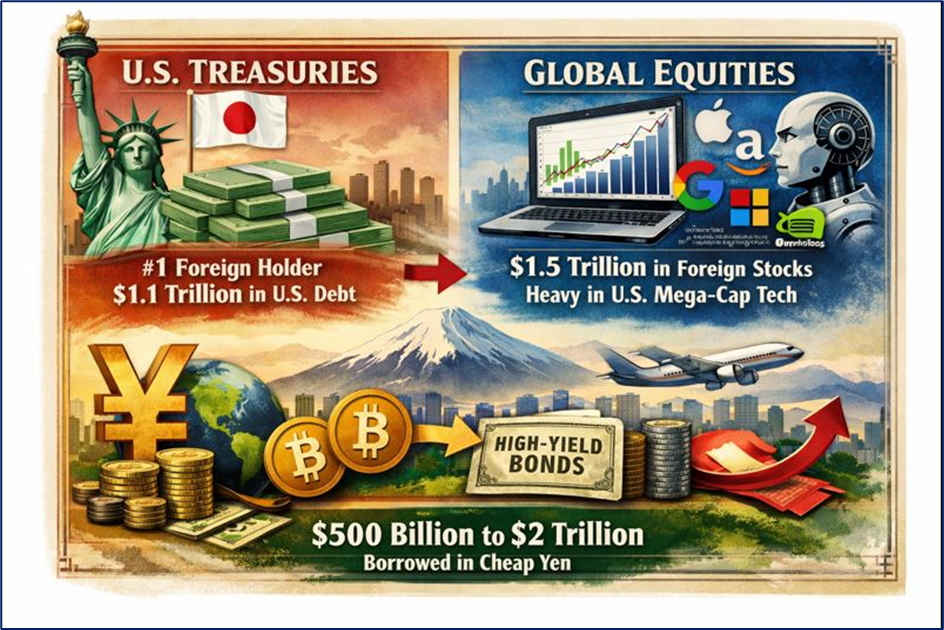
Japan sits on the world’s largest net international investment position, totalling $3.66 trillion (as of Q3 2025). The total footprint of Japanese capital globally is a staggering $4.9 trillion.
Source: Kalkine Group
The Exposure Breakdown:
- U.S. Treasuries: Japan is the #1 foreign holder, with $1.1 trillion in US debt.
- Global Equities: Roughly $1.5 trillion is parked in foreign stocks, heavily weighted toward U.S. Mega-Cap Tech (AI and the "Magnificent Seven").
- The Carry Trade: Estimated at $500 billion to $2 trillion, this represents money borrowed in cheap Yen to fund everything from high-yield emerging market bonds to Bitcoin.
Fund Manager Strategy: The "Repatriation" Playbook
Institutional "whales" like Japan’s GPIF (the world’s largest pension fund) and global hedge funds are shifting gears. The strategy going forward focuses on Repatriation and De-leveraging.
Source: Kalkine Group
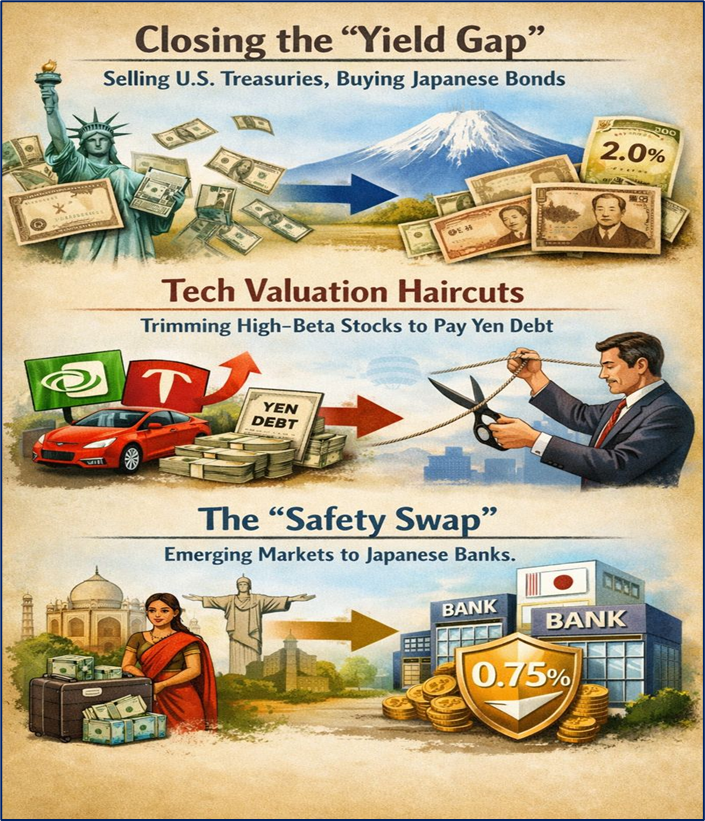
- Closing the "Yield Gap": With 10-year Japanese Government Bond (JGB) yields surging toward 2.0%, Japanese insurers no longer need to chase U.S. yields that come with high currency-hedging costs.
- The Move: Selling U.S. Treasuries and bringing cash home to buy domestic JGBs.
- Tech Valuation Haircuts: Fund managers are reducing exposure to "high-beta" assets. The Yen was the funding currency for risk; as Yen borrowing costs rise, managers are trimming "winner" positions (Nvidia, Tesla) to pay back Yen-denominated debt.
- The "Safety Swap": Rotating out of emerging markets (India, Brazil) and into Japanese Banks, which directly profit from expanded lending margins at 0.75%.
Retail Investor Landscape: Navigating the Unwind
For retail investors, the BOJ hike marks the end of "easy mode" for global liquidity. The primary risk is a volatility spike rather than a fundamental collapse.
Source: Kalkine Group
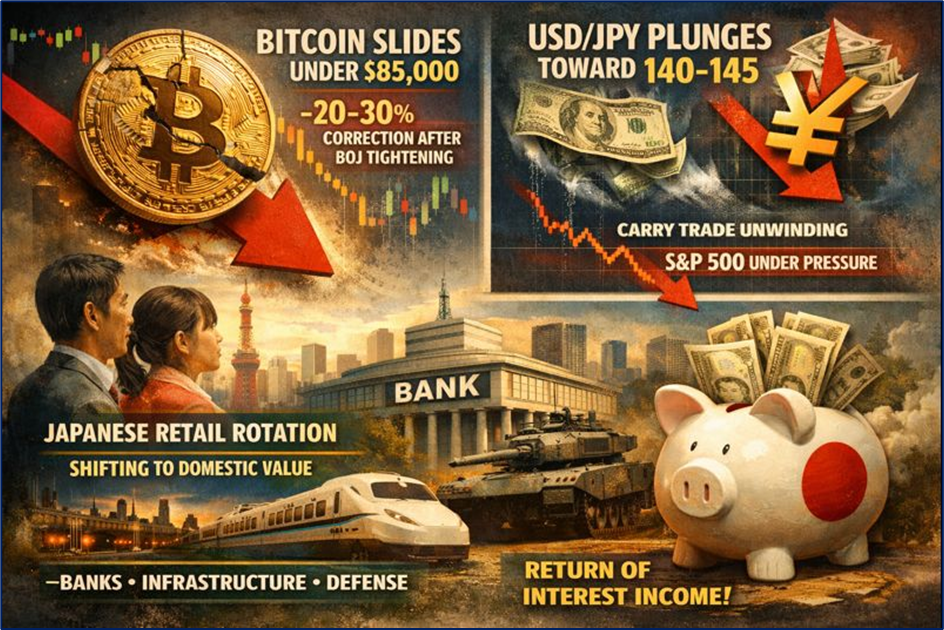
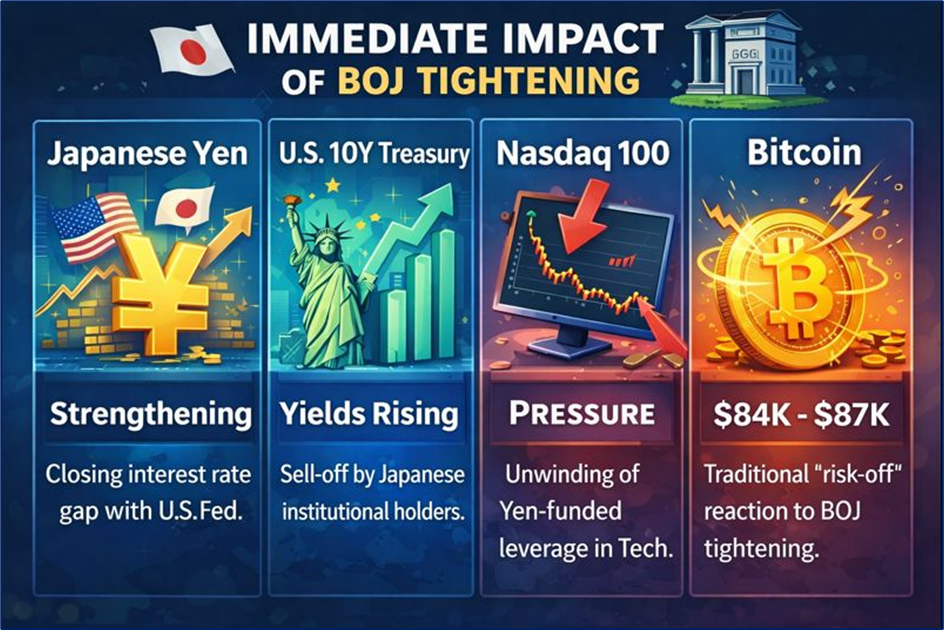
- Crypto Sensitivity: Historically, every major BOJ tightening event in 2024 and 2025 has been followed by a 20-30% correction in Bitcoin. As of today, BTC is under pressure, trading near the $85,000 mark as traders brace for a liquidity drain.
- Currency Shifts: The USD/JPY is the most critical ticker on the board. A move toward 140–145 would signify a massive unwinding of carry trades, putting downward pressure on the S&P 500.
- Domestic Japan Rotation: Retail sentiment in Japan is shifting toward domestic value. Banks and "Sanaenomics-aligned" sectors (infrastructure and defense) are seeing increased inflows as the middle class anticipates a return of interest income on their savings.
Market Reaction Summary
Source: Kalkine Group
Conclusion: A Return to "Normal"
The verdict is in: Japan is finally re-joining the global monetary norm. While the 0.75% rate is still low by Western standards, the velocity of the change is what matters. The global financial system has been "doped" on cheap yen for 30 years; today, the withdrawal symptoms have officially begun.
Key Watch Item: Governor Kazuo Ueda’s press conference (06:30 GMT). If he hints at a 1.0% terminal rate by mid-2026, expect the Yen rally and the Tech sell-off to accelerate into the weekend.


 Jun 24, 2026




 Please wait processing your request...