
 AU
AU
 UK
UK
 US
US
 NZ
NZ
 IND
IND

 CA
CA

 Share
Share
 X (Formerly Twitter)
 Whatsapp
 Facebook
 LinkedIn
 Telegram
 Email This Article
 Copy Link
 Summarize with AI
 Chat GPT
 Perplexity

The 2026 Canada Playbook: Key Takeaways
- The "Discount" Trade: The S&P/TSX trades at a significant valuation gap compared to the S&P 500 (~16x vs ~21x P/E). Analysts see this as a "safety buffer" if global valuations undergo a major correction.
- The Yield Curve Pivot: With the Bank of Canada (BoC) hitting its neutral rate, the yield curve is steepening. This "normalization" shifts the advantage to Banks (higher lending margins) and Long-duration Bonds.
- Resource Sovereignty: The 2026 narrative is no longer just about "commodities"—it's about Strategic Security. Canada is being re-rated as a "safe-haven supplier" for Uranium (Nuclear/AI power), Copper (Grids), and LNG.
- The Mark Carney Factor: The federal budget under Prime Minister Mark Carney focuses heavily on productivity and industrial speed-ups. This is expected to act as a "fiscal tailwind" for industrials and natural resource projects.
- The USMCA "Cliff": The July 2026 trade review is the elephant in the room. Any aggressive rhetoric from the US could trigger "headline volatility" for Ontario and Quebec-based manufacturing and auto parts.
- AI Beyond Tech: Portfolio managers are shifting from "AI creators" (US Tech) to "AI Enablers". In Canada, this means looking at Utilities and Energy companies providing the massive baseload power required for new North American data centres.
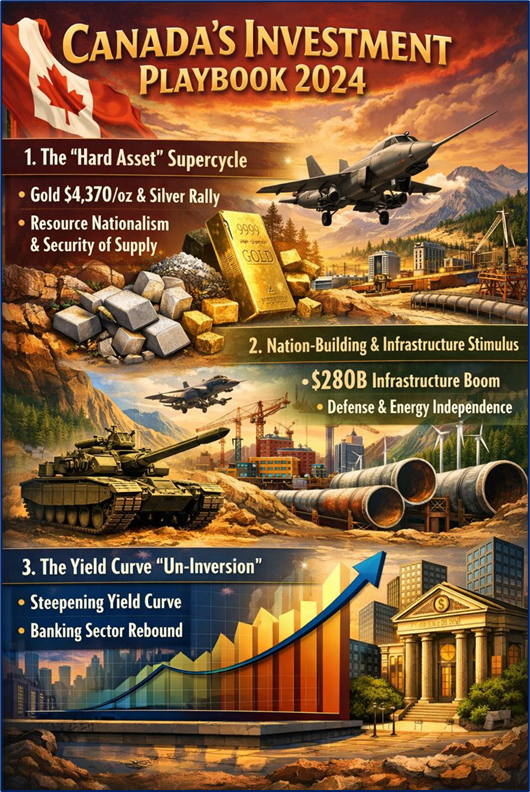
Top Investment Themes for 2026
Source: Kalkine Group
- The "Hard Asset" Supercycle
While the US market wrestles with AI valuations, Canada is capitalizing on what it does best: Rocks and Reserves. Gold has breached new highs ($4,370/oz range), and silver is rallying. The theme isn't just inflation protection; it's a structural supply deficit in critical minerals needed for the global energy transition.
- Buzzword: "Resource Nationalism" & "Security of Supply."
- Nation-Building & Infrastructure Stimulus
Federal strategies are pivoting aggressively toward domestic security and productivity. We are seeing a $280B capital spending boom (planned through 2029) focused on defense, critical mineral supply chains, and energy independence. This is government-backed growth, insulating specific sectors from the wider economic slowdown.
- The Yield Curve "Un-Inversion"
The abnormal is ending. The yield curve is steepening, a classic signal that favors financials. Banks are expected to see improved net interest margins as the gap between short-term borrowing and long-term lending rates widens.
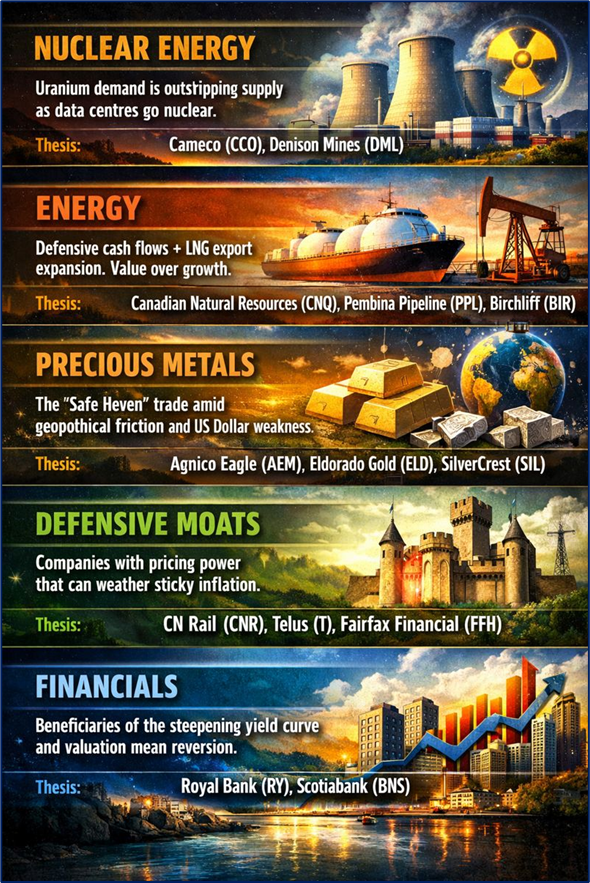
Sectors & Stocks to Watch (The 2026 Watchlist)
Source: Kalkine Group
Street Consensus: The "Big Six" & Global Titans Weigh In
The consensus is fractured, which creates opportunity for active managers.
- The Interest Rate Split:
- BMO & TD: Dovish. They see productivity dragging and expect the Bank of Canada (BoC) to cut rates to spur growth (target <2.0%).
- Scotiabank: Hawkish. They warn of a "sticky inflation" resurgence and predict the BoC might actually hike rates by 50bps in late 2026 to curb wage growth and currency depreciation.
- The Takeaway: Volatility in the bond market is guaranteed.
- BlackRock & Vanguard:
- Vanguard: Favors bonds and value stocks. They argue US growth stocks are priced for perfection and see Canada’s value-heavy index as a prudent diversifier.
- BlackRock: "Micro is Macro." They remain pro-risk but selective, warning that the "diversification mirage" (buying index funds) won't work. They favor active stock picking and private credit over broad passive exposure.
Strategies for the Retail Investor
- "Barbell" Your Portfolio
Combine high-quality fixed income (now offering real returns) with commodity exposure. This captures yield if the economy slows, and upside if inflation reignites.
- Focus on "Dividend Aristocrats" with Growth
In a slow-growth GDP environment (forecasted ~1%), dividends become a larger portion of total return. Look for companies like Telus or Enbridge that have a history of hiking payouts regardless of the cycle.
- Avoid "Unprofitable Tech"
The market's patience for "growth at any cost" is evaporating. 2026 is about Free Cash Flow (FCF). If a company can't fund its own operations without issuing debt, it is vulnerable.
The "Wall of Worry": Major Risks to Watch
- The "CUSMA" Time Bomb (July 2026): The review of the US-Canada-Mexico trade agreement is the single biggest tail risk. Any friction here could slap tariffs on Canadian exports, hurting the auto and manufacturing sectors.
- The AI Hangover: A correction in US tech giants (Nvidia, Microsoft) would trigger a "wealth effect" shock, dragging down global sentiment and Canadian equities correlated to US risk appetite.
- The "Sticky" 3% Inflation: If inflation refuses to drop to 2%, the Bank of Canada cannot cut rates, potentially choking off the mortgage renewal cycle and hurting consumer discretionary spending.
Conclusion: The "Maple" Hedge
2026 is shaping up to be the year of Real Assets > Financial Engineering.
Canada offers a unique proposition: it is a resource-rich, politically stable (relative to global peers) economy trading at a discount. While the US chases AI dreams, Canada is selling the copper, uranium, and energy required to power them.


 Jun 24, 2026




 Please wait processing your request...