
 AU
AU
 UK
UK
 US
US
 NZ
NZ
 IND
IND

 CA
CA

 Share
Share
 X (Formerly Twitter)
 Whatsapp
 Facebook
 LinkedIn
 Telegram
 Email This Article
 Copy Link
 Summarize with AI
 Chat GPT
 Perplexity
The 23% surge in DeFi Technologies' stock on November 25, 2025, marked a decisive tectonic reversal following a period of intense pressure. While the previous week was defined by a severe sell-off and a downward revenue guidance revision, the surge was the market quickly re-pricing the stock based on the underlying, rock-solid operational health of the company's core business: acting as the indispensable regulated gateway between traditional finance (TradFi) and the booming world of Decentralized Finance (DeFi).
This dramatic movement confirms that for sophisticated investors, the predictable fee revenue from its asset management business is far more compelling than the temporary volatility in its trading desk operations.
Q3 2025 Financial & Operational Snapshot
DeFi Technologies reported its Q3 2025 results on November 14, 2025, revealing a nuanced picture of growth and temporary market challenges. The financial performance highlights the inherent duality of its business model: a stable, fee-based core and a high-variance, high-reward trading component.
Financial Highlights (Three Months Ended September 30, 2025)
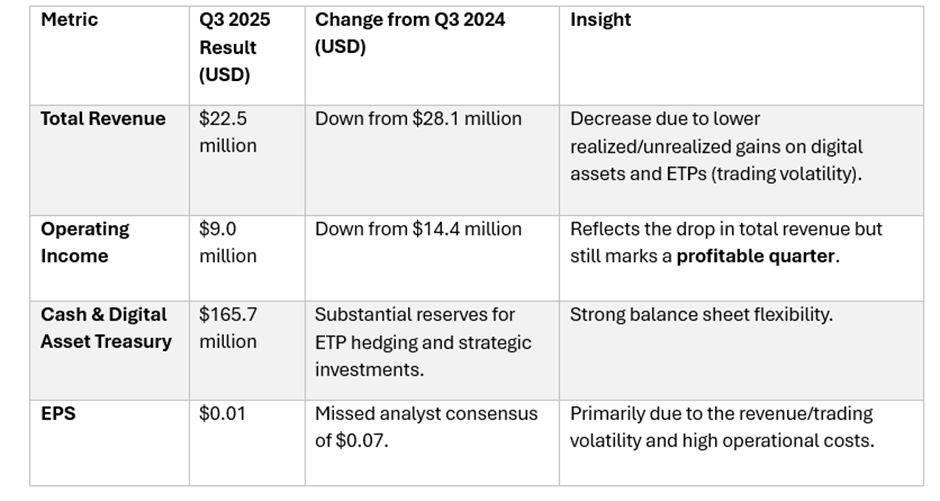
Source: Kalkine Group
Operational Highlights
- Average AUM Record: Average Assets Under Management (AUM) exceeded $900 million per month in Q3 2025, the highest quarterly average in the company’s history.
- AUM Milestone: Valour's month-end AUM reached $987 million as of late September, demonstrating consistent investor inflows.
- Core Revenue Growth: Revenues from staking/lending income and management fees increased year-over-year, directly benefiting from rising AUM.
- New Revenue Stream: The new DeFi Advisory business generated its first revenues of $192,407 from two clients, diversifying the revenue base.
- Balance Sheet Fortification: The company successfully closed a $100 million equity financing in September 2025, significantly boosting capital reserves.
The Multi-Pillar Business Model
DeFi Technologies employs a multi-faceted business model designed to capture various revenue streams across the DeFi ecosystem, while maintaining a regulated and institutionally compliant front end.
- Asset Management (Valour)
- Product: Issuer of Exchange-Traded Products (ETPs), including Bitcoin, Ethereum, and a range of altcoin-backed products, listed on European exchanges.
- Revenue Stream: Management Fees (a percentage of AUM) and Staking/Lending Income (yield generated by staking the underlying digital assets held by the ETPs).
- Role: This is the most stable and scalable revenue stream, as it is based on the size of institutional capital inflows (AUM), not on market trading volatility.
- Trading and Liquidity Services (DeFi Alpha / Stillman Digital)
- Product: Proprietary trading, prime brokerage, and institutional liquidity provision, including the DeFi Alpha arbitrage desk.
- Revenue Stream: Trading Gains (realized and unrealized gains from trading strategies, including arbitrage) and Trading Commissions (from services like the institutional dark pool, GoDark).
- Role: This is the high-variance pillar. In Q3 2025, the reduction in arbitrage opportunities led to a downward revenue revision, causing the initial stock decline. However, when market conditions are favorable, it generates spectacular returns (as seen in Q2 2025).
- Ventures and Strategic Expansion
- Product: Investments in early-stage, compliant, and disruptive DeFi and Web3 infrastructure.
- Revenue Stream: Fair Value Gains from the venture portfolio and Strategic Fees/Growth from incubated projects.
- Role: This is the long-term, forward-looking growth engine, highlighted by investments in regulated stablecoins (like cNGN in Nigeria and QCAD in Canada) to build digital payment rails in emerging markets.
Summary
DeFi Technologies operates a flywheel: Institutional Trust (Valour ETPs) generates Recurring Fees (Management/Staking), which fund Strategic Expansion (Stablecoins/Ventures) and Proprietary Trading (DeFi Alpha). While the trading pillar is volatile, the AUM anchor provides resilience. The 23% surge was the market finally acknowledging this resilience and buying the dip on the strength of a $165.7 million balance sheet and a fundamentally sound, scalable business model. The company embodies the entire risk-reward profile of the crypto-finance convergence: complex, volatile, and essential for the future of global money.
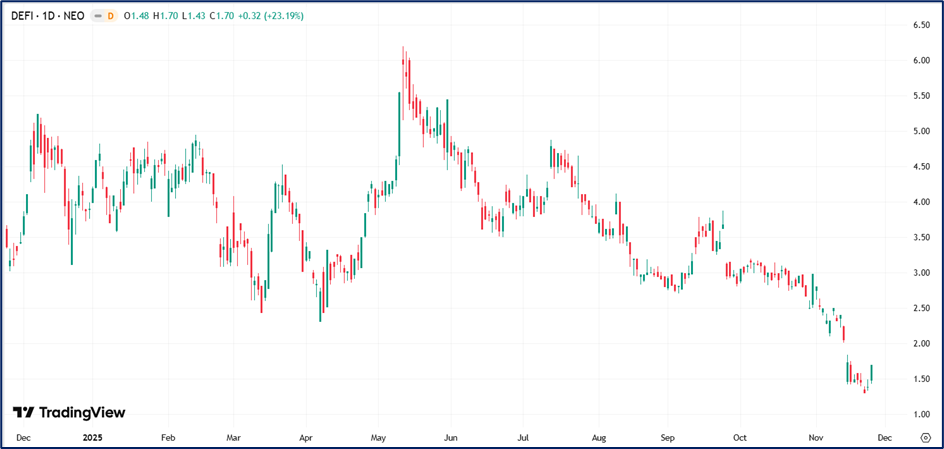
Source: Trading View, 25 Nov 2025


 Jun 24, 2026




 Please wait processing your request...