
 NZ
 UK
 US
 AU
 IND

 CA

 Share
 X (Formerly Twitter)
 Whatsapp
 Facebook
 LinkedIn
 Telegram
 Email This Article
 Copy Link
 Summarize with AI
 Chat GPT
 Perplexity
Key Takeaways: What You Need to Know Now
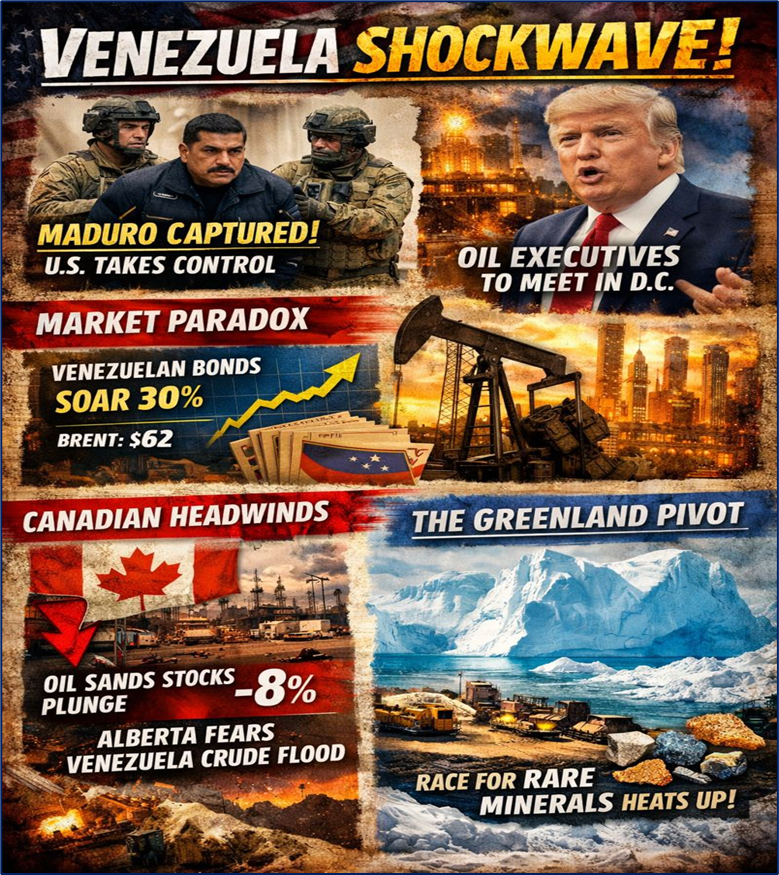
- The Shock Event: Following the Jan-3, U.S. military capture of President Nicolás Maduro, Venezuela is under "temporary American control," according to President Trump, with a meeting of U.S. oil executives scheduled this week to discuss rebuilding the nation's energy sector.
- Market Paradox: Oil prices rose slightly (Brent at ~$62), but the "real" winners are U.S. energy services and Venezuelan sovereign bonds, which surged 30% on debt restructuring hopes.
- Canadian Headwinds: Oil sands giants like Cenovus and Canadian Natural Resources fell 5–8% this week as investors fear a long-term flood of Venezuelan heavy crude displacing Alberta’s market share in the U.S. Gulf Coast.
- The Greenland Pivot: Melting Arctic ice and the "Venezuela Shock" have accelerated the race for Greenland’s critical minerals as a hedge against energy volatility.
Source: Kalkine Group
The Capture That Shook the World
The first week of 2026 has redefined "geopolitical risk." With Nicolás Maduro now in a New York federal court pleading "not guilty" to narco-terrorism charges, the world’s largest oil reserves (303 billion barrels) are effectively under new management.
Wall Street is already moving. EODHD/Others and Bloomberg data show a massive rally in Venezuelan "zombie bonds"—sovereign debt that has been in default since 2017—as giants like Fidelity and T. Rowe Price prepare for what could be the most complex debt restructuring in history.
The "Big Oil" Land Grab
The White House has signaled a "temporary" administration of Venezuela’s oil industry. For retail investors, the play isn't just the oil itself—it’s the infrastructure.
- Energy Services Boom: Analysts from JPMorgan and Morgan Stanley highlight Halliburton (HAL) and SLB (formerly Schlumberger) as primary beneficiaries. Their stocks jumped 8–9% this week because Venezuela’s infrastructure is currently "decaying," requiring billions in immediate services to reach even half of its 3.5M bpd peak.
- Refining Edge: Phillips 66 (PSX) and Valero (VLO) surged as they are specifically tuned to process the "heavy-sour" crude that Venezuela produces—and that Canada currently dominates.
The "Greenland Concern": The Arctic Hedge
While Venezuela provides the oil shock, Greenland is providing the strategic anxiety. As energy markets volatilize, global powers are eyeing Greenland’s Critical Minerals as the ultimate backup plan.
Why Greenland matters as of today:
- Rare Earth Dominance: Projects like Tanbreez are now being discussed in the same breath as national security. Greenland holds the terbium and dysprosium needed for the EV motors and wind turbines that will eventually replace fossil fuels.
- Trump’s Renewed Bid: Bloomberg reports that the Trump administration has renewed interest in a Greenland equity stake to counter Chinese influence in the Arctic.
- The Logistics Risk: The "concern" isn't the resource, it's the shipping. Volatility in the Atlantic makes the ice-free ports of southern Greenland the most contested real estate of 2026.
Impact on Canadian Markets: A "Massive Overreaction"?
Source: Kalkine Group
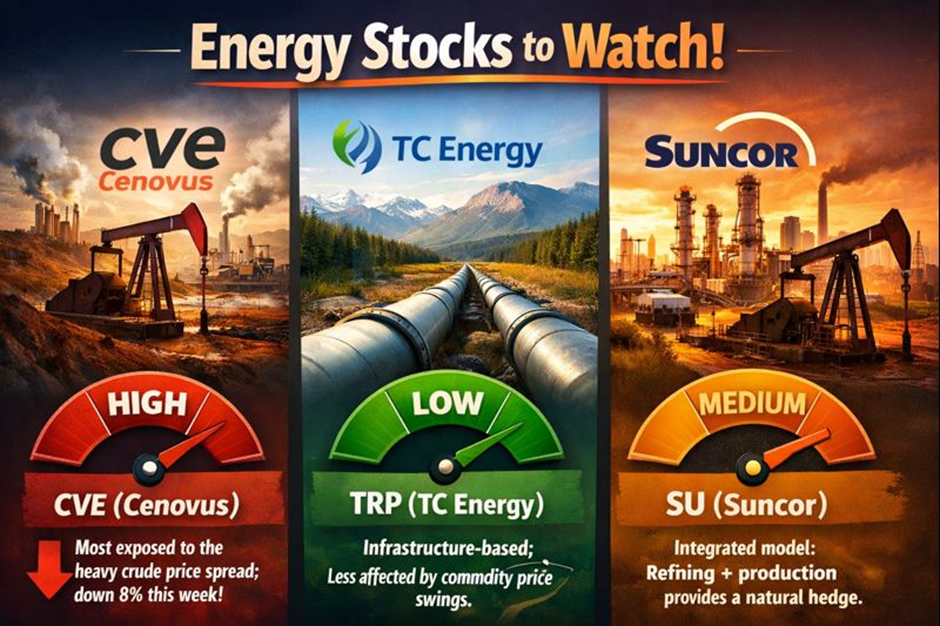
The TSX Energy Index took a 3.6% hit this week, with the "Big Three"—Suncor, Cenovus, and CNRL—leading the decline.
The Bear Case: Wall Street fears that a "liberated" Venezuela will flood the U.S. Gulf Coast with heavy crude, widening the WCS-WTI differential. If Venezuelan oil flows freely, Canadian oil becomes the expensive alternative.
The Bull Case: Professional analysts like Eric Nuttall are calling this a "massive overreaction."
"Geography favors Canada," notes Charles St-Arnaud, chief economist at Servus Credit Union. "69% of Canadian oil goes to the U.S. Midwest through pipelines that can't easily be re-routed to Venezuelan tankers."
Conclusion: The New Energy Map
The "Venezuela Shock" isn't a 2026 story about a supply glut—it's a story about re-alignment. It will take years and over $150 billion to fix Venezuela’s fields. In the meantime, the volatility is driving capital toward "safe" but strategically complex bets like Greenland.
For the retail investor, the message is clear: the era of stable energy pricing is over. The focus has shifted from "How much oil is there?" to "Who controls the infrastructure and the critical minerals of the future?"


 Nov 20, 2026





 Please wait processing your request...