
 AU
AU
 UK
UK
 US
US
 NZ
NZ
 IND
IND

 CA
CA

 Share
Share
 X (Formerly Twitter)
 Whatsapp
 Facebook
 LinkedIn
 Telegram
 Email This Article
 Copy Link
 Summarize with AI
 Chat GPT
 Perplexity
Highlights
- Electrovaya introduced new lithium-ion battery systems for material handling applications
- The company expanded its product portfolio with configurable battery and charging solutions
- Saturn Oil & Gas Inc. (TSX:SOIL) reported production above guidance in the fourth quarter of 2025
- The company delivered record free funds flow while continuing debt reduction and shareholder returns
Growth stories in equity markets often begin quietly—through incremental product launches, operational milestones, or shifts in strategic direction. Over time, these developments form a narrative that investors follow closely, connecting present activity with future potential. On the Toronto Stock Exchange (TSX), growth-oriented companies span sectors as varied as clean technology and energy, each navigating its own cycle of expansion, execution, and recalibration.
This article explores two TSX-listed companies—Electrovaya Inc. (TSX:ELVA) and Saturn Oil & Gas Inc. (TSX:SOIL)—through the lens of their recent updates. Rather than projecting outcomes, the focus remains on understanding how ongoing developments contribute to their positioning within broader industry trends.
Growth Stocks on the TSX: A Broad Framework
Growth stocks typically represent companies aiming to expand their operations, enter new markets, or develop new technologies. Their narratives are often shaped by innovation cycles, capital allocation decisions, and the ability to execute on strategic plans.
On the TSX, growth companies are not confined to a single sector. Instead, they reflect a mix of emerging technologies, resource development, and evolving industrial applications. This diversity means that growth can stem from different drivers—product innovation in one case, and operational scale in another.
- Electrovaya Inc. (TSX:ELVA): Expanding Battery Applications
Electrovaya Inc. (TSX:ELVA) recently announced the launch of a new line of lithium-ion battery systems designed for walkie pallet jacks. These vehicles are widely used across warehouses, distribution centres, manufacturing facilities, and retail environments, forming a core component of material handling operations.
The product line introduces two battery capacities—108 Ah and 162 Ah—along with configurable charger options. This approach allows the systems to be adapted to different operational requirements, reflecting a focus on flexibility within industrial applications.
The addition of this product line extends the company’s material handling battery portfolio, aligning with efforts to provide integrated solutions across equipment categories.
Technology and Manufacturing Focus
Electrovaya’s broader strategy centres on its proprietary Infinity Battery Technology, which is positioned around safety, longevity, and performance in industrial and energy-storage applications.
To support demand, the company is expanding its manufacturing footprint in the United States, including a planned gigafactory at its Jamestown, New York site. This expansion reflects a combination of production scaling and alignment with energy security initiatives.
Participation in Energy Storage Initiatives
In addition to product development, Electrovaya is participating in a U.S. Department of Energy-funded project focused on energy storage for critical infrastructure.
The initiative involves deploying a 1.2 MWh battery system within a data centre environment, aimed at demonstrating applications such as peak demand management, backup power, and load balancing.
The project brings together multiple industry and research partners, highlighting collaboration across the battery technology and power systems ecosystem.
Positioning Within Industry Trends
Electrovaya’s recent developments reflect broader trends in electrification and energy storage. The expansion into material handling and participation in infrastructure-focused projects both illustrate how battery technologies are being integrated across different sectors.
Technical Snapshot
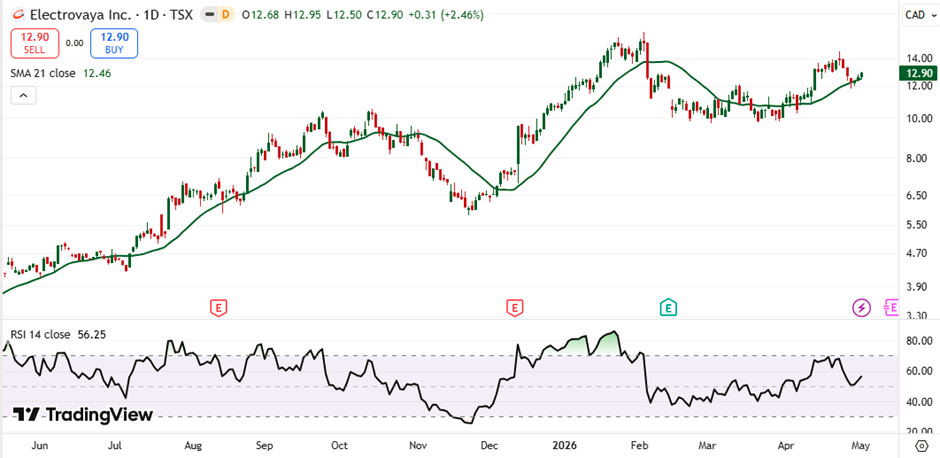
ELVA is trading above a key rising support level, supported by a noticeable uptick in volume, indicating strengthening buying interest and early signs of accumulation. The 14-day Relative Strength Index (RSI) stands at 56.25, reflecting moderate bullish momentum with further room for upside before reaching overbought conditions. Additionally, the stock is trading above its 21-day moving average, which is now acting as dynamic support and reinforcing the prevailing uptrend. This alignment points to improving technical strength in the near term. As long as the price sustains above this moving average, the overall bias is likely to remain positive. However, a break below this support zone could trigger short-term consolidation or a mild corrective phase.
2. Saturn Oil & Gas Inc. (TSX:SOIL): Operational Scale and Financial Metrics
Saturn Oil & Gas Inc. (TSX:SOIL) reported production of 43,657 barrels of oil equivalent per day (boe/d) in the fourth quarter of 2025, exceeding its guidance and marking a sequential increase from the previous quarter.
For the full year, production averaged 41,728 boe/d, contributing to growth in production per debt-adjusted share. These figures provide context for the company’s operational scale within the energy sector.
Financial Outcomes and Cash Flow
The company reported adjusted funds flow of $464 million for 2025, alongside record free funds flow of $223 million.
Free funds flow was allocated toward debt repayment, shareholder returns, and acquisitions, reflecting a structured approach to capital deployment.
In addition, Saturn repaid $110 million in debt during the year, reducing its net debt position while maintaining operational activity.
Shareholder Returns and Capital Strategy
During 2025, the company returned over $33 million to shareholders through share buybacks, with total returns increasing when including subsequent activity in 2026.
This approach highlights the role of capital returns within the company’s broader financial framework, alongside operational development and balance sheet management.
Reserves and Long-Term Inventory
Saturn’s reserves evaluation indicated growth in proved developed producing reserves and an expansion in drilling locations.
The company estimates that its inventory could support approximately 20 years of drilling at the current pace, providing a long-term operational outlook based on existing assets.
Industry Context
Saturn operates within the oil and gas sector, where production efficiency, cost management, and reserves development are central to company performance. The reported metrics reflect how these factors are tracked and communicated within the industry.
Technical Snapshot
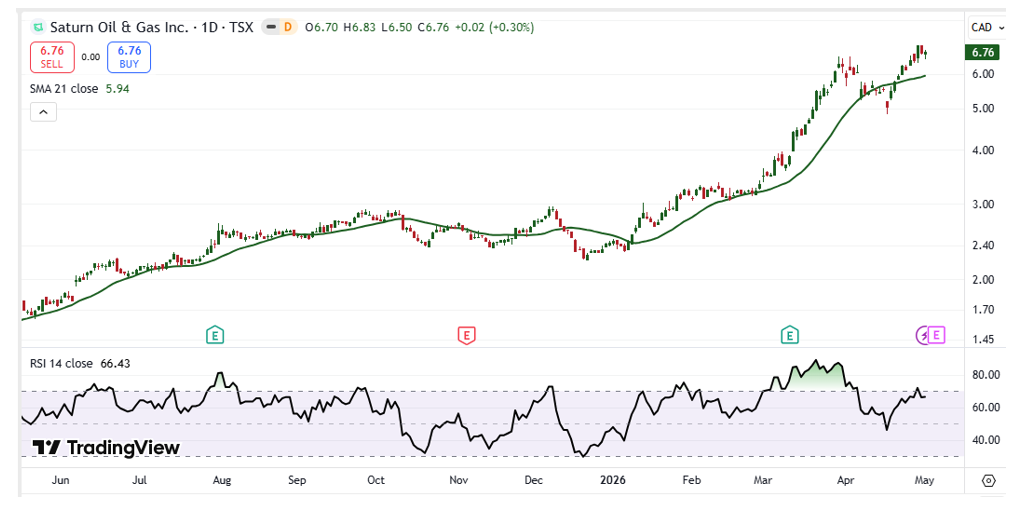
SOIL is trading above a key horizontal support level, supported by a noticeable uptick in volume, indicating strengthening buying interest and early signs of accumulation. The 14-day Relative Strength Index (RSI) stands at 66.43, reflecting solid bullish momentum and suggesting the stock is approaching overbought territory. Additionally, the stock is trading above its 21-day moving average, which is now acting as dynamic support and reinforcing the prevailing uptrend. This alignment highlights improving technical strength in the near term. As long as the price sustains above this moving average, the overall bias is likely to remain positive. However, a failure to hold above this support zone could lead to short-term consolidation or a mild corrective phase.
Comparing Growth Narratives Across Sectors
The contrast between Electrovaya and Saturn Oil & Gas highlights the diversity of growth stories on the TSX.
- Electrovaya’s trajectory is shaped by technology development, product launches, and participation in energy storage initiatives.
- Saturn’s narrative is defined by production metrics, financial performance, and reserves management.
Both companies illustrate how growth can be expressed through different operational models—one driven by innovation cycles, and the other by resource development and efficiency.
Broader Takeaways for TSX Growth Stocks
Growth stocks on the TSX often operate at the intersection of execution and expectation. Their updates—whether product launches or financial results—serve as checkpoints within longer-term strategies.
Understanding these companies involves looking at how individual developments connect to broader industry dynamics, rather than viewing each update in isolation. This approach allows for a clearer picture of how growth narratives evolve over time.
FAQs
What defines a growth stock on the TSX?
Growth stocks are typically companies focused on expanding operations, developing new products, or increasing market presence, often reinvesting earnings to support future growth.
Which sectors commonly feature TSX growth stocks?
Growth stocks on the TSX can be found across sectors including technology, energy, mining, and industrials, reflecting the exchange’s diverse composition.
How do company updates influence growth narratives?
Operational updates, financial results, and product developments contribute to the evolving story of a company, helping investors track progress over time.
Why do growth stocks vary across industries?
Different industries have distinct drivers of growth, such as innovation in technology or production efficiency in energy, leading to varied growth profiles among companies.


 Jun 24, 2026




 Please wait processing your request...