
 AU
AU
 UK
UK
 US
US
 NZ
NZ
 IND
IND

 CA
CA

 Share
Share
 X (Formerly Twitter)
 Whatsapp
 Facebook
 LinkedIn
 Telegram
 Email This Article
 Copy Link
 Summarize with AI
 Chat GPT
 Perplexity
The Silent Compounder: Inside Trisura’s +1.2% Year-End Pop
On December 31, 2025, Trisura Group Ltd. (TSX: TSU) closed the year with a decisive ~1.2% uptick, finishing at CAD 42.72. While a single-day movement might seem like market noise to the uninitiated, for analytical observers, this caps a year of strategic calibration. This move wasn't just a "Santa Claus Rally"—it was a validation of a business model that has quietly shifted gears from pure growth to disciplined profitability.
The following analysis breaks down the mechanics behind this movement, stripping away the noise to look at the operational engine driving Trisura into 2026.
- Key Reasons for the Dec 31 Move
The immediate catalyst for the year-end bump can be traced to a convergence of technical and fundamental factors:
Source: Kalkine Group
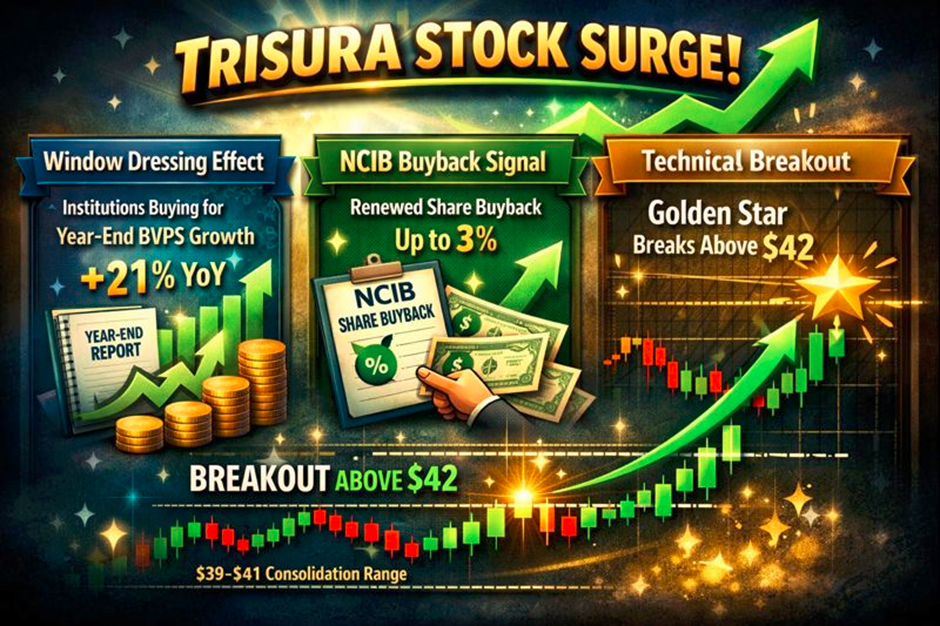
- The "Window Dressing" Effect: Institutional investors shoring up portfolios at year-end likely bought into TSU to capture its robust annual Book Value Per Share (BVPS) growth (~21% YoY), wanting to show ownership of high-quality compounders on their reporting dates.
- NCIB Confidence Signal: In early December 2025, Trisura renewed its Normal Course Issuer Bid (NCIB), authorizing the repurchase of up to 3% of its outstanding shares. This buyback program acts as a relentless floor for the stock price, signaling management's belief that the market is undervaluing their assets.
- Technical Breakout: The stock had been consolidating in the $39–$41 range. Breaking past $42 on the final day signals a "Golden Star" technical setup, often attracting algorithmic traders looking for momentum carrying into January.
- Strategic Drivers: The Engine Room
The upward drift is supported by three fundamental pillars established throughout late 2025:
- US Surety Expansion: The "Primary Lines" (Surety, Corporate Insurance, Warranty) are the crown jewels. By Q4 2025, Trisura had expanded its US Surety footprint to 33 state licenses. This is critical because surety bonding is high-margin, low-frequency loss business tied to infrastructure spend—a sector insulated from typical consumer recession risks.
- Investment Income Tailwinds: As an insurer, Trisura holds a massive "float." With yields remaining elevated throughout 2025, their investment portfolio generated ~24% higher income year-over-year. They are effectively a profitable investment fund wrapped in an insurance license.
- Hybrid Business Model: Unlike standard insurers who take all the risk, Trisura’s "Fronting" model allows them to earn fee income by connecting reinsurers with capital. This fee-based revenue creates a smoother earnings curve, less volatile than traditional catastrophe-exposed insurance.
- SWOT Analysis
Source: Kalkine Group
Strengths (Internal Power)
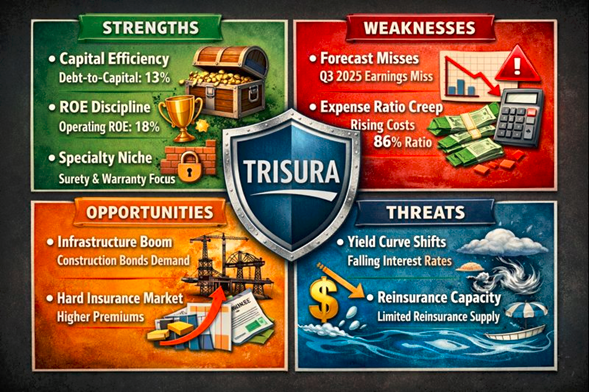
- Capital Efficiency: A debt-to-capital ratio of ~13% (well below the 20% target) gives them a "war chest" for acquisitions or aggressive organic growth without over-leveraging.
- ROE Discipline: Consistently delivering an Operating ROE of ~18% is elite in the insurance world, where 12-15% is standard.
- Specialty Niche: Focus on difficult-to-insure risks (Surety/Warranty) creates high barriers to entry for competitors.
Weaknesses (Internal Drag)
- Forecast Misses: Q3 2025 saw a miss on both revenue and EPS estimates. This "earnings surprise" creates short-term volatility and suggests difficulty in predicting the exact timing of fee income.
- Expense Ratio Creep: As they scale the US team, operational expenses have ticked up, pushing the combined ratio slightly higher (though still profitable at ~86%).
Opportunities (External Growth)
- Infrastructure Boom: Continued North American infrastructure spending ensures steady demand for construction bonds—Trisura’s sweet spot.
- Hard Market in Insurance: Pricing power remains strong in specialty lines, allowing them to raise premiums without losing clients.
Threats (External Risks)
- Yield Curve Shifts: If interest rates plummet rapidly in 2026, the "free money" from their investment float will shrink.
- Reinsurance Capacity: Their fronting model relies on reinsurance partners. If global reinsurance capital dries up (due to mega-catastrophes elsewhere), Trisura’s capacity to write new business contracts.
- Latest Business Model & Operational Updates
As of late 2025, Trisura has refined its identity. It is no longer just a Canadian specialty insurer; it is a North American specialty platform.
- The Pivot to Primary: The company is deliberately shifting mix toward "Primary Lines" where they retain more risk but keep significantly more margin. This explains the higher combined ratio (more expenses to run these teams) but significantly higher bottom-line ROE.
- US Fronting Stabilization: After some turbulence in 2024 (program non-renewals), the US Fronting business has stabilized, focusing on fewer, higher-quality partners rather than chasing volume.
- Digital Integration: Operational updates highlight increased automated underwriting in the Warranty segment, reducing the cost-per-policy and improving speed-to-quote.
- Financial Snapshot (Late 2025 Context)
- Book Value Per Share (BVPS): Approaching $19.00+, up >20% YoY. For insurance investors, BVPS is the "true north" metric of value creation.
- Combined Ratio: Hovering around 86.0%. (Note: A ratio under 100% indicates profitable underwriting. 86% is exceptionally healthy, meaning they keep 14 cents of underwriting profit on every dollar of premium before investment income).
- Net Income: Q3 and Q4 trends show Net Income outpacing Operating Income due to investment gains, painting a picture of a dual-engine profit machine.
- Risks to Watch in 2026
Investors must remain vigilant regarding:
- The "Mix Shift" Risk: As they retain more risk (Primary Lines), a single large loss event (e.g., a major construction firm defaulting on a bond) hits their balance sheet harder than before.
- Regulatory Friction: Expansion into 50 US states requires navigating 50 different insurance commissioners. Regulatory drag could slow the pace of the US rollout.
- Valuation Premium: TSU trades at a premium multiple to book value compared to boring P&C insurers. The market expects 20% growth; if they drop to 10%, the multiple could compress rapidly.
- Conclusion: The "Compounding Machine" Thesis
Trisura’s performance on December 31, 2025, was not an anomaly but a reflection of a high-quality compounder doing what it does best: growing book value per share. The company ends 2025 with a "fortress balance sheet" (low debt) and a diversified engine (Canada stable, US growing).
While the missed forecasts in Q3 served as a speed bump, the recovery suggests the market values the long-term ROE story over short-term quarterly noise. For the analytical observer, Trisura represents a classic "pick and shovel" play on risk management—boring, complex, and highly profitable.


 Jun 24, 2026




 Please wait processing your request...