
 AU
AU
 UK
UK
 US
US
 NZ
NZ
 IND
IND

 CA
CA

 Share
Share
 X (Formerly Twitter)
 Whatsapp
 Facebook
 LinkedIn
 Telegram
 Email This Article
 Copy Link
 Summarize with AI
 Chat GPT
 Perplexity
Allied Properties REIT stands at a critical juncture in the Canadian real estate landscape, offering a staggering 12.32% dividend yield that has captured the attention of yield-hungry investors and skeptical analysts alike. As a premier owner-operator of "distinctive urban workspace," Allied has long been the gold standard for brick-and-beam office environments in Canada’s major metros.
However, the current divergence between its high-quality asset base and its depressed unit price has created a complex narrative. While the yield appears lucrative, it reflects a market pricing in significant structural risks and the recent reality of a distribution reset. For the disciplined observer, Allied represents the quintessential "battleground stock"—a test of whether urban density and creative workspace can overcome the persistent headwinds of the high-interest-rate era and the evolution of the modern office.
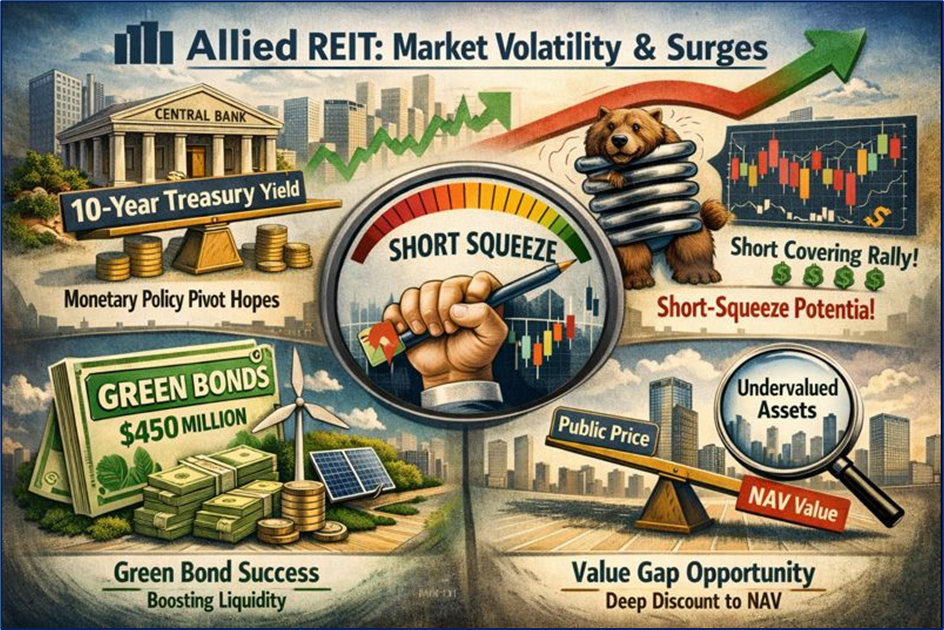
Latest Key Reasons for Surge and Market Drivers
Source: Kalkine Group
Despite the broader challenges facing the office sector, several factors have driven recent volatility and periodic surges in Allied's trading activity:
- Monetary Policy Pivot Expectations: As central banks hint at stabilizing or lowering interest rates in early 2026, REITs like Allied, which are highly sensitive to the 10-year Treasury yield, have seen renewed speculative interest.
- Short-Squeeze Potential: High short interest in the office REIT sector has occasionally led to rapid price appreciation on any news perceived as "less bad" than expected.
- Green Bond Success: The successful offering of $450 million in green bonds in late 2025 provided the company with necessary liquidity, signaling institutional confidence in its ability to refinance debt even in a constrained credit market (Allied Press Release, Sept 2025).
- Public-Private Valuation Gap: A significant divergence exists where Allied’s units trade at a deep discount to its Net Asset Value (NAV), attracting value-oriented investors betting on an eventual convergence.
Current Business Model
Allied Properties operates with a specialized focus that differentiates it from traditional "glass-tower" office REITs:
- Urban Workspace Niche: The model centers on "distinctive" workspaces—older, historically significant buildings retrofitted with modern tech and amenities. This "brick-and-beam" aesthetic is designed to attract knowledge-based workers in tech, advertising, and media.
- Geographic Concentration: The portfolio is heavily weighted toward Toronto and Montreal, focusing on high-density urban cores where "human connectivity" is a primary driver of tenant demand.
- Sustainability Integration: A core pillar of the current model is the "Net-Zero Carbon" plan, aiming to reduce energy intensity and attract premium tenants who prioritize ESG (Environmental, Social, and Governance) standards (Allied ESG Report, June 2025).
- Ancillary Revenue: Beyond traditional office leasing, Allied leverages data-center space and mixed-use developments (such as "The Well" in Toronto) to diversify cash flow streams.
Latest Financial, Operational, and Dividend Updates
Recent filings and announcements provide a clear picture of the company’s current standing:
- Distribution Adjustment: In a major move to preserve capital, Allied declared a monthly distribution of $0.06 per unit for January 2026 ($0.72 annualized), representing a significant reduction from previous years (Allied Press Release, Jan 15, 2026).
- Occupancy and Leasing: While the office sector remains pressured, Allied reported stable leasing activity at landmark projects like The Well, though overall portfolio occupancy remains a key metric under scrutiny (Allied Leasing Update, Nov 2025).
- Balance Sheet Management: The REIT has focused on non-core property sales to de-lever its balance sheet, aiming to maintain its investment-grade credit rating amidst rising interest expenses (Allied Quarterly Report, Oct 2025).
- Earnings Conference: The company has scheduled its Q4 2025 financial results conference for early 2026, which is expected to provide updated guidance on Funds From Operations (FFO) per unit (Allied Investor Relations, Jan 2026).
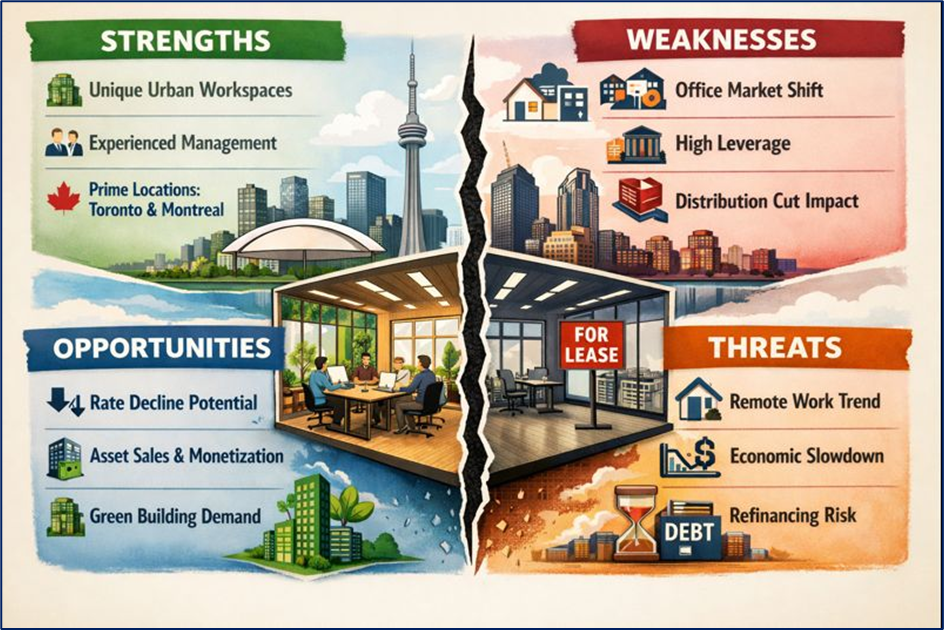
Latest SWOT Analysis
Source: Kalkine Group
Strengths
- Unique Asset Class: High-quality, distinctive urban workspaces that are difficult to replicate and highly attractive to creative industries.
- Experienced Management: A leadership team with a long-term track record of urban transformation and disciplined capital allocation.
- Strategic Geographic Footprint: Dominant presence in Canada's most resilient economic hubs (Toronto and Montreal).
Weaknesses
- Office Sector Concentration: High exposure to the office market, which is currently undergoing a structural shift due to hybrid work models.
- High Leverage: Despite recent efforts to de-lever, interest coverage ratios remain under pressure compared to historical norms.
- Distribution Cut Impact: The recent reduction in monthly payouts has negatively impacted sentiment among income-focused retail investors.
Opportunities
- Interest Rate Normalization: A potential decline in interest rates in 2026 could significantly reduce debt servicing costs and boost REIT valuations.
- Asset Monetization: Continued sale of non-core or residential-intensive assets could provide a "war chest" for debt reduction or opportunistic acquisitions.
- Sustainable Premium: Increasingly stringent ESG requirements for corporate tenants may drive higher occupancy and rents for Allied's green-certified buildings.
Threats
- Structural Vacancy: The "work-from-home" trend may lead to a permanent reduction in total office space required by large knowledge-based firms.
- Economic Slowdown: A potential recession in 2026 could lead to tenant defaults and increased pressure on rental rates.
- Refinancing Risk: Persistent "higher-for-longer" interest rates could make maturing debt significantly more expensive to roll over.
Outlook and Risks
The outlook for Allied Properties in 2026 is one of calculated transition. Management is clearly prioritizing financial flexibility over payout growth, a move that is painful for current unitholders but potentially vital for the REIT’s long-term survival. Market data suggests that while listed real estate is expected to outperform private real estate in 2026, the recovery will be uneven. Allied's success hinges on its ability to maintain high retention rates and prove that "distinctive" workspace remains a necessity for corporate culture.
The primary risks remain the valuation divergence and liquidity constraints. If the gap between Allied's trading price and its appraised NAV does not close, the company may face pressure to sell more assets at less-than-ideal prices. Furthermore, any further deterioration in the macro-economic environment could jeopardize the "stabilized" distribution level announced in early 2026.
Compelling Conclusion
Allied Properties REIT remains the ultimate litmus test for the future of the Canadian urban core. At a 12% yield, the market is signaling a high degree of skepticism, yet the underlying quality of Allied’s "brick-and-beam" portfolio remains largely unmatched in the TSX universe. The recent distribution reset reflects a pragmatic shift toward balance sheet fortification, positioning the REIT to weather the final stages of the high-rate cycle. For those watching the TSX, Allied is no longer just a yield play; it is a strategic bet on the enduring value of the city and the resilience of high-quality urban infrastructure in a post-pandemic world.


 Jun 24, 2026




 Please wait processing your request...