
 AU
AU
 UK
UK
 US
US
 NZ
NZ
 IND
IND

 CA
CA

 Share
Share
 X (Formerly Twitter)
 Whatsapp
 Facebook
 LinkedIn
 Telegram
 Email This Article
 Copy Link
 Summarize with AI
 Chat GPT
 Perplexity
A comprehensive 2026 dividend analysis of Vanguard S&P 500 Index ETF, covering dividend yield, distribution history, portfolio holdings, risk factors, tax considerations, and long-term portfolio strategy for Canadian investors.
Quick Facts at a Glance
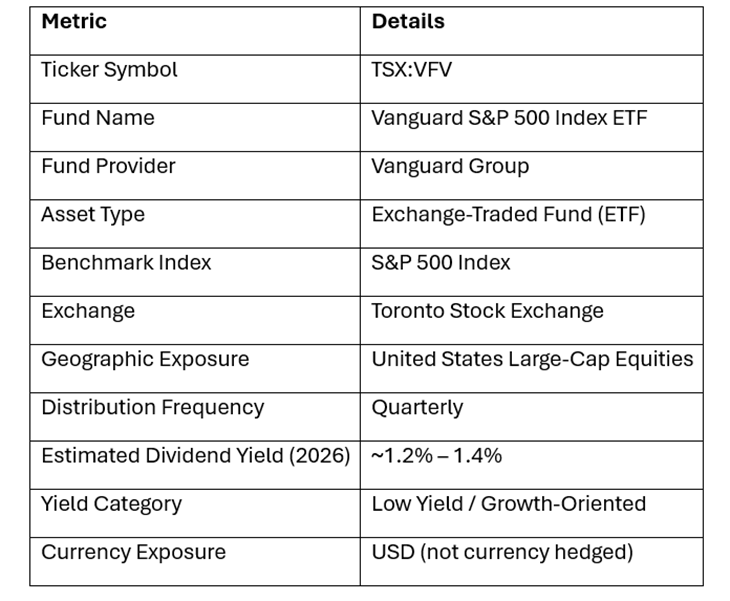
Source: Market Data
Introduction and Investment Thesis
The Vanguard S&P 500 Index ETF (TSX:VFV) is one of the most widely held index ETFs among Canadian investors seeking exposure to the U.S. equity market. By tracking the S&P 500 Index, the fund provides access to approximately 500 of the largest publicly traded companies in the United States.
Unlike high-yield dividend ETFs, VFV is primarily designed for long-term capital appreciation rather than income generation. However, it still distributes dividends derived from the underlying companies within the index, which include many of the world’s largest dividend-paying corporations.
These companies include global leaders such as:
- Apple Inc.
- Microsoft
- Nvidia
- Amazon
- Johnson & Johnson
Because these companies prioritize growth and innovation, the resulting dividend yield from VFV remains relatively modest compared with traditional income funds.
However, for many investors, the total return potential—a combination of price appreciation and reinvested dividends—makes VFV one of the most attractive long-term core holdings available on the Toronto Stock Exchange.
Fund Structure and Portfolio Composition
VFV is structured as a Canadian-listed ETF that mirrors the performance of the S&P 500 through a low-cost passive index strategy.
Key structural characteristics include:
Broad Diversification
The ETF provides exposure to hundreds of large-cap U.S. companies across multiple sectors.
Low Management Fees
Vanguard is known globally for cost-efficient funds. VFV typically maintains a management expense ratio (MER) around 0.06%, significantly lower than most actively managed funds.
Sector Allocation (Approximate)
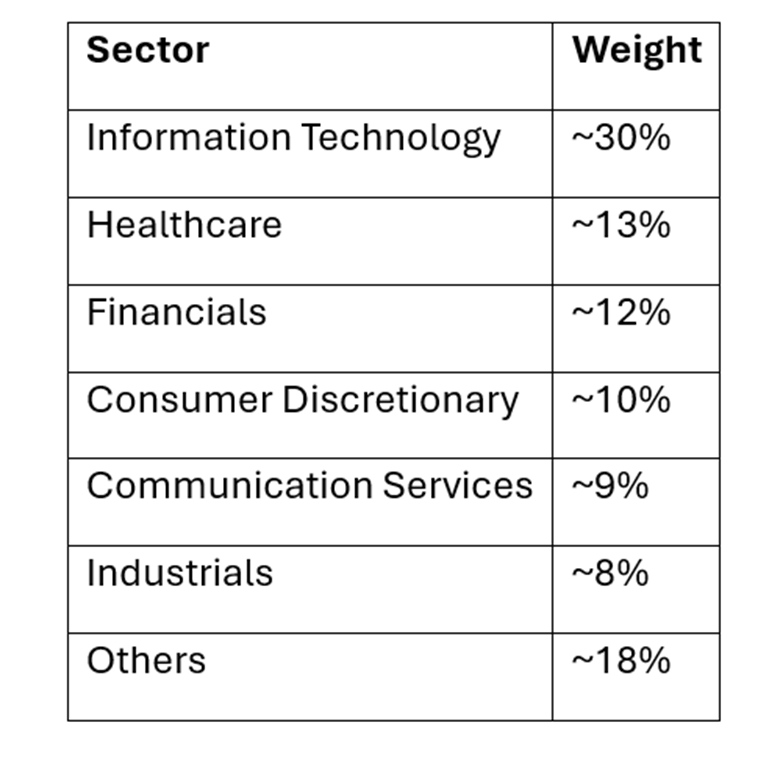
This diversified structure reduces single-company risk while allowing investors to participate in the growth of the U.S. economy.
Dividend Yield and Distribution Analysis
Income investors evaluating VFV should understand that the ETF’s dividend yield is largely determined by the dividend policies of companies within the S&P 500.
Estimated VFV Dividend Profile (2026)
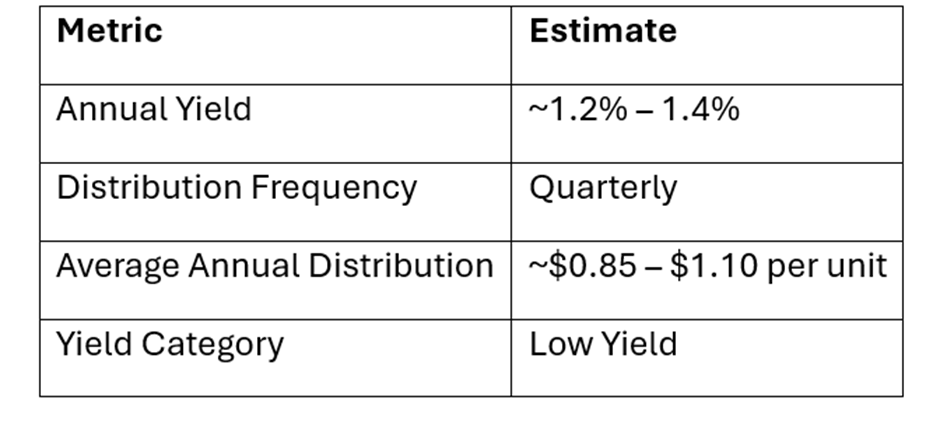
Although this yield is lower than typical Canadian dividend ETFs, VFV offers something many income funds cannot:
Long-term dividend growth potential.
Many S&P 500 companies have multi-decade dividend growth histories, which means distributions may gradually increase over time.
Historical Distribution Trends
The distribution growth of VFV reflects the dividend growth of the underlying S&P 500 companies.
Over the past decade, dividends paid by S&P 500 companies have grown consistently due to:
- rising corporate earnings
- global economic expansion
- share buyback programs
- strong free cash flow among technology and healthcare leaders
This growth dynamic means investors often experience rising income even with a modest yield.
Tax Considerations for Canadian Investors
Understanding the tax treatment of VFV distributions is essential for optimizing after-tax returns.
Types of Income in VFV Distributions
Distributions may include:
- Foreign dividend income
- Capital gains
- Return of capital
Because VFV holds U.S. stocks, foreign withholding tax may apply.
Account Placement Strategy
TFSA
- Foreign withholding tax applies
- income not taxable in Canada
RRSP
- U.S. withholding tax generally exempt
- tax deferred until withdrawal
Non-registered accounts
- foreign income taxed at marginal rate
For many investors, holding VFV within an RRSP can provide the most efficient tax treatment.
Key Risk Factors
While VFV is considered a relatively stable ETF, investors should understand several potential risks.
Market Risk
Because VFV tracks the S&P 500, its performance closely mirrors the U.S. equity market. Market downturns can significantly affect the ETF’s value.
Currency Risk
VFV is not currency hedged, meaning the Canadian dollar–U.S. dollar exchange rate impacts returns.
If the Canadian dollar strengthens against the U.S. dollar, Canadian investors may experience lower returns.
Sector Concentration Risk
Technology companies dominate the S&P 500 today. As a result, VFV has significant exposure to the tech sector.
Interest Rate Sensitivity
Higher interest rates can shift investor preferences toward fixed income assets, potentially affecting equity valuations.
Peer Comparison: Canadian S&P 500 ETFs
Canadian investors have several ETFs that track the S&P 500.
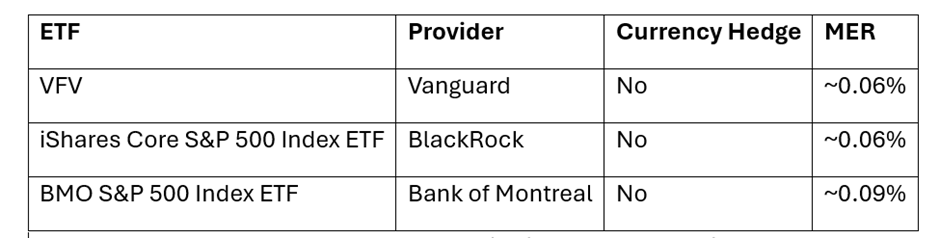
VFV remains one of the largest and most liquid S&P 500 ETFs in Canada, which contributes to its popularity among investors.
Dividend Reinvestment Strategy (DRIP)
Dividend reinvestment plans allow investors to automatically reinvest distributions into additional ETF units.
Benefits include:
Compounding Growth
Each reinvested dividend purchases additional units that generate future income.
Cost Efficiency
Most Canadian brokerages offer synthetic DRIPs with zero commissions.
Long-Term Wealth Creation
Over decades, reinvested dividends can represent a substantial portion of total returns.
Investors who do not require immediate income often benefit significantly from DRIP participation.
Portfolio Strategy: How VFV Fits in a Portfolio
VFV is often used as a core equity holding within Canadian portfolios.
Common portfolio roles include:
Core Growth Allocation
Many investors allocate 30–50% of equity exposure to S&P 500 ETFs.
Global Diversification
VFV complements Canadian dividend stocks by adding exposure to global technology leaders.
Passive Investment Strategy
Index investing reduces reliance on stock picking.
Long-Term Outlook for VFV
The long-term outlook for VFV remains closely tied to the future growth of the U.S. economy and the companies within the S&P 500.
Key drivers include:
- artificial intelligence and technology innovation
- global consumer demand
- healthcare and biotechnology advancement
- digital infrastructure expansion
Given these factors, the ETF continues to be viewed by many analysts as a foundational long-term investment vehicle.
While its dividend yield is modest, VFV historically delivers strong total returns, making it a valuable component of diversified portfolios.
Final Verdict
For Canadian investors seeking exposure to the world’s largest companies, TSX:VFV remains one of the most efficient and cost-effective options available.
Key strengths include:
- extremely low fees
- broad diversification
- exposure to leading global corporations
- consistent dividend growth potential
However, investors seeking high immediate income may prefer dividend-focused ETFs instead.
For those prioritizing long-term wealth accumulation and global diversification, VFV remains a powerful core holding within a balanced portfolio.
Final Verdict
For Canadian investors seeking exposure to the world’s largest companies, TSX:VFV remains one of the most efficient and cost-effective options available.
Key strengths include:
- extremely low fees
- broad diversification
- exposure to leading global corporations
- consistent dividend growth potential
However, investors seeking high immediate income may prefer dividend-focused ETFs instead.
For those prioritizing long-term wealth accumulation and global diversification, VFV remains a powerful core holding within a balanced portfolio.


 Jun 24, 2026




 Please wait processing your request...