
 NZ
 UK
 US
 AU
 IND

 CA

 Share
 X (Formerly Twitter)
 Whatsapp
 Facebook
 LinkedIn
 Telegram
 Email This Article
 Copy Link
 Summarize with AI
 Chat GPT
 Perplexity

Get the latest TSX Composite Index market commentary for January 30, 2026 — sectors in green & red, top gainers & losers in CAD, key drivers, economy & asset class updates, forecasts, strategies, analysts’ targets and actionable investor.
Market Summary – TSX Ends in Red
On January 30, 2026, Canada’s benchmark S&P/TSX Composite Index closed sharply down -3.31% to 31,923.52 — its largest one-day drop since April 2025. The sell-off was broad-based as precious metals plunged, U.S. monetary policy shocks rippled into Canadian assets, and major stocks weakened.
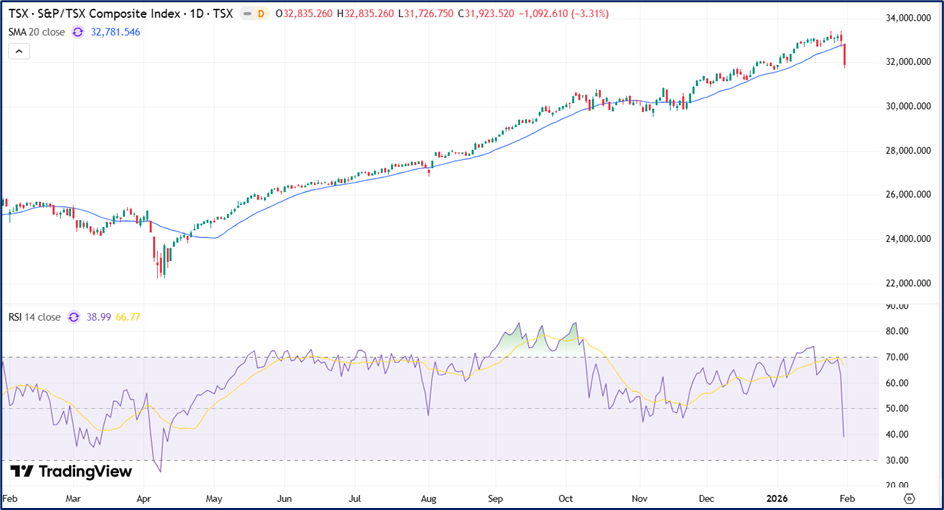
Source: Trading View
Why the TSX Sold Off (Key Drivers)
- Precious Metals Plunge
Mining stocks suffered as gold & silver slumped sharply, directly dragging materials stocks — a key TSX sector — lower. Reuters reported gold sliding over 10%, which hit metal miners especially hard.
- U.S. Fed Policy Impact
The nomination of Kevin Warsh as the U.S. Federal Reserve Chair boosted expectations of tighter policy, strengthening the U.S. dollar and hurting commodity prices and risk assets globally.
- Industrial Earnings & Trade Risks
Weak earnings (e.g., Imperial Oil) and threats of tariffs on Canadian products pressured industrial stocks, compounding broader weakness.
- Economic Growth Concerns
Canada’s GDP stagnated in November 2025, with contractions in manufacturing and trade sectors, leading markets to price in slower growth prospects.
TSX Sector Performance (Jan 30, 2026)
- Red (Weakest):
- Materials / Mining – hit hardest by metals sell-off.
- Industrials – pressured by tariff risks & earnings misses.
- Technology – tech weakness globally spilled over.
- Green (Relatively Stable / Defensive):
- Energy – oil prices held up better, limiting losses compared to others.
- Telecom – defensive interest amid market stress.
- Financials – banks steadied on stable rates.
Note: Official sector closes aren’t fully released; this reflects reported performance trends.
Top Gainers (All Prices in CAD)
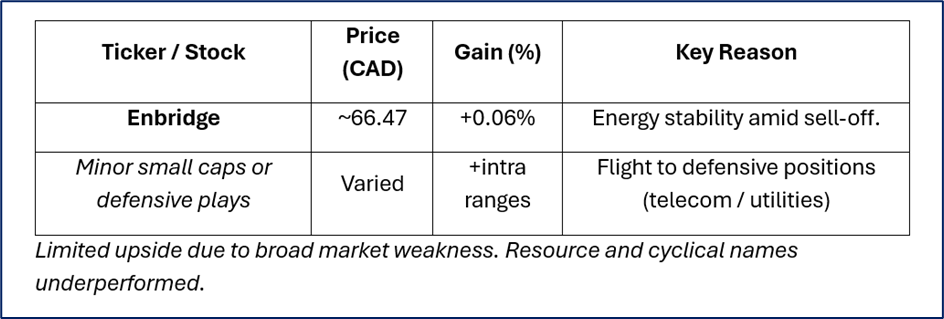 Source: Market Data
Top Losers (All Prices in CAD)
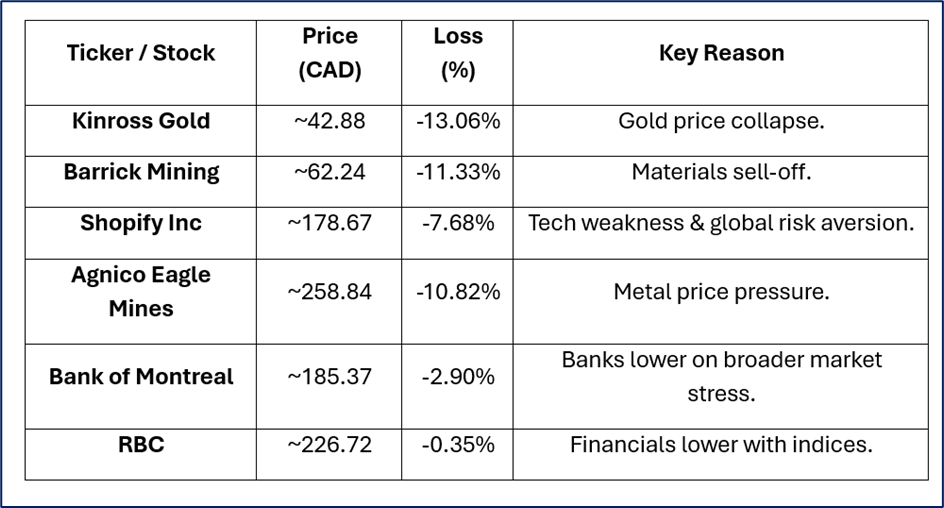
Source: Market Data
Current Market & Economic Dynamics
Canadian Macro
- Growth stalled in late 2025, dampening investor confidence.
- Unemployment remains moderate, while inflation pressures persist.
Currency & Asset Classes
- CAD weakened versus USD amid risk-off sentiment.
- Commodities saw divergent moves: oil held better, metals sold off.
- Bonds gained as risk assets retreated.
External Drivers
- U.S. rate expectations.
- Trade policy uncertainty.
- Global tech weakness, emerging markets trends.
TSX Outlook – Short, Medium & Long Term
Short Term (1-4 Weeks)
Expect volatility. Weakness in materials & tech may persist unless metals stabilize or risk sentiment improves. Energy and defensive names could outperform.
Medium Term (3-9 Months)
Broad economic data will set direction — a weak recovery in manufacturing could slow returns. If inflation continues easing, equities may stabilize.
Long Term (12+ Months)
Canada’s diversified economy + natural resources offer structural growth, especially if commodity cycles rebound. Long-term investors may benefit from value and dividend themes.
Investor Strategies per Timeframe
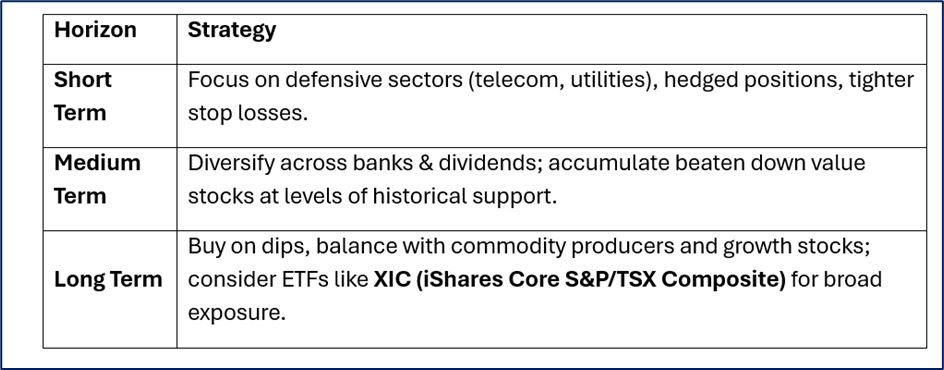
Source: Kalkine Group Analysis
Analysts & Broker Targets (Latest)
Note: Specific target data for Jan 30 2026 is limited in real-time; below are representative analyst themes and reputable outlooks. Sources in brackets.
- Bullish on Canada’s Energy & Financials: Many Canadian broker targets remain positive on banks & pipelines due to stable cash flows (implied by sector behavior).
- Cautious on Materials: Banks lowered materials targets amid commodity volatility (inferred from sector performance).
- ETF Flows Strong: Canadian ETFs recorded record inflows in 2025, indicating ongoing institutional interest in broad equity exposure.
Frequently Asked Questions (FAQ Schema)
Q1: Why did the TSX index drop over 3% Jan 30, 2026?
A: Mainly due to sharp declines in metals, Fed policy uncertainty, and broader risk-off sentiment.
Q2: Which sectors outperformed?
A: Energy, Telecom & Financials showed relative resilience.
Q3: What should investors watch next?
A: Metals price direction, Bank of Canada decisions, U.S. macro data.
Conclusion – What This Means for You
January 30, 2026’s TSX sell-off was driven by external monetary shifts and internal commodity weakness. While markets may stabilize, persistent economic headwinds suggest a cautious but diversified approach. Broad Canadian equity ETFs and defensive positions may be prudent near term, while long-term investors should see dips as buying opportunities in high-quality names.


 Nov 20, 2026





 Please wait processing your request...