
 AU
AU
 UK
UK
 US
US
 NZ
NZ
 IND
IND

 CA
CA

 Share
Share
 X (Formerly Twitter)
 Whatsapp
 Facebook
 LinkedIn
 Telegram
 Email This Article
 Copy Link
 Summarize with AI
 Chat GPT
 Perplexity
Why Did the TSX Composite Index Rise 0.56% on February 4, 2026?
Canada’s S&P/TSX Composite Index advanced 0.56% to 32,571.55 on February 4, 2026, extending a multi-session rebound and standing out as one of the most resilient developed-market equity benchmarks amid global volatility. The move was powered by industrials, consumer sectors, and energy, which more than offset technology weakness, as investors leaned into commodities, earnings visibility, and sector rotation.
Key Takeaways – TSX Market Summary (February 2026)
- Broad-based gains led by industrials, consumer discretionary, staples, and energy
- Commodity tailwinds boosted heavyweight resource names
- Earnings-driven stock selection favored services and infrastructure exposure
- Tech underperformance contained overall downside risk
- Technical rebound signals a cautious upside bias, not an overheated rally
What Drove the TSX Rally on Feb 4, 2026?
Four forces aligned to lift Canadian equities:
- Stronger oil and commodity prices, lifting energy and materials-linked cash flows
- Selective earnings strength across industrial and service businesses
- Defensive rotation into consumer staples and high-quality discretionary leaders
- Relative insulation from global tech sell-offs, given the TSX’s value and resource tilt
The result: a selective risk-on environment with disciplined capital allocation.
Which TSX Sectors Outperformed?
Industrials (Leader): Earnings beats, infrastructure exposure, and operating leverage drove gains.
Consumer Discretionary: A sharp rebound as investors priced in stable domestic demand and pricing power.
Consumer Staples: Inflation-resilient cash flows and dividend stability attracted defensive capital.
Energy: Firmer crude prices and improved geopolitical risk pricing lifted the sector.
Which Sector Lagged?
Technology: Modest declines persisted due to global valuation resets, U.S.-led tech weakness, and AI-related disruption concerns.
Top TSX Gainers on February 4, 2026
- FirstService Corporation — surged on confidence in recurring property-services demand
- Alamos Gold — rallied as gold prices stabilized near recent highs
- West Fraser Timber — advanced on renewed construction-materials optimism
- Alimentation Couche-Tard — climbed on defensive retail strength
- Insurance & specialty finance — benefited from yield-driven rotation
Smaller-cap resource stocks also posted outsized percentage gains on volume spikes and exploration optimism.
Biggest TSX Decliners: What Fell and Why?
Losses were sector-specific, centered in materials, uranium, crypto-linked equities, and oil services, reflecting:
- Profit-taking after sharp prior rallies
- Commodity-specific volatility
- Global risk-off pressure on speculative assets
Importantly, selling was contained, not market-wide.
Canada Macro Snapshot: What the Data Says
Economic Signals
- Manufacturing returned to expansion, supporting cyclical optimism
- Services data softened, highlighting uneven growth
- Inflation stabilized, easing near-term rate-hike fears
Assets & FX
- Oil and gold provided equity tailwinds
- Canadian dollar traded range-bound
- Fixed income signaled gradual normalization, not stress
How Does the TSX Compare Globally?
While U.S. markets were mixed and tech-heavy indices lagged, Canada’s resource- and value-oriented index outperformed—underscoring why the TSX can shine during global tech volatility.
Technical View: Is the Rally Sustainable?
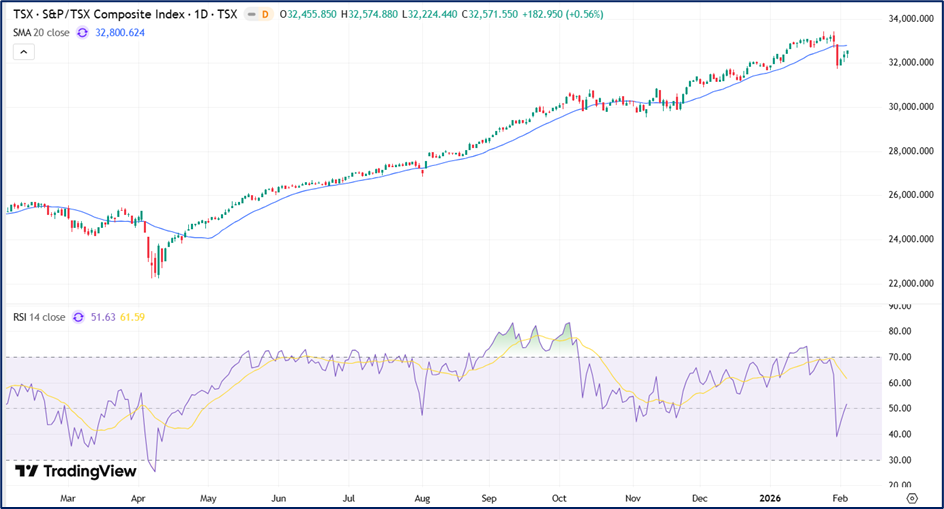
Source: Trading View
- Support reclaimed after a clean rebound
- Momentum indicators improving
- Volatility elevated but controlled
- Resistance above recent highs; support firm below
Read-through: a cautious upside bias, not exuberance.
TSX Outlook: What Comes Next?
Short Term (Weeks–Months): Constructive if commodities hold and earnings follow through; sensitive to global shocks.
Medium Term (6–12 Months): Hinges on economic normalization, trade clarity, and manufacturing momentum.
Long Term (1–3+ Years): Anchored by energy transition, infrastructure investment, financial services, and resource leadership.
Bull vs. Bear Scenarios
Bull Case: Commodities trend higher, global growth stabilizes, earnings improve → Break above recent highs.
Bear Case: Services slowdown deepens, volatility spikes, cyclicals rotate out → Lower consolidation first.
What Are Strategists Saying?
Consensus themes include:
- Energy & industrials as preferred cyclicals
- Gold equities as portfolio stabilizers
- Dividend payers in financials and consumer sectors as income anchors
Broker targets generally point to moderate upside over the next 12 months, with stock selection key.
Final Takeaway
The TSX’s 0.56% gain on February 4, 2026 reinforces Canada’s relative resilience. Leadership from industrials, energy, and consumers—paired with contained tech weakness—keeps the risk-reward balanced. Watch commodity trends, earnings durability, and global sentiment for the next move, while long-term returns remain tied to Canada’s structural strengths.


 Jun 29, 2026




 Please wait processing your request...