
 AU
AU
 UK
UK
 US
US
 NZ
NZ
 IND
IND

 CA
CA

 Share
Share
 X (Formerly Twitter)
 Whatsapp
 Facebook
 LinkedIn
 Telegram
 Email This Article
 Copy Link
 Summarize with AI
 Chat GPT
 Perplexity

Market Pulse: The "Copper Hill" Catalyst
Golden Harp Resources Inc. (TSXV: GHR.H) captured the attention of the global mining community on January 9, 2026, as its stock price surged by approximately 118% following a series of transformative corporate developments.
The primary driver behind this explosive move was the overwhelming shareholder approval of a district-scale land consolidation at the company’s flagship Copper Hill property in Northern Ontario. By securing a mining claims purchase agreement with its control person, Timothy A. Young, the company has successfully unified a fragmented land package, effectively removing long-standing joint venture constraints. This "integrated exploration" narrative has resonated with retail and institutional investors alike, who view the consolidation as a prerequisite for a Tier-1 discovery.
Key Drivers and Strategic Tailwinds

Source: Kalkine Group
- Unified District Control: The approval allows Golden Harp to execute systematic exploration across a 145-square-kilometer land package in the prolific Abitibi Greenstone Belt without needing third-party consent for specific drilling targets.
- Insider Conviction: The transaction involves the issuance of common shares to the company’s control person, increasing his stake to approximately 87%. In the small-cap world, this level of "skin in the game" is often interpreted as a massive vote of confidence in the underlying geology.
- Gold Macro Momentum: The surge coincides with a broader "Gold Rush 2026" sentiment, with gold prices testing $4,500 levels. As a leveraged play on exploration success, Golden Harp is benefiting from the capital flow returning to the junior materials sector.
- Reactivation Potential: While the company currently sits on the NEX board, management has signaled that this consolidation is a vital step toward a potential "graduation" or reactivation to the TSX Venture Tier 1 or 2, which would significantly improve liquidity and institutional access.
Technical Analysis: The Vertical Breakout
Source: Trading View
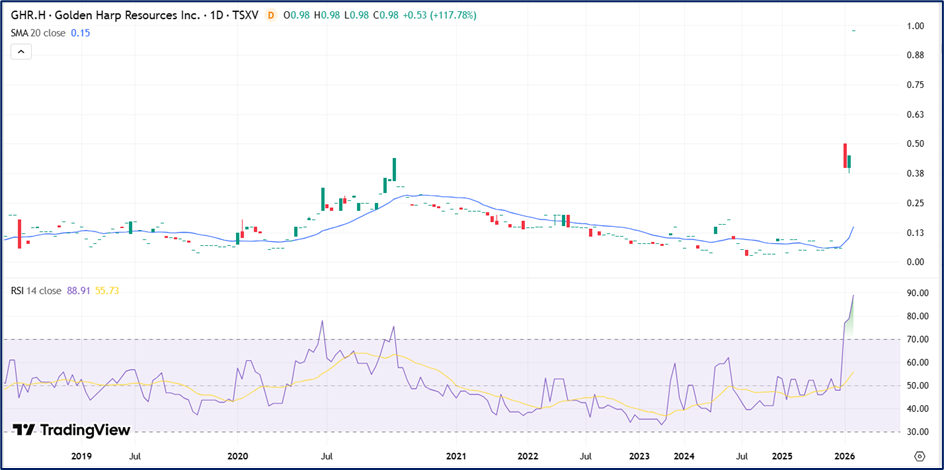
From a technical perspective, the price action on January 9 represents a "God candle" that has shattered multiple years of horizontal consolidation. Prior to this move, the stock was trading in a tight, low-volume range between $0.04 and $0.06.
The breakout occurred on volume that was more than 300% higher than the three-month average, a classic sign of institutional accumulation. The Relative Strength Index (RSI) has entered overbought territory, suggesting the potential for a short-term cooling-off period or "flag" formation as the market digests the news. Immediate support is now established at the previous resistance level of $0.15, while the next psychological ceiling is eyed at the $1.02 mark.
Business Model and Operational Strategy
- Asset-Focused Strategy: Golden Harp’s business model is strictly centered on the "Prospect Generator" and "Discovery" phases. They acquire high-potential land in established mining camps, add value through data consolidation and preliminary drilling, and then seek to prove up a resource.
- Operational Pivot: The latest operational update highlights a shift from "maintenance mode" to "active exploration." Following the shareholder vote on January 6, the company is now preparing an integrated geological model for Copper Hill, which includes historical data from 855 contiguous claim units.
- Cost Management: Operating out of Vancouver, the company maintains a lean corporate structure, ensuring that a high percentage of raised capital is directed toward "into-the-ground" exploration costs rather than administrative overhead.
Financial Health and Analyst Sentiment
Latest financial filings indicate that Golden Harp has historically operated with a minimal cash burn, often reporting a small net income due to the absence of active drilling programs during the consolidation phase. However, the current transformation will require a significant capital infusion.
While major investment banks like Goldman Sachs or RBC do not typically cover NEX-listed stocks, boutique mining analysts have noted that GHR.H is now "significantly undervalued" relative to its land-per-acre peer group in the Abitibi region. There have been no formal downgrades; rather, the sentiment has shifted from "Neutral/Hold" to "Speculative Buy" among independent research houses following the January 7 announcement of 100% voter approval for the acquisition.
Risks and Speculative Caveats
- Liquidity and Listing: As a NEX-listed entity, Golden Harp remains in the "penalty box" of the exchange. Trading is often thin, and the bid-ask spreads can be wide, leading to extreme price volatility.
- Execution Risk: Consolidation is only the first step. The company must now deliver actual drill results that prove the existence of an economic ore body.
- Dilution: To fund the upcoming exploration programs across the expanded property, the company will likely need to conduct a private placement, which could dilute existing shareholders.
- Regulatory Hurdles: The transaction still requires final acceptance from the TSX Venture Exchange within a 90-day window; failure to secure this would void the agreement.
Conclusion
Golden Harp Resources has successfully transitioned from a dormant shell with fragmented claims to a unified, district-scale explorer in one of the world's premier gold jurisdictions. The triple-digit gain reflects the market's realization that the path to a major discovery has been cleared of legal and joint-venture hurdles. However, the stock remains a high-risk, high-reward speculative play, dependent on both the drill bit and the continued strength of the global gold market.


 Jun 24, 2026




 Please wait processing your request...