
 AU
AU
 UK
UK
 US
US
 NZ
NZ
 IND
IND

 CA
CA

 Share
Share
 X (Formerly Twitter)
 Whatsapp
 Facebook
 LinkedIn
 Telegram
 Email This Article
 Copy Link
 Summarize with AI
 Chat GPT
 Perplexity
Key Reasons & Drivers for the January 8th Surge
Cenovus Energy (TSX: CVE) saw a notable reversal on January 8, 2026, gaining approximately 3.42% to close at C$22.70. This upward movement followed a period of intense volatility in early January, primarily driven by geopolitical shifts in South America.

Source: Kalkine Group
- Market Oversold Recovery: After a sharp nearly 9% tumble on January 5th due to news of the U.S. military’s capture of Venezuelan President Nicolás Maduro, the stock reached a technical "pivot bottom." Investors viewed the initial sell-off—sparked by fears of a Venezuelan oil resurgence—as an overreaction, leading to value-hunting at lower price levels.
- Goldman Sachs Reinstatement: A primary catalyst for the week’s sentiment was Goldman Sachs reinstating coverage on Cenovus with a "Buy" rating and a bullish outlook for 2027. The firm highlighted Cenovus as a leader in free cash flow (FCF) growth among its Canadian peers, projecting a high FCF yield in a $65–$75 Brent environment.
- Strategic Consolidation: The market is beginning to price in the long-term benefits of the recently completed MEG Energy acquisition. By absorbing MEG, Cenovus has effectively doubled its production since 2020, signaling to investors that it is ready to transition from an "aggressive growth" phase to a "cash harvest" phase.
Technical Analysis
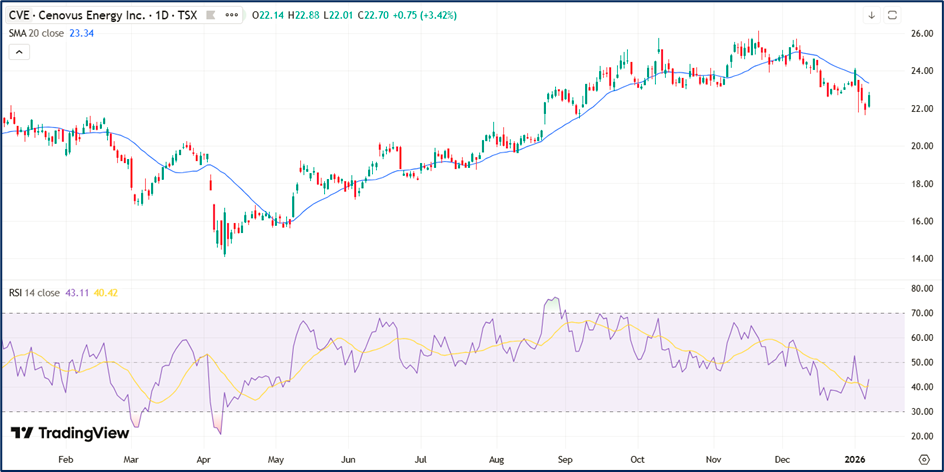
Source: Trading View
The technical picture for Cenovus on January 8th showed signs of a tactical turnaround within a broader bearish trend. A buy signal was issued from a pivot bottom point on Wednesday, January 7th, which served as the foundation for the 3.5% rally.
- Indicator Divergence: While the price moved higher on the 8th, trading volume actually fell by approximately 11 million shares compared to previous sessions. This creates a volume-price divergence, which often serves as a warning that the immediate upward momentum may lack the "fuel" for a sustained breakout without further consolidation.
- Moving Averages: Despite the daily gain, the stock remains below its short-term and long-term moving averages. The long-term average currently sits above the short-term, which technically maintains a "sell" signal. Resistance is expected at the CA$22.94 and CA$24.14 levels; a clean break above these would confirm a bullish trend reversal.
- Support Levels: Strong support has formed at C$22.67 based on accumulated volume. Analysts suggest a stop-loss around the C$21.73 mark to manage risk against further geopolitical volatility.
Latest Analyst Upgrades & Downgrades
Wall Street and Bay Street maintain a generally bullish consensus on the stock, despite recent macro headwinds.
- The Goldman Sachs Group: Upgraded to "Strong Buy" (Jan 2, 2026), setting a price target suggesting significant upside based on 2027 free cash flow projections.
- Desjardins: Boosted price target from CA$33.00 to CA$33.50 (Dec 12, 2025), citing a 35% potential upside.
- RBC Capital Markets: Reaffirmed an "Outperform" rating with a target of CA$32.00, focusing on the successful integration of the MEG Energy assets.
- Zacks Research: Upgraded from "Hold" to "Strong Buy" in mid-December 2025, following the release of the 2026 capital budget.
- Consensus View: Of the analysts covering the stock, the average price target remains near CA$29.59, representing a forecasted upside of over 30% from the January 8th close.
Latest Business Model & Strategy
Cenovus has evolved into a powerhouse integrated energy company, focusing on a "well-to-wheel" strategy that links massive upstream oil sands production with a sophisticated downstream refining network.
- Integration and Scale: The business model now centers on maximizing the value of its heavy oil through its own refineries in Canada and the U.S. By controlling the refining process, Cenovus mitigates the impact of wide Western Canadian Select (WCS) price differentials.
- The MEG Synergy: The acquisition of MEG Energy added 110,000 barrels per day (bbl/d) of low-decline bitumen production. Cenovus is applying its proprietary SAGD (Steam-Assisted Gravity Drainage) expertise to these assets to lower operating costs and increase recovery rates.
- Capital Allocation Framework: The company has shifted toward a shareholder-friendly model. Once net debt is below key thresholds, Cenovus intends to return 100% of excess free funds flow to shareholders via dividends and buybacks. Currently, with debt above CA$6 billion, the target is 50% return to shareholders.
Latest Financial & Operational Updates (2026 Guidance)
The 2026 capital budget, released in late 2025, outlines a disciplined approach to spending and production growth.
- Production Targets: Upstream production is forecast between 945,000 and 985,000 BOE/d for 2026, a 4% year-over-year increase after adjusting for the MEG merger.
- Capital Expenditure: Total capital investment for 2026 is pegged at C$5.0 billion to C$5.3 billion. This includes C$1.2 billion–C$1.4 billion for growth projects like the West White Rose offshore project and the Christina Lake North expansion.
- Downstream Efficiency: Throughput is expected to be 430,000–450,000 bbl/d, representing a utilization rate of 91% to 95%. This high utilization is critical for capturing refining margins in a volatile price environment.
- Debt Management: The company recently closed a C$2.6 billion offering of senior notes to manage its maturity profile and support the redemption of higher-interest debt.
Risks
While the outlook is positive, several "black swan" and operational risks remain on the horizon.
- Venezuelan Competition: The geopolitical shift in Venezuela poses a long-term threat. If U.S. investment successfully revives Venezuelan heavy oil production, it could compete directly with Canadian heavy oil for U.S. Gulf Coast refinery space.
- Pipeline Bottlenecks: While the Trans Mountain expansion provided relief, analysts warn of a potential "export pipeline capacity crunch" by late 2028 if production growth across the WCS basin outpaces new infrastructure.
- Refining Margins: Unplanned maintenance or "turnarounds" at U.S. refineries (like Lima or Toledo) can significantly impact quarterly earnings, as seen in previous "misses" where refining margins turned negative due to inventory headwinds.
Conclusion
Cenovus Energy enters 2026 as a significantly larger, more integrated player following the MEG Energy acquisition. The 3.5% gain on January 8th reflects a market that is beginning to look past temporary geopolitical shocks and focusing on the company’s ability to generate "peer-leading" free cash flow. While technical resistance remains a hurdle and the Venezuelan situation requires monitoring, the fundamental story—backed by Tier-1 oil sands assets and a disciplined 2026 capital plan—remains robust for long-term investors.


 Jun 24, 2026




 Please wait processing your request...