
 AU
AU
 UK
UK
 US
US
 NZ
NZ
 IND
IND

 CA
CA

 Share
Share
 X (Formerly Twitter)
 Whatsapp
 Facebook
 LinkedIn
 Telegram
 Email This Article
 Copy Link
 Summarize with AI
 Chat GPT
 Perplexity
Views Expressed Disclaimer:
You are reading a free article with opinions that may differ from the recommendation given by Kalkine in its paid research reports. Become a Kalkine member today to get access to our research reports, in-depth technical and fundamental research.
Key Takeaways — February 2026
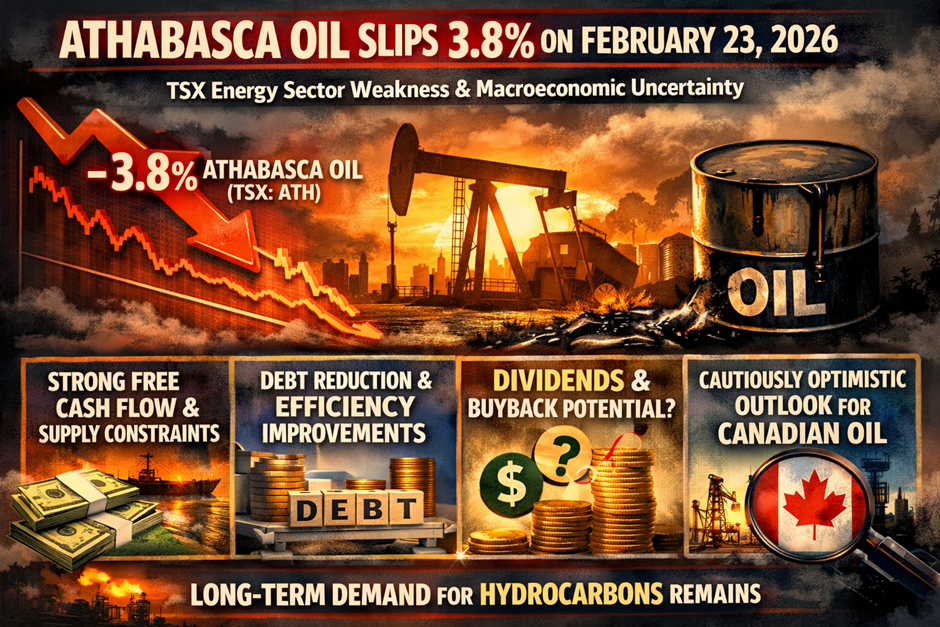
- Athabasca Oil (TSX: ATH) declined approximately 3.8% on 23 February 2026 mainly due to crude oil price fluctuations, broader TSX energy sector weakness, and macroeconomic uncertainty rather than company-specific negative news.
• The Canadian energy sector remains fundamentally supported by strong free cash flow generation and global oil supply constraints.
• Athabasca continues strengthening its balance sheet with improving debt metrics and operational efficiency (company filings).
• Future dividend or share buyback potential remains one of the most important long-term catalysts.
• Analysts remain cautiously optimistic about Canadian oil producers due to structural demand for hydrocarbons despite energy transition trends.
Source: Kalkine Group
Why Did Athabasca Oil Stock Fall in February 2026?
Athabasca Oil stock, TSX ATH share price, Canadian oil stocks February 2026, TSX energy sector outlook, oil price forecast 2026, Canada economy outlook, CAD currency trends, and TSX Composite analysis are among the most searched financial topics globally right now as investors attempt to understand whether recent volatility represents risk or opportunity. The 3.8% decline on 23 February 2026 appears largely driven by macroeconomic sentiment and commodity price movements rather than deterioration in company fundamentals.
Global crude oil prices experienced short-term volatility due to mixed economic signals from major economies, evolving geopolitical developments, and expectations around supply decisions from major producers. Energy equities on the TSX often respond quickly to commodity price fluctuations because revenues are directly tied to oil benchmarks, creating higher short-term volatility compared with other sectors.
Currency dynamics also played a role. Movements in the Canadian dollar relative to the U.S. dollar can influence investor perception of profitability for exporters. Even modest foreign exchange changes can trigger sector-wide sentiment shifts, contributing to temporary share price declines.
What Are the Current Global Oil Market Dynamics in 2026?
The global energy market environment remains structurally supportive despite periodic volatility. Several long-term drivers continue shaping the industry outlook:
- Years of underinvestment in upstream oil production capacity globally
• Persistent geopolitical risks affecting supply stability
• Growing energy demand from emerging economies
• Industrial and transportation sectors still heavily dependent on hydrocarbons
• Gradual pace of renewable transition requiring fossil fuel support
These structural factors create a relatively constructive long-term pricing environment for producers, including Canadian oil sands companies.
How Are the Canada Economy and TSX Composite Affecting ATH Stock?
Canada’s macroeconomic landscape in February 2026 is characterized by mixed indicators:
- Inflation moderating but still influencing monetary policy expectations
• Interest rate uncertainty affecting equity valuations
• Consumer and housing sector softness impacting sentiment
• Commodity exports supporting economic resilience
The TSX Composite Index remains heavily weighted toward energy and financial sectors, meaning commodity-driven volatility significantly impacts overall market sentiment. When oil prices fluctuate, Canadian energy stocks often experience amplified reactions regardless of company-specific developments.
What Is Athabasca Oil’s Current Business Model and Financial Position?
Athabasca Oil focuses on thermal oil sands production and light oil development, targeting long-life reserves and efficient capital deployment. Recent operational themes from company disclosures include:
- Improving free cash flow supported by disciplined capital spending
• Ongoing balance sheet strengthening and debt reduction
• Optimization of production efficiency across core assets
• Focus on shareholder value creation through capital discipline (company filings)
The company’s strategic emphasis on deleveraging before initiating shareholder distributions reflects a conservative financial approach that could enhance long-term sustainability.
Could Athabasca Oil Introduce Dividends or Shareholder Returns?
Dividend potential remains a major investor focus. Although the company does not currently pay a dividend, several indicators suggest future shareholder return possibilities:
- Declining leverage ratios
• Consistent free cash flow generation
• Industry trend toward returning capital to investors
• Peer companies already implementing dividends and buybacks
A transition toward shareholder returns often serves as a powerful valuation catalyst for energy companies moving into more mature financial stages.
How Does Athabasca Compare With Canadian Energy Peers?
Compared with other Canadian oil producers, Athabasca presents a unique risk-reward profile.
Competitive strengths include:
- Strong leverage to oil price upside
• Improving financial structure
• High-quality resource base with long production life
Challenges include:
- Smaller scale relative to major producers
• Absence of current dividend
• Higher perceived volatility
If financial improvements continue, valuation convergence toward peers could occur over time.
What Is the Short-, Medium-, and Long-Term Outlook for the Sector and Stock?
Short-Term Outlook (3–6 Months)
- Oil price volatility likely to dominate share performance
• Interest rate uncertainty influencing investor sentiment
• Range-bound trading possible without major catalysts
Medium-Term Outlook (1–3 Years)
- Continued balance sheet improvements could unlock valuation upside
• Potential shareholder return announcements
• Production stability improving investor confidence
Long-Term Outlook (3–5+ Years)
- Structural global energy demand supporting oil prices
• Supply constraints benefiting producers
• Long-life Canadian oil sands assets offering visibility
What Forward-Looking Strategies Might Investors Consider Across Time Horizons?
Short-Term Perspective
- Monitoring commodity price trends and macro indicators
• Evaluating quarterly earnings and operational performance
• Tracking global economic sentiment shifts
Medium-Term Perspective
- Assessing debt reduction progress
• Watching for shareholder return policy changes
• Comparing valuation metrics with industry peers
Long-Term Perspective
- Focusing on reserves, asset quality, and production sustainability
• Evaluating management capital allocation discipline
• Considering long-term energy demand projections
Is Athabasca Oil Stock Bullish, Bearish, or Neutral?
Short-Term View: Neutral to Slightly Bearish
Commodity price uncertainty and macro volatility may limit near-term upside momentum.
Long-Term View: Moderately Bullish
Logical drivers supporting this perspective include:
- Improving financial health
• Strong commodity leverage
• Potential shareholder return catalysts
• Structural industry support
What Key Drivers Could Push ATH Stock Higher?
Potential positive catalysts include:
- Sustained higher oil prices
• Faster-than-expected debt reduction
• Dividend or buyback announcements
• Operational efficiency improvements
• Strategic acquisitions or partnerships
What Are the Major Risks Investors Should Monitor?
Key risks include:
- Oil price declines
• Regulatory and environmental policy changes
• Cost inflation in operations
• Currency fluctuations
• Execution risks in capital allocation
Energy equities naturally carry cyclical volatility due to commodity exposure.
What Do Analysts Currently Indicate About ATH Stock?
Analyst sentiment toward Canadian mid-cap energy producers remains broadly constructive based on industry fundamentals.
Common themes in research coverage include:
- Positive outlook tied to free cash flow generation
• Valuation supported by commodity leverage
• Upside potential from shareholder return policies
Price target ranges typically reflect sensitivity to oil price assumptions and financial improvements (analyst reports).
What Scenario Analysis Helps Understand Possible Outcomes?
Bullish Scenario
- Oil prices remain strong
• Debt reduction accelerates
• Shareholder returns introduced
• Production exceeds expectations
Bearish Scenario
- Commodity prices decline significantly
• Costs increase materially
• Regulatory pressures intensify
• Free cash flow weakens
Base Scenario
- Stable commodity environment
• Gradual financial improvement
• Moderate share price appreciation with volatility
What Frequently Asked Questions Are Investors Asking in 2026?
Is Athabasca Oil undervalued?
Valuation depends largely on oil price expectations and financial improvement trajectory.
Will Athabasca Oil pay dividends?
Future dividends are possible once leverage targets are achieved.
Why is ATH stock volatile?
Commodity exposure and smaller market capitalization increase price swings.
What drives ATH stock performance?
Oil prices, production levels, free cash flow, and capital allocation decisions.
Final Investment Perspective — February 2026
Athabasca Oil’s recent share price decline appears primarily linked to external macroeconomic and commodity factors rather than company-specific weakness. The company continues progressing toward stronger financial positioning with improving operational efficiency and potential future shareholder return catalysts.
The investment narrative centers on commodity leverage combined with disciplined capital management. While volatility remains inherent in the energy sector, structural industry fundamentals provide a supportive long-term backdrop.
This content is informational only and not financial advice.


 Jun 24, 2026




 Please wait processing your request...