
 AU
AU
 UK
UK
 US
US
 NZ
NZ
 IND
IND

 CA
CA

 Share
Share
 X (Formerly Twitter)
 Whatsapp
 Facebook
 LinkedIn
 Telegram
 Email This Article
 Copy Link
 Summarize with AI
 Chat GPT
 Perplexity
Gold mining stocks historically magnify moves in bullion prices, and few TSX-listed names demonstrate this leverage more clearly than New Gold Inc. As gold prices firm and macro uncertainty rises, investors are questioning whether New Gold’s improving production profile and tighter cost discipline could unlock outsized equity upside in 2026.
This analysis breaks down the February 2026 surge, the macro forces driving gold equities, and whether New Gold’s recovery story is strong enough to justify a sustained rerating.
Key Takeaways (Latest Update: February 2026)
- New Gold shares jumped approximately 11.9% on 6 February 2026, dramatically outperforming the broader TSX Composite as gold prices, risk appetite, and mining equities surged.
- Operational leverage to both gold and copper has re-emerged, positioning New Gold as a high-beta beneficiary of rising safe-haven demand, rate-cut expectations, and currency volatility.
- Balance sheet repair and disciplined capital allocation are steadily improving market confidence, while dividends remain a medium-term optionality rather than a near-term driver.
- Momentum signals are bullish in the short term, constructive in the medium term, and selectively attractive over the long term—contingent on execution, cost control, and metal prices.

Source: Kalkine Group
Why Did TSX New Gold Shares Surge 11.9% on 6 February 2026?
The sharp rally in New Gold stock reflects a confluence of macro, sectoral, and company-specific catalysts.
As gold prices strengthened amid falling real yields, investors rotated aggressively into TSX-listed gold miners, amplifying gains in mid-cap producers with meaningful operating leverage. A weaker Canadian dollar (CAD) further boosted sentiment, as Canadian miners typically generate revenue in USD while incurring a significant portion of costs in CAD—expanding margins almost instantly.
Crucially, New Gold has re-established itself as a high-beta proxy for improving precious-metals sentiment. When gold prices move higher, New Gold historically moves faster, a dynamic intensified by positioning resets and short covering during the February 2026 metals rally.
How Are Global Markets in February 2026 Fueling Gold and Mining Stocks?
Global financial markets in early 2026 are navigating a delicate balance between cooling growth, easing inflation, and expectations for more flexible monetary policy—a combination that has historically favored gold.
Investors are simultaneously hedging macro risk and chasing momentum, creating a fertile backdrop for gold equities, particularly miners with operational torque.
Key macro tailwinds include:
- Compressed real yields, increasing the appeal of non-yielding assets like gold
- Persistent geopolitical uncertainty, sustaining safe-haven demand
- Equity market leadership shifting toward commodities and cyclicals during reflationary pauses
This environment has reignited institutional flows into TSX gold stocks, with New Gold emerging as a clear beneficiary.
What Does the Canadian Economic Backdrop Mean for New Gold in 2026?
Canada’s economic landscape in early 2026 is characterized by moderating growth, easing inflation pressures, and a central bank leaning toward policy flexibility. This setup has important implications for gold miners.
A softer domestic outlook often translates into CAD weakness, which directly enhances earnings visibility for Canadian producers exporting gold in USD terms.
Key implications:
- Dovish Bank of Canada expectations support currency depreciation
- Weaker CAD boosts translated revenues and operating margins
- Mining exports become more competitive globally
For New Gold, this macro alignment strengthens free cash flow optics and supports valuation expansion.
What Is the TSX Composite Signaling About Gold Stocks?
The TSX Composite has been rotating decisively toward resources and financials, a classic signal of institutional demand for real assets and inflation hedges.
Historically, when commodities lead TSX performance, gold producers tend to outperform, particularly those with visible operating leverage. New Gold’s February 2026 breakout fits squarely within this historical playbook.
Where Does New Gold’s Operating Leverage Come From?
New Gold operates long-life mining assets with exposure to both gold and copper, providing diversified revenue streams and strong cyclical sensitivity.
The company’s strategic priorities include:
- Operational consistency and tighter cost control
- Balance sheet discipline and ongoing deleveraging
- Selective growth that avoids shareholder dilution
Recent corporate updates point to stable production, incremental optimization initiatives, and capital discipline, reinforcing the recovery narrative.
Is New Gold Paying a Dividend, and Could That Change?
New Gold’s dividend policy remains intentionally conservative. Management has prioritized balance sheet strength and reinvestment over aggressive capital returns.
That said, dividend optionality is re-emerging. If gold prices remain supportive and free cash flow continues to improve, the company could revisit shareholder returns over the medium term—particularly if cost pressures stabilize and margins expand.
How Does New Gold Compare With Other TSX Gold Miners?
Within the TSX gold universe:
- Agnico Eagle Mines offers scale and dividend stability
- Barrick Gold provides diversification and balance-sheet strength
- Kinross Gold delivers leverage with higher execution sensitivity
New Gold differentiates itself through higher beta and turnaround torque, making it particularly attractive to momentum-oriented investors during gold upcycles.
What Is the Outlook for New Gold Across Time Horizons?
Short term (3–6 months):
- Bias: Bullish, driven by momentum, gold price support, and FX tailwinds
- Risks: Volatility and profit-taking after sharp advances
Medium term:
- Bias: Constructive, assuming steady execution and supportive macro conditions
- Watchpoints: Costs, grades, and free cash flow consistency
Long term:
- Bias: Neutral-to-positive, dependent on sustained gold demand
- Watchpoints: Capital discipline, reserve life, and cycle timing
What Are the Key Drivers Behind the February 2026 Rally?
- Rising gold prices and renewed safe-haven demand
- CAD weakness enhancing operating margins
- TSX sector rotation into metals and commodities
- Positioning shifts and sentiment normalization toward miners
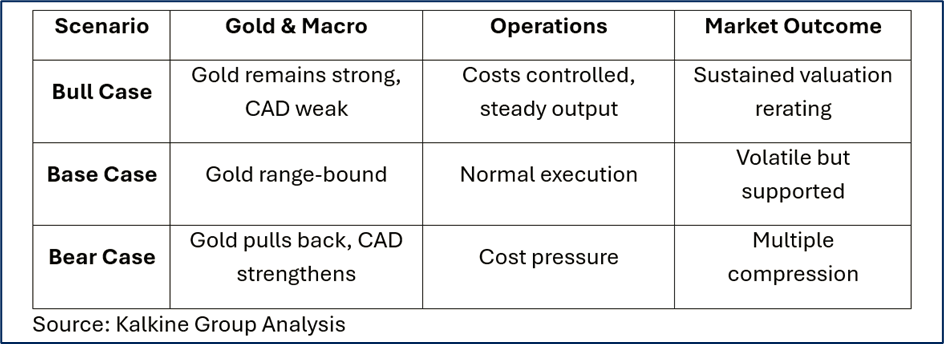
Bull, Base, and Bear Scenarios for New Gold in 2026
What Are Analysts Saying About New Gold?
Recent commentary from major Canadian brokers reflects cautious optimism, with consensus views clustering above recent trading levels. Analysts highlight gold price leverage, improving fundamentals, and balance sheet progress, while maintaining a strong focus on execution risk. Ratings generally skew Hold to Buy, underscoring disciplined optimism rather than exuberance.
Final Investment View: Is New Gold Worth Watching in 2026?
New Gold’s 11.9% surge in February 2026 reinforces its reputation as a high-beta TSX gold stock during precious-metal upswings. With supportive macro conditions, currency tailwinds, and improving operational fundamentals, the stock remains firmly on investor radar.
For those seeking momentum combined with cyclical leverage, New Gold stands out—provided investors remain mindful of execution risk and gold-price volatility. This analysis is informational only and not personal investment advice.


 Jun 24, 2026




 Please wait processing your request...