
 AU
AU
 UK
UK
 US
US
 NZ
NZ
 IND
IND

 CA
CA

 Share
Share
 X (Formerly Twitter)
 Whatsapp
 Facebook
 LinkedIn
 Telegram
 Email This Article
 Copy Link
 Summarize with AI
 Chat GPT
 Perplexity
As of January 21, 2026, Parex Resources Inc. (TSX: PXT) stands as a distinct entity within the Canadian energy landscape, offering a dividend yield that has recently hovered near the 9% mark—a figure that significantly outpaces many of its mid-cap peers. Operating as the largest independent oil producer in Colombia, the company has successfully merged a high-yield return model with a debt-free balance sheet, providing a unique profile for income-focused investors.
While the broader energy sector grapples with price volatility, Parex’s ability to generate substantial free funds flow from its Colombian assets allows it to maintain aggressive capital return programs, including both quarterly dividends and active share buybacks, even as it pivots toward high-impact exploration in the Llanos Foothills.
Latest Drivers and Reasons for the Recent Surge
Source: Kalkine Group
The recent momentum in Parex Resources' stock price and investor interest is driven by several converging factors:
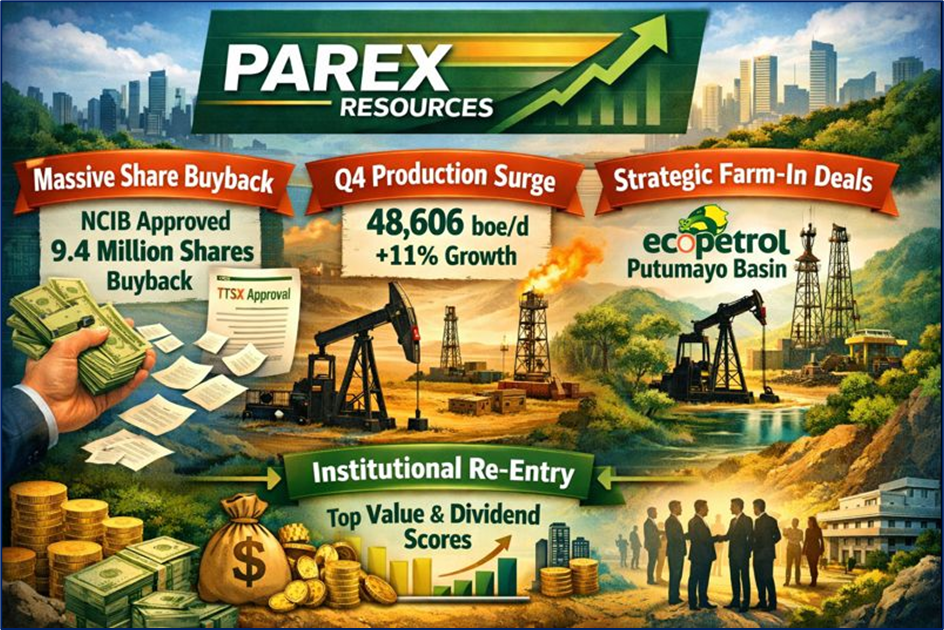
- Massive Share Buyback Approval: On January 20, 2026, Parex announced that the TSX approved its Normal Course Issuer Bid (NCIB), allowing the company to repurchase and cancel up to 9,407,490 shares—approximately 10% of its public float (Company Source: GlobeNewswire, Jan 20, 2026).
- Q4 Production Outperformance: The company reported Q4 2025 average production of 48,606 boe/d, an 11% increase over Q3 2025. This surge was primarily driven by successful new wells in the LLA-32 and LLA-74 blocks (Company Source: Production Update, Jan 12, 2026).
- Successful Farm-in Agreements: Strategic partnerships with Ecopetrol for the Llanos Foothills and Putumayo Basin have opened up high-potential exploration targets that were previously inaccessible, providing a roadmap for reserve replacement.
- Institutional Re-entry: Recent filings show a renewed interest from Canadian E&P institutional investors, attracted by the company’s "Value" and "Dividend" scores, which currently rank at the top of quantitative scales (Source: Smartkarma, Jan 20, 2026).
Latest Analyst Coverage
Current analyst sentiment remains generally positive, characterized by a "Moderate Buy" consensus:
- Jefferies: Raised price target to C$20.50 from C$18.00, citing strong production momentum and capital efficiency (Source: Investing.com, Dec 15, 2025).
- Royal Bank of Canada (RBC): Issued a price target of C$20.00 with a "Sector Perform" rating, adjusting slightly for the current commodity price environment (Source: MarketBeat, Jan 13, 2026).
- Roth/MKM: Initiated coverage with a "Buy" rating and a price target of C$24.00, highlighting Parex as a compelling value play based on enterprise value to debt-adjusted cash flow (Source: Investing.com, Dec 12, 2025).
- Scotiabank: Increased target to C$20.00, maintaining a "Sector Perform" stance (Source: MarketBeat, Jan 2026).
Current Business Model
Parex Resources operates a high-margin, conventional oil and gas model focused exclusively on Colombia:
- Conventional Production Focus: Unlike shale producers, Parex focuses on conventional reservoirs in the Llanos, Magdalena, and Putumayo basins, which typically offer lower decline rates and lower sustaining capital requirements.
- Financial Discipline: The company operates with a "debt-free" philosophy, maintaining a cash-positive balance sheet that allows it to self-fund capital expenditures and dividends through internal cash flow (Company Source: Investor Presentation, Jan 2026).
- Tax Efficiency: Operating in Colombia allows the company to benefit from specific fiscal regimes, with an effective tax rate estimated between 1% and 3% for the 2026 fiscal year (Company Source: 2026 Guidance, Jan 19, 2026).
Latest Financial, Operational, and Dividend Updates
Based on the latest company releases in January 2026:
- 2026 Production Guidance: Targeted average production is set at 47,000 boe/d (range of 45,000–49,000 boe/d), representing a 5% growth over 2025 (Company Source: 2026 Guidance, Jan 19, 2026).
- Capital Expenditure (CAPEX): Planned spending for 2026 is $300 million, with $190 million allocated to base development and $110 million for longer-term growth initiatives (Company Source: 2026 Guidance, Jan 19, 2026).
- Dividend Maintenance: Parex continues to pay a quarterly dividend of C$0.385 per share, resulting in an annualized dividend of C$1.54. Based on recent trading prices, this provides a yield between 8% and 9% (Company Source: Investor Presentation, Jan 2026).
- Cash Flow Projections: At a $60/bbl Brent price, Parex estimates FY 2026 funds flow from operations (FFO) of $405 million and free funds flow of $105 million (Company Source: 2026 Guidance, Jan 19, 2026).
Outlook and Risks
The company’s outlook is centered on a "Value vs. Growth" balancing act for the 2026 calendar year:
- Outlook: Management is prioritizing "Independent Pathways" for growth, specifically targeting the Foothills prospect (Piedemonte) and the Putumayo Basin. A transformational gas-condensate well at Floreña Huron is expected to spud in mid-2026 (Company Source: Jan 19, 2026).
- Political and Regional Risk: As a 100% Colombia-focused producer, Parex is sensitive to changes in Colombian fiscal policy, regulatory shifts, and security conditions in operating regions like the Arauca department.
- Commodity Price Volatility: While the company has hedged approximately 25% of its H1 2026 production using three-way collars (strike prices $53–$70), prolonged Brent prices below $60/bbl would impact the pace of share repurchases.
- Exploration Risk: The recent abandonment of the Guapo-1 exploration well at a cost of $12 million serves as a reminder of the inherent risks in high-impact drilling (Company Source: Jan 12, 2026).
Conclusion
Parex Resources enters 2026 as a robust cash-flow engine with a clear mandate to return value to shareholders. By combining a 10% share buyback program with a high-single-digit dividend yield and a debt-free balance sheet, the company has positioned itself as a defensive yet high-yielding energy play. While exploration results remain a variable, the company’s ability to grow production by 11% in the final quarter of 2025 suggests that its operational core remains strong enough to support its aggressive capital allocation strategy in the year ahead.


 Jun 24, 2026




 Please wait processing your request...