
 NZ
 UK
 US
 AU
 IND

 CA

 Share
 X (Formerly Twitter)
 Whatsapp
 Facebook
 LinkedIn
 Telegram
 Email This Article
 Copy Link
 Summarize with AI
 Chat GPT
 Perplexity
Key Highlights
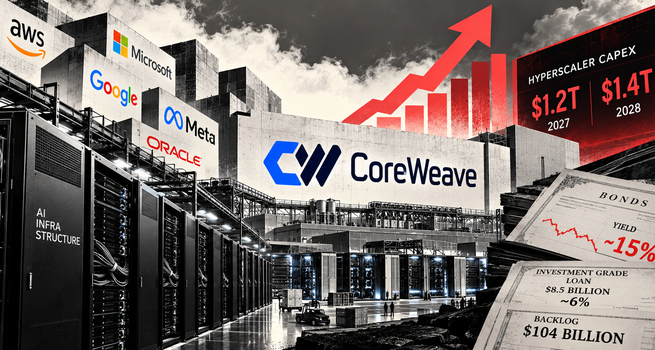
- Morgan Stanley estimates put the five largest hyperscalers’ capex at about $1.2 trillion in 2027 and $1.4 trillion in 2028
- A substantial portion of hyperscaler capex flows through neoclouds such as CoreWeave
- Hyperscaler contracts let CoreWeave borrow at lower rates, including an $8.5 billion investment-grade Loan at about 6%
- CoreWeave’s Backlog was about $104 billion at the end of the second quarter
- The key risk is hyperscalers cutting capex before neoclouds turn free Cash Flow positive
CoreWeave (NASDAQ: CRWV) has come under pressure from Credit investors, with its bonds yielding close to 15% in mid-October. One market observer argues that a default is not imminent, and the reasoning rests on a single link: as long as hyperscaler spending on AI infrastructure keeps flowing, neoclouds such as CoreWeave can keep funding themselves.
The Capex Cycle Is Still Rising
The observer points to Morgan Stanley, which has revised its hyperscaler capex estimates upward again. As reported, the bank now expects the five largest hyperscalers to spend about $1.2 trillion in 2027 and $1.4 trillion in 2028, increases of 9% and 10% from its prior forecasts. The observer cites growth of 30% in hyperscaler capex from this year through 2028. These are Sell-Side model estimates, not company guidance, but they show spending plans moving in one direction.
How Hyperscaler Contracts Lower Borrowing Costs
A substantial portion of that spending reaches neoclouds, and the contracts attached to it change how they borrow. CoreWeave closed an $8.5 billion delayed draw term loan in the first quarter that carried an investment-grade rating and was non-recourse to the parent. Reports said it was backed by CoreWeave’s agreements with Meta, and it priced at about 5.9% on its fixed-rate portion, even though CoreWeave itself is rated below Investment grade. CoreWeave’s chief financial officer said he expects more neoclouds to secure investment-grade financing against take-or-pay deals with credible AI labs and hyperscalers.
A Backlog That Backs the Debt
The contracted Revenue is large. CoreWeave’s backlog was about $104 billion at the end of the second quarter, up from $99.4 billion at the end of the first. That includes a $21 billion Meta commitment running from 2027 to 2032, which brought Meta’s total commitment to more than $35 billion. Management has said commitments from non-investment grade AI-native companies and foundation labs make up less than 30% of the backlog. Chief Executive Officer Mike Intrator has argued that the backlog more than covers the company’s debt.
Where the Pressure Shows
The credit market is not fully convinced. CoreWeave’s 9.625% notes due 2032 yielded roughly 14.8% on October 14, and S&P rates the company B+. Interest expense was $640 million in the second quarter and is guided to between $860 million and $940 million in the third. Reports put combined Debt and Lease obligations at about $52 billion as of June, and the company guides 2026 Capital spending to between $35 billion and $39 billion.
Not Every Loan Looks the Same
Contract backing varies. A later $2.6 billion delayed draw loan carries interest of 5.5 percentage points over the secured overnight financing rate, well above the 2.25 points on the investment-grade facility. It has a roughly five-year Maturity against customer contracts that average about three years, which leaves CoreWeave to renew or reassign capacity. That contrast shows how much the cost of borrowing depends on the strength of the customer behind the contract.
What Would Change the Picture
The observer’s warning is specific. If hyperscalers start cutting back on capex before neoclouds are free cash flow positive, there would be a problem. CoreWeave’s Operating Margin has already moved from a profit of 6.3% of sales a year earlier to a loss of 3.0% over the twelve months to June 2026, so the cushion from operations is thin while capital spending runs this high.
What to Watch
CoreWeave is expected to report quarterly results on or around November 11. Investors will be watching free cash flow, interest costs, its bond yields and any new financing, along with further revisions to hyperscaler capex plans, since those plans underpin both the backlog and the lower-cost loans.
The Bottom Line
The case against an imminent default rests on rising hyperscaler spending, large contracted Demand and financing that is cheaper when major customers stand behind it. The case for caution rests on heavy debt, rising interest costs and a Business that is not yet generating free cash flow. The balance between them depends on how long the capex cycle lasts.
This content is for informational purposes only and does not constitute investment advice. Readers should do their own research before making any investment decision.


 Nov 25, 2026





 Please wait processing your request...