
 NZ
 UK
 US
 AU
 IND

 CA

 Share
 X (Formerly Twitter)
 Whatsapp
 Facebook
 LinkedIn
 Telegram
 Email This Article
 Copy Link
 Summarize with AI
 Chat GPT
 Perplexity

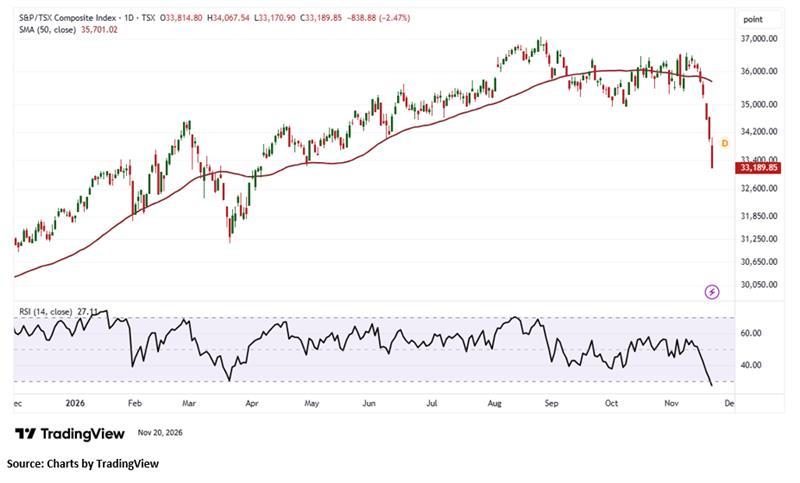
The S&P/TSX Composite index is expected to open lower, weighed down by weakness across the basic materials and technology sectors. From a technical perspective, the index continues to trade below its 21-day Simple Moving Average (SMA), which is acting as a key dynamic resistance level and restricting recovery attempts. Immediate support is positioned near 32,800, while resistance is placed around 33,600. A decisive break below 32,800 could weaken the technical structure, intensify selling pressure and expose the index to further downside risks. Overall, the near-term outlook remains cautious, with the index's ability to defend immediate support likely to determine its next directional move.
Global Macro Backdrop
United States - Political developments and economic outlook
US equities suffered another sharp selloff on Friday as doubts over artificial-intelligence spending, elevated growth-stock valuations and the path of interest rates undermined investor confidence. The retreat in Anthropic shares following its recent stock-market debut reinforced concerns about the sustainability of the AI Investment cycle. Canadian technology stocks followed the broader US selloff.
All three major US benchmarks finished lower. The Dow Jones Industrial Average declined 1.93% to 48,147.33, the S&P 500 fell 3.70% to 6,910.39 and the Nasdaq Composite dropped approximately 5.0% to 22,617.73. Weakness across semiconductor and AI-related businesses intensified the risk-off tone and weighed heavily on North American equities.
Federal Reserve policy remained a key consideration, as investors assessed persistent Inflation and the possibility that US interest rates could remain elevated. Higher borrowing costs and valuation concerns continued to weigh on companies whose Earnings expectations depend on sustained long-term growth, while the relatively firm dollar complicated the outlook for metals.
Canadian equities faced pressure from both collapsing metal prices and the US technology selloff. Financial stocks also retreated, contributing materially to the TSX decline. Communication services, consumer staples and utilities showed relative resilience, although gains in these groups were too small to offset the sharp losses elsewhere.
China - Industrial activity and Commodity demand
Chinese manufacturing, infrastructure and construction Demand remained central to the outlook for copper, aluminium and other industrial commodities. Investors increasingly balanced physical Supply constraints against concerns that softer global growth and reduced data-centre investment could weaken future demand.
Copper trading remained weak near US$5.50 per pound as a firmer dollar, uncertain industrial demand and concern about technology-sector Capital Expenditure affected sentiment. The industrial-metals backdrop weighed on diversified Canadian miners, alongside the severe decline in precious-metal prices.
Global bond yields and risk appetite
Global appetite for risk weakened further as losses accelerated across both US and Canadian stock markets. The TSX entered correction territory after retreating more than 10% from its August 25 record close, while its seven-day losing streak became the longest since October 2023.
The outlook for US interest rates, bond yields and the dollar remained important for Equity valuations and commodities. Investors also monitored the shifting Middle East risk premium in Crude Oil as shipping activity through the Strait of Hormuz improved, reducing some earlier supply concerns.
Canadian Market Focus
The S&P/TSX Composite Index fell 838.88 points (2.47%) to close at 33,189.85 on November 20. This was its seventh consecutive decline and lowest closing level since April 6. The index fell approximately 8.1% over the week, its steepest weekly loss since March 2020, and entered correction territory from its August record high.
Statistics Canada reported that September retail sales increased 0.8% month over month to CAD 75.3 billion, supported by spending at gasoline stations and fuel vendors. However, a preliminary estimate indicated that October sales could decline 1.5%, adding to concerns about consumer spending and Canadian growth momentum.
Sector declines were concentrated in information technology (-6.1%), materials (-5.0%) and financials (-2.5%). Celestica lost 16.38%, while Shopify and major banks were significant index detractors. Smaller gains in communication services, consumer staples and utilities did little to moderate the broader decline.
Canada’s October inflation rate of 3.1% and recent softer employment figures remained relevant for Bank of Canada policy expectations. The weaker advance estimate for October retail sales reinforced uncertainty around household demand. Investors also monitored International Trade developments and the impact of currency Volatility on Canadian businesses.
Company-level performance was sharply divided. Quebecor Class B rose approximately 4.90%, Brookfield Infrastructure gained 4.60% and Boyd Group advanced 4.41%. In contrast, Celestica fell 16.38%, AbraSilver declined 11.46% and Vizsla Silver lost 10.59%, underscoring the intensity of selling in technology and Mining shares.
Commodity view - what moved the TSX
- Crude: Crude oil fell to around $83 per barrel on Monday, entering a fourth week of declines as expectations of strong global supply offset concerns over escalating geopolitical tensions in the Middle East.
- Gold: Gold jumped 2% to around $3,600 an ounce on Monday, reversing losses from the previous session as traders dialed back bets on US Federal Reserve Interest Rate hikes following a widespread selloff in equity markets, driven by an unwinding of the artificial intelligence trade.
- Silver: Silver jumped more than 2% to above $42 an ounce on Monday, recouping losses from the previous session as traders dialed back bets on US Federal Reserve interest rate hikes following a widespread selloff in equity markets, driven by an unwinding of the artificial intelligence trade.
- Copper: Copper futures steadied above $5.50 per pound on Monday following a steep decline last week, as investors continued to evaluate the outlook for artificial intelligence-driven demand.
Forex Watch
USD/CAD: The USD/CAD Exchange Rate fell to 1.4340 on November 23, 2026, down 0.02% from the previous session. Over the past month, the Canadian Dollar has weakened 2.34%, and is down by 1.65% over the last 12 months.
Canada’s September retail-sales increase was overshadowed by the preliminary 1.5% decline projected for October. Alongside October inflation of 3.1% and weaker employment data, the figures added complexity to the Bank of Canada’s monetary-policy outlook.
US dollar: The dollar remained relatively firm amid cautious global risk appetite and expectations for restrictive Federal Reserve policy. Dollar movements continued to affect gold, silver, copper and the Canadian currency.
Canadian dollar implications: A weaker loonie raises the translated value of US-dollar revenues for exporters but increases the cost of imported machinery and equipment. Currency hedging, foreign-currency Debt and commodity exposure remain important considerations for Canadian-listed businesses.
Key Market Drivers
- TSX closing performance: The Composite fell 838.88 points (2.47%) to 33,189.85, recording its seventh consecutive decline and steepest weekly drop since March 2020.
- Technology and materials: Information technology declined 6.1% and materials lost 5.0%, with financials also dropping 2.5%.
- US market selloff: The Dow fell 1.93%, the S&P 500 lost 3.70% and the Nasdaq dropped sharply as AI-linked shares came under renewed pressure.
- Monetary policy: Persistent inflation concerns and uncertainty about Federal Reserve tightening weighed on Growth Stocks and precious metals.
- Crude oil: WTI crude settled near US$83.98 per barrel, up around 0.9% on Friday but lower for the third consecutive week.
- Gold and silver: December gold futures fell toward US$3,524 per ounce, while silver weakened to around US$41.
- Industrial metals: Copper hovered near US$5.50 per pound amid global-demand concerns and uncertainty about AI infrastructure spending.
- USD/CAD: The Canadian dollar traded around 69.7 US cents as weak domestic equities and policy divergence influenced the currency.
- Corporate stock movers: Quebecor, Brookfield Infrastructure and Boyd Group gained; Celestica, AbraSilver and Vizsla Silver declined.
- Market breadth: Decliners outnumbered advancers 830 to 185, with 57 unchanged; the TSX 60 VIX rose 13.84% to 22.21.

Market Outlook
The November 20 session extended the TSX Composite’s losing streak to seven days. The benchmark tumbled 2.47% to 33,189.85, closing at its lowest level since April 6 and entering correction territory after retreating more than 10% from its August record. Friday capped an approximately 8.1% weekly decline, the steepest since March 2020.
Technology and materials led the losses as Celestica and precious-metal producers fell sharply. US markets also recorded substantial declines, with the Nasdaq and S&P 500 particularly affected by concerns over AI valuations, elevated rates and the sustainability of major technology investment plans.
In Canada, September retail sales rose 0.8% to CAD 75.3 billion, but Statistics Canada’s advance estimate pointed to a 1.5% decline in October. The divergence added to concerns about domestic demand, alongside softer employment and October inflation of 3.1%.
Commodity performance remained unsettled. December gold futures declined to approximately US$3,524 per ounce and silver traded near US$41, while copper remained near US$5.50 per pound. US crude futures recovered modestly to about US$83.98 per barrel but still posted a weekly decline.
Near term, investors should monitor 33,000 and 32,800 as support zones, with resistance near 33,600 and 34,000. The outlook for precious metals, the US technology sector, interest-rate expectations and Canadian economic activity will remain central to the market’s next directional move.
Overall view: The TSX remains under pronounced selling pressure after a seven-day decline and an unusually steep weekly fall. Weakness in technology, mining and financial stocks has outweighed relative resilience in defensive sectors. A sustained move above 33,600 could indicate stabilization, while a break below 32,800 would raise the risk of further declines.


 Nov 25, 2026





 Please wait processing your request...