
 NZ
 UK
 US
 AU
 IND

 CA

 Share
 X (Formerly Twitter)
 Whatsapp
 Facebook
 LinkedIn
 Telegram
 Email This Article
 Copy Link
 Summarize with AI
 Chat GPT
 Perplexity

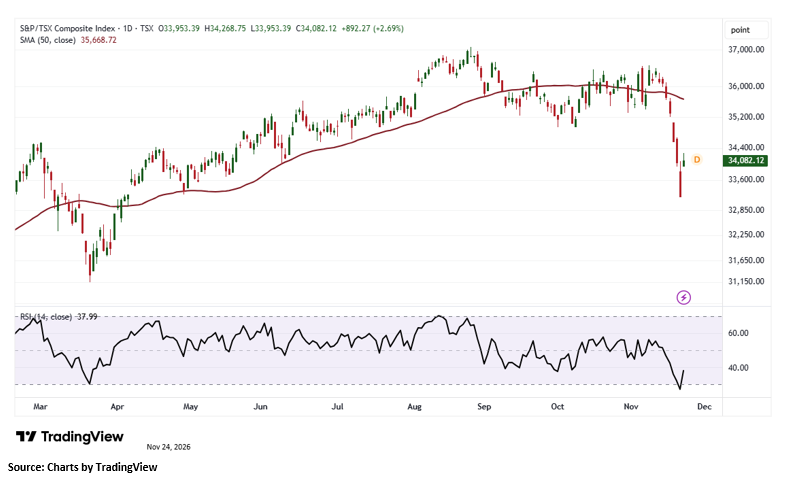
The S&P/TSX Composite index is expected to open higher, supported by strength across the basic materials and technology sectors. However, from a technical perspective, the index continues to trade below its 21-day Simple Moving Average (SMA), which is acting as a key dynamic resistance level and restricting recovery attempts. Immediate support is positioned near 33,500, while resistance is placed around 34,500. A decisive breakdown below 33,500 could weaken the technical structure, intensify selling pressure and expose the index to further downside risks. Overall, despite the anticipated positive opening, the near-term technical outlook remains cautious, with the index's ability to sustain above immediate support likely to determine its next directional move.
Global Macro Backdrop
United States - Political developments and economic outlook
US equities rebounded sharply on Monday as a recovery in artificial-intelligence-related stocks reversed part of the prior week’s decline. Nvidia reinstated Jensen Huang as chief executive, boosting confidence in AI-related businesses and lifting technology shares across North American markets. Investors nevertheless remained attentive to corporate spending, elevated valuations and interest-rate risks.
Wall Street recorded broad gains at Monday’s close. The S&P 500 rose 4.73% to 7,237.17, the Nasdaq Composite climbed 6.51% to 24,089.56 and the Dow Jones Industrial Average gained 3.01% to 49,595.31. The technology-led rally helped reverse an exceptionally weak prior week, although the scale of the move underscored continued volatility.
Federal Reserve interest-rate expectations continued to shape asset pricing. Investors assessed whether the recent equity-market selloff could temper expectations of further tightening, while the US dollar remained firm. Elevated Treasury yields and the cost of financing remained relevant for growth-stock valuations and Commodity markets.
Canadian equities benefited from the global risk-on reversal. A rebound in bullion supported precious-metal producers, and improving sentiment toward AI-linked businesses lifted the technology sector. However, falling Crude Oil prices weighed on select Canadian energy shares, making the session’s recovery uneven across industries.
China - Industrial activity and commodity demand
China’s manufacturing, infrastructure and construction activity continued to shape Demand expectations for copper and other industrial metals. Investors balanced concerns about global growth against longer-term requirements for electrification and data-centre infrastructure. Changing trade conditions and US dollar movements remained influential for Canadian resource companies.
Copper futures stabilized near US$5.50 per pound following the previous week’s steep decline. The firmer tone in commodity-linked equities was driven predominantly by precious metals rather than an unequivocal improvement in Chinese industrial demand. The near-term outlook for base-metal producers remained sensitive to global growth expectations.
Global bond yields and risk appetite
Global appetite for risk improved markedly on Monday as Canadian and US indexes recovered. The TSX recorded its largest daily gain since April 2025 following a seven-session losing streak. Gold Mining shares and AI-linked technology companies led the advance, while investors reduced some defensive positioning built during the previous week.
Bond yields, the US dollar and monetary-policy expectations remained central to the outlook. Although the return of buying interest provided near-term relief, persistent Inflation uncertainty and financing costs continued to present risks for growth companies and for commodity pricing.
Canadian Market Focus
The S&P/TSX Composite Index gained 891.59 points (2.69%) to close at 34,081.44 on November 23, ending seven consecutive declines. It was the benchmark’s largest daily percentage advance since April 2025. The rebound more than offset Friday’s 838.88-point loss, with mining and technology shares supplying much of the buying momentum.
Statistics Canada’s previously released September retail-sales report showed a 0.8% monthly increase to CAD 75.3 billion, although its preliminary estimate suggested October retail sales could fall 1.5%. On Monday, a flash estimate indicated that Canadian Manufacturing sales likely increased 2.3% in October, led by petroleum and coal products and primary metals. These mixed signals continued to inform expectations for domestic economic activity.
Materials was the leading TSX sector, rising approximately 6.4% as gold recovered, while information technology and consumer discretionary shares also advanced. Energy performance lagged as US crude futures declined. The recovery was broad by number of stocks, with 756 TSX issues advancing, 236 declining and 57 unchanged.
Canada’s October CPI inflation rate of 3.1% and weaker employment conditions remained important for Bank of Canada policy expectations. The Canadian dollar weakened as crude prices fell and the US dollar strengthened. Investors also assessed whether a rebound in global risk appetite could sustain further gains after the TSX’s unusually steep prior-week decline.
Among major individual movers, Montage Gold advanced 12.46%, NovaGold Resources gained 12.01% and Hammond Power Solutions rose 11.79%. In contrast, Strathcona Resources declined 5.46%, TELUS fell 4.85% and Parex Resources lost 3.85%. The mixed results illustrated a sharp divergence between mining- and technology-linked winners and energy-sensitive laggards.
Commodity view - what moved the TSX
- Crude: Crude oil fell below $80 per barrel on Tuesday, the lowest since August 7, after a 3.9% drop in the previous session, as renewed diplomatic efforts to end the US-Iran conflict weighed on the market. US Vice President JD Vance reportedly held talks with Qatar’s prime minister regarding potential negotiations with Tehran.
- Gold: Gold held above $3,600 per ounce on Tuesday after recovering from more than one-year lows in the previous session, as a rally in technology stocks and renewed optimism surrounding AI helped ease selling pressure on precious metals.
- Silver: Silver traded above $43 an ounce on Tuesday after recovering from more than one-year lows in the previous session, as a rally in technology stocks and renewed optimism surrounding AI helped ease selling pressure on precious metals.
- Copper: Copper futures fell to below $5.50 per pound on Tuesday, the lowest since March 24th as the broad metals rally in the previous session, driven by Jensen Huang’s return as Nvidia CEO, lost momentum.
Forex Watch
USD/CAD: The Canadian dollar weakened to around 1.43 per USD in mid-November, its lowest level since March 2025, as softer-than-expected inflation eased bets of another rate hike by the Bank of Canada.
The September retail-sales increase was tempered by a preliminary estimate of weaker October consumer spending. Combined with October inflation of 3.1% and soft labour-market data, the domestic backdrop remained mixed for the Bank of Canada and the Canadian dollar.
US dollar: The greenback benefited from renewed optimism in US equities and ongoing monetary-policy divergence. US Dollar Index futures gained approximately 0.5% to around 104.26, creating a mixed backdrop for commodity markets.
Canadian dollar implications: A softer loonie can increase the translated value of US-dollar Revenue for exporters while raising costs for imported equipment, machinery and Debt servicing. Companies with material foreign-currency exposure remain sensitive to shifts in USD/CAD.
Key Market Drivers
- TSX closing performance: The Composite climbed 891.59 points (2.69%) to 34,081.44, ending a seven-session losing streak and posting its largest daily gain since April 2025.
- Materials and technology: Mining shares led the rebound, with the materials sector rising approximately 6.4%, while AI-linked sentiment lifted technology stocks.
- US market rebound: The S&P 500 gained 4.73%, the Nasdaq advanced 6.51% and the Dow rose 3.01% as technology shares recovered.
- Monetary policy: Expectations for Federal Reserve policy, Treasury yields and a firm US dollar remained central to the outlook for Growth Stocks and metals.
- Crude oil: US WTI futures settled around US$80.17 per barrel, down about 3.9%, limiting the recovery in energy stocks.
- Gold and silver: December gold futures rose roughly 3.4% to US$3,636 per ounce, with silver also recovering from last week’s declines.
- Industrial metals: Copper steadied near US$5.50 per pound amid uncertainty over global industrial demand.
- USD/CAD: The loonie weakened to a 19-month low as declining oil prices and US dollar demand outweighed stronger Canadian Equity sentiment.
- Corporate stock movers: Montage Gold, NovaGold and Hammond Power Solutions advanced; Strathcona Resources, TELUS and Parex Resources declined.
- Market breadth: Advancers outnumbered decliners 756 to 236, with 57 unchanged; the TSX 60 VIX declined 8.96% to 20.22.

Market Outlook
The November 23 session marked a sharp Reversal in Canadian equities. The TSX Composite gained 2.69% to 34,081.44, ending seven consecutive losses and posting its best daily advance since April 2025. Strength in precious-metal producers and technology shares helped restore part of the ground lost during the preceding week.
US equities also rallied as Nvidia reinstated Jensen Huang as chief executive, supporting renewed demand for AI-linked stocks. The Nasdaq gained more than 6%, while the S&P 500 and Dow also advanced substantially. Nevertheless, inflation, interest-rate expectations and elevated valuations remained potential sources of renewed volatility.
In Canada, September retail sales increased 0.8% to CAD 75.3 billion, while preliminary October retail data indicated a possible decline. A separate flash estimate suggested October manufacturing sales rose 2.3%. These releases presented a mixed domestic demand outlook alongside soft employment and 3.1% headline inflation.
Commodity performance diverged. Gold futures rebounded to around US$3,636 per ounce and silver also recovered, while US WTI crude fell to about US$80.17 per barrel. The Canadian dollar weakened despite the TSX rally, underscoring continued sensitivity to commodity prices and interest-rate differences.
Near term, investors should monitor whether the TSX can remain above 33,500 and test the 34,500 resistance area. Gold and oil prices, US technology-sector performance, and developments in Federal Reserve and Bank of Canada policy expectations could determine whether Monday’s recovery extends.
Overall view: The TSX recorded a notable relief rally after a seven-session decline. Materials and technology drove the rebound and Market Breadth improved, but the index has yet to establish a sustained recovery above its 21-day SMA. A move above 34,500 could strengthen confidence; renewed trading below 33,500 would place the rebound at risk.


 Nov 24, 2026





 Please wait processing your request...