
 NZ
 UK
 US
 AU
 IND

 CA

 Share
 X (Formerly Twitter)
 Whatsapp
 Facebook
 LinkedIn
 Telegram
 Email This Article
 Copy Link
 Summarize with AI
 Chat GPT
 Perplexity

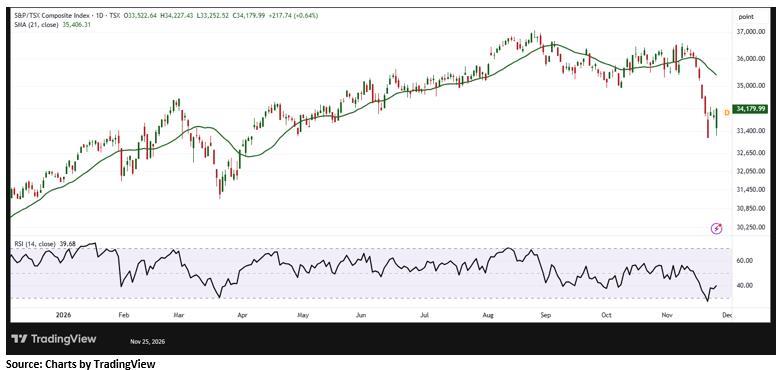
The S&P/TSX Composite index is expected to open higher, supported by strength across the basic materials and industrial sectors. From a technical standpoint, the index continues to trade below its 21-day Simple Moving Average (SMA), which remains a key dynamic resistance level and is limiting recovery attempts. Immediate support is positioned near 33,800, while resistance is placed around 34,500. Sustained trading above the support level could help stabilise market sentiment and provide a potential base for recovery. However, a decisive breakdown below 33,800 could weaken the prevailing technical structure, intensify selling pressure and expose the index to further downside risks. Overall, the near-term outlook remains cautious, with the index's ability to hold above immediate support likely to determine its next directional move.
Global Macro Backdrop
United States - Political developments and economic outlook
US equities pared steep intraday losses on Wednesday, although technology-linked stocks remained under pressure. Investors weighed fresh US Inflation data, new Tariff proposals affecting several trading partners and lingering concerns about artificial-intelligence valuations. The pullback in US Growth Stocks contrasted with Canada’s commodity-led market rebound ahead of the Thanksgiving holiday.
The Dow Jones Industrial Average gained 164.25 points (0.33%) to 50,182.95, while the S&P 500 lost 18.31 points (0.25%) to 7,182.78 and the Nasdaq Composite declined 147.73 points (0.62%) to 23,585.80. All three indexes recovered substantially from their intraday lows, but technology shares continued to lag after the earlier relief rally.
US inflation news reinforced concerns that the Federal Reserve could maintain tighter Monetary Policy for longer. Reports of proposed additional tariffs on goods from major trading partners also contributed to market caution. Investors monitored bond yields and the US dollar as key influences on precious metals, Equity valuations and the global Investment outlook.
Canadian equities outperformed US technology-heavy benchmarks as recovering gold and Crude Oil prices supported resource companies. Materials and energy stocks helped the TSX reverse an early decline of more than 700 points, although weakness in technology demonstrated that global risk appetite remained uneven.
China - Industrial activity and Commodity demand
China’s manufacturing, construction and infrastructure outlook continued to influence the Demand prospects for copper and other industrial inputs. Investors weighed uneven global economic conditions against longer-term resource requirements for power grids, electrification and industrial investment. Changes in trade policy and the US dollar remained important for Canadian miners.
Base-metal shares participated in Wednesday’s rebound after an earlier selloff. First Quantum Minerals advanced 6.51%, while the broader materials group rose approximately 3.0%. Nevertheless, the industrial-metals outlook remained vulnerable to Chinese demand uncertainty, trade developments and fluctuations in global growth expectations.
Global bond yields and risk appetite
Global risk appetite remained mixed. US technology shares declined, but commodity-linked Canadian equities recovered, highlighting a shift in investor interest during the session. The TSX reversed heavy early losses and closed at a one-week high, helped by stronger metals and energy prices ahead of the US Thanksgiving holiday.
Interest-rate expectations and currency movements continued to shape investor behaviour. US inflation data increased concern over the path of Federal Reserve policy, while lower Treasury yields during Wednesday’s US session offered some relief. The near-term market outlook will remain sensitive to economic releases, trade policy and changing perceptions of technology valuations.
Canadian Market Focus
The S&P/TSX Composite Index rose 217.69 points (0.64%) to 34,179.99 on November 25, its highest closing level in a week. The benchmark recovered from a drop of more than 700 points earlier in the session as commodity prices strengthened and technology-sector selling moderated. The advance followed Tuesday’s modest decline and continued the market’s effort to stabilise after the previous week’s steep losses.
Domestic economic conditions remained mixed. Statistics Canada had reported a 0.8% monthly increase in September retail sales, while a preliminary estimate suggested weaker consumer spending in October. A flash estimate pointed to stronger Manufacturing sales in October. Together with a softer labour market and inflation concerns, these releases remained relevant for the Bank of Canada’s policy outlook.
Materials led the TSX higher, advancing approximately 3.0%, while energy gained 1.0% and industrials rose 0.9%. Real estate and clean-technology shares also contributed to the recovery. Five major sectors finished lower, including information technology, which slipped 0.6% as Celestica declined 2.8%. The mixed sector pattern highlighted a commodity-driven rebound rather than a uniform market recovery.
Monetary-policy and trade developments remained important for Canadian equities. Investors assessed the Bank of Canada’s response to inflation risks and the possibility of further US rate tightening. Proposals for new US tariffs added uncertainty for exporters and manufacturers, while the US Thanksgiving holiday was expected to reduce trading activity later in the week.
Company-specific moves were notable. 5N Plus advanced 7.54%, First Quantum Minerals rose 6.51% and Avino Silver & Gold Mines gained 6.05%. By contrast, Celestica fell 2.81%, Extendicare declined 2.22% and Strathcona Resources lost 2.03%. Advancing stocks outnumbered decliners 557 to 446, with 57 issues unchanged.
Commodity view - what moved the TSX
- Crude: Crude oil rose above $84 per barrel on Thursday, extending gains for the third session, as escalating attacks in the Middle East heightened concerns over potential Supply disruptions.
- Gold: Gold prices declined toward $3,550 an ounce on Thursday, resuming their downward trend as stronger-than-expected US economic data reinforced expectations of a Federal Reserve rate hike next month.
- Silver: Silver prices declined toward $41 an ounce on Thursday, resuming their downward trend as stronger-than-expected US economic data reinforced expectations of a Federal Reserve rate hike next month.
- Copper: Silver prices declined toward $41 an ounce on Thursday, resuming their downward trend as stronger-than-expected US economic data reinforced expectations of a Federal Reserve rate hike next month.
Forex Watch
USD/CAD: The Canadian dollar weakened to around 1.43 per USD in mid-November, its lowest level since March 2025, as softer-than-expected inflation eased bets of another rate hike by the Bank of Canada.
Bank of Canada policy expectations continued to reflect the balance between inflation pressures and slower domestic employment growth. A recovery in commodity prices helped the loonie, while prospects for tighter Federal Reserve policy and changes in US tariffs remained potential headwinds.
US dollar: US Dollar Index futures traded around 103.65 in late-session reporting, down modestly. Inflation concerns and proposed tariffs remained central to the currency outlook, while changes in the greenback continued to influence gold, silver and other US-dollar-denominated commodities.
Canadian dollar implications: A stronger loonie may reduce the Canadian-dollar translation of overseas Revenue while easing the cost of imported equipment and materials. Exporters, resource producers and firms with US-dollar liabilities remain sensitive to currency volatility.
Key Market Drivers
- TSX closing performance: The Composite gained 217.69 points (0.64%) to 34,179.99, reversing steep early losses and reaching its highest close in a week.
- Sector leadership: Materials rose 3.0%, energy gained 1.0% and industrials added 0.9%; technology slipped 0.6%.
- US equity markets: The Dow gained 0.33%, while the S&P 500 declined 0.25% and the Nasdaq fell 0.62%, with AI-related shares remaining under pressure.
- Inflation and trade policy: Fresh US inflation data and proposed tariffs on trading partners kept Federal Reserve policy and International Trade uncertainty in focus.
- Crude oil: US WTI futures settled near US$83.68 per barrel, nearly 2% higher amid renewed Middle East supply-disruption concerns.
- Gold and silver: Bullion recovered from an intraday low as investors returned to precious metals; December gold futures traded near US$3,579 per ounce.
- Industrial metals: Base-metal equities rebounded, with First Quantum Minerals rising 6.51%, although concerns about global demand persisted.
- USD/CAD: The loonie strengthened modestly as commodities recovered, with the currency remaining near 70 US cents.
- Corporate stock movers: 5N Plus, First Quantum and Avino Silver & Gold advanced; Celestica, Extendicare and Strathcona Resources declined.
- Market breadth: Advancers outnumbered decliners 557 to 446, with 57 unchanged; the TSX 60 VIX slipped 3.97% to 19.84.

Market Outlook
The November 25 session saw the TSX Composite rebound 0.64% to 34,179.99, its highest closing level in one week. A rally in precious-metal miners and energy shares lifted the benchmark after it initially fell more than 700 points. The recovery demonstrated renewed buying interest but remained uneven across sectors.
US markets finished mixed as technology shares continued to face selling pressure. The Dow advanced modestly, while the S&P 500 and Nasdaq declined. Reports of proposed US tariffs and fresh inflation data reinforced concerns over interest rates, leaving global sentiment sensitive to further developments ahead of the Thanksgiving holiday.
Canadian investors continued to assess a mixed domestic demand picture alongside Bank of Canada policy risks. September retail sales were stronger, but the preliminary October estimate suggested a slowdown. Uncertainty about the US trade outlook remained significant for Canadian exporters and industrial businesses.
Commodity markets helped drive the reversal. Gold recovered from an intraday low, US WTI crude settled near US$83.68 per barrel and base-metal miners attracted buying interest. The Canadian dollar strengthened modestly, while technology shares continued to underperform the broader TSX.
Near term, investors should monitor whether the TSX can remain above the 33,800 area and move towards 34,500 resistance. Movements in precious metals, crude oil, US technology shares, inflation expectations and trade policy will remain important for determining whether the rebound can extend.
Overall view: Wednesday’s rebound improved sentiment after the earlier selloff, but the benchmark remains below its 21-day SMA and the recovery is not yet firmly established. Materials and energy provided leadership, while technology weakness highlighted continuing vulnerabilities. A sustained move above 34,500 would support a stronger recovery, while renewed weakness below 33,800 would increase downside risks.


 Nov 26, 2026





 Please wait processing your request...