
 AU
AU
 UK
UK
 US
US
 NZ
NZ
 IND
IND

 CA
CA

 Share
Share
 X (Formerly Twitter)
 Whatsapp
 Facebook
 LinkedIn
 Telegram
 Email This Article
 Copy Link
 Summarize with AI
 Chat GPT
 Perplexity
Snapshot: key HDRO trading data
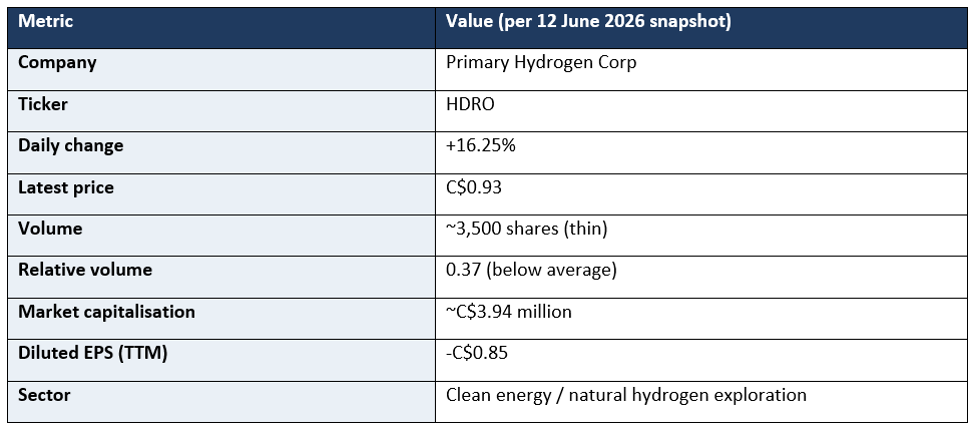
Primary Hydrogen Corp (TSXV:HDRO) provided a rare clean-energy presence on the Canadian top-gainers screen on 12 June 2026, on a list otherwise dominated by miners and metals names. According to the TradingView market-movers snapshot, HDRO stock rose 16.25% to a quoted price of C$0.93, on volume of roughly 3,500 shares and a market capitalisation of approximately C$3.94 million.
The two most important details in the HDRO entry are its very small size and its thin trading. With a market capitalisation under C$4 million and only about 3,500 shares traded at below-average relative volume, this is a micro-cap whose price can move sharply on very little capital. This article explains what the snapshot confirms, the cautious range of explanations, the company’s clean-energy context, and the heightened risks that come with a tiny, thinly traded speculative name.
Why did HDRO stock rise 16%?
The exact reason for the Primary Hydrogen move is not confirmed by the snapshot, and the dominant considerations here are the company’s small size and thin trading. When a micro-cap with a sub-C$4 million market value trades only around 3,500 shares, a small number of trades can move the price — and the calculated percentage change — substantially. The headline gain may therefore reflect liquidity dynamics as much as any fresh wave of demand.
Possible contributing factors that investors should verify include company-specific news, renewed speculative interest in clean-energy and hydrogen themes, broader risk-on sentiment, or simply a thin-market print. The below-average relative volume of 0.37 reinforces that this was a quiet session by normal standards, which makes the liquidity interpretation more compelling.
So while HDRO stock rose 16.25% on the screen, the responsible reading is that the move occurred in a small, thinly traded name and should be confirmed against the company’s disclosures and a second data source before being treated as significant.
Primary Hydrogen: company background and context
Primary Hydrogen is associated with the emerging field of natural (sometimes called white or geologic) hydrogen exploration — the search for naturally occurring hydrogen accumulations that could, in principle, provide a low-carbon energy source. This is a speculative and early-stage theme that has attracted periodic investor interest as part of the broader clean-energy and energy-transition narrative.
With a market capitalisation of roughly C$3.94 million and a negative trailing EPS of -C$0.85, Primary Hydrogen has the profile of a very early-stage, pre-revenue explorer. At this size, value is tied almost entirely to the perceived promise of its exploration concept rather than to current operations, and the share price can be extremely sensitive to news, sentiment and liquidity. Investors should confirm the company’s projects, financial position and recent activity directly through its filings on SEDAR+ and its investor materials.
Given how nascent natural-hydrogen exploration is as a field, primary-source verification is especially important before drawing any conclusions about the company’s prospects.
Putting the HDRO move in context
The context for HDRO is dominated by its micro-cap status and thin trading. A volume of about 3,500 shares is very low, and relative volume of 0.37 indicates a quiet session by the stock’s own standards. In such conditions, percentage moves can be large yet economically thin, meaning they may not be repeatable at scale because there are not enough shares trading to absorb meaningful buying or selling near the quoted price.
This is why the HDRO figure should be treated with particular care. The TradingView screen itself warns of retracement risk and urges users to weigh all statistics, including share price and market cap. For a sub-C$4 million company trading a few thousand shares, that caution is especially relevant: the quoted C$0.93 may not reflect a price achievable in size.
The sensible framing is that HDRO experienced a sharp but thin advance tied to a speculative theme, the durability of which will only become clear over subsequent sessions.
Clean-energy sentiment: the broader backdrop
Clean-energy and hydrogen themes have moved in and out of favour with investors as part of the broader energy-transition narrative. When sentiment toward these themes improves — often alongside rising risk appetite or supportive policy headlines — speculative capital can rotate quickly into early-stage names, including very small explorers pursuing novel concepts such as natural hydrogen.
The flip side is that these themes can fall out of favour just as quickly, and micro-cap names tied to them are among the most volatile in the market because of their limited floats and speculative character. The appearance of a hydrogen name among the day’s gainers may reflect a renewed flicker of clean-energy speculation, but such interest can be fleeting and should not be mistaken for a confirmed trend.
What are the risks for HDRO investors?
The risks attached to HDRO are among the highest on the day’s list. The company is very small, thinly traded and pursuing an unproven, early-stage exploration concept, which means liquidity, execution and dilution risks are all elevated. The materially negative trailing EPS underscores that it is loss-making, and pre-revenue micro-caps frequently need to raise capital. Speculative-theme exposure also means sentiment can shift abruptly.
- Liquidity risk: ~3,500 shares traded means thin, potentially unrepresentative pricing.
- Concept risk: natural-hydrogen exploration is early-stage and unproven.
- Financing and dilution risk for a sub-C$4 million, loss-making company.
- Theme and volatility risk: clean-energy speculation can fade quickly.
Why does HDRO’s micro-cap status amplify everything?
With a market capitalisation of roughly C$3.94 million, Primary Hydrogen is one of the smallest companies on the entire gainers screen, and that size amplifies every aspect of its risk-and-reward profile. In a company this small, a modest amount of capital can move the share price substantially, news can have an outsised effect, and liquidity can evaporate quickly. The 16.25% gain on only about 3,500 shares is a direct illustration of how little trading it takes to generate a large percentage move at this scale.
Micro-cap status is not inherently negative — many companies begin small — but it does mean that the usual cautions around volatility, liquidity and information scarcity apply with extra force. For HDRO, the combination of a sub-C$4 million valuation and thin trading places it firmly in the most speculative tier of the market, where prices can swing sharply in both directions and where verification of the underlying story is paramount.
What is natural hydrogen, and why is it speculative?
Natural hydrogen — also called white or geologic hydrogen — refers to hydrogen that occurs naturally in the Earth’s crust and which some companies are seeking to locate and, potentially, produce as a low-carbon energy source. It is an emerging and largely unproven field, attracting interest precisely because, if viable at scale, it could offer hydrogen without the energy-intensive production methods used today.
The speculative nature of the theme cannot be overstated. The science, commercial viability and economics of natural-hydrogen exploration remain at an early stage, and companies pursuing it are typically pre-revenue with concept-driven valuations. For Primary Hydrogen, this means the investment narrative rests on a frontier idea rather than on established operations. Investors interested in the theme should approach it with a clear understanding that early-stage, concept-led exploration carries a high probability of setbacks alongside any potential upside.
How does clean-energy speculation drive names like HDRO?
Clean-energy themes tend to move in waves of investor enthusiasm, and micro-cap names tied to them are among the most sensitive to those swings. When the energy-transition narrative is in favour — perhaps prompted by policy headlines, rising risk appetite or attention to a novel technology — speculative capital can rotate quickly into small, thematically aligned stocks, producing rapid gains on limited volume.
The same dynamic works in reverse. When enthusiasm fades, thinly traded clean-energy micro-caps can give back gains just as fast, because there is little underlying liquidity to cushion the move. For HDRO, the appearance among the day’s gainers may reflect a renewed flicker of clean-energy speculation, but such interest is often short-lived. The prudent view treats the move as a sentiment-driven event in a speculative name rather than as evidence of a durable shift in the company’s prospects.
A balanced view of the HDRO speculation
A clear-eyed view of Primary Hydrogen keeps its speculative appeal and its substantial risks in proportion. The confirmed facts are a 16.25% gain to C$0.93 on only about 3,500 shares, in a company valued at roughly C$3.94 million with a markedly negative trailing EPS of -C$0.85. HDRO sits in the most speculative tier of the market: a micro-cap pursuing an early-stage, unproven concept in natural-hydrogen exploration.
The appeal, for those drawn to it, is exposure to a frontier clean-energy idea that could matter if it proves viable at scale. The risks are formidable: the concept is unproven, the company is very small and thinly traded, liquidity is limited, and a loss-making pre-revenue explorer is likely to need further capital, with the dilution that can imply. Thematic sentiment can also evaporate quickly. The balanced conclusion is that HDRO stock rose on a thin, sentiment-driven print rather than on confirmed fundamental progress, and that the move should be treated as a speculative event in a high-risk name, verified against the company’s own disclosures.
What should investors watch next?
For anyone monitoring HDRO, the priority is to watch whether trading volume normalises and whether the price holds once more shares change hands. Any company news on its exploration projects or financing would help explain the move, and confirming the project portfolio and balance sheet via SEDAR+ is an essential first step given the company’s size. Broader clean-energy sentiment will also shape how the stock behaves.
In summary, HDRO stock rose 16.25% to C$0.93, but on only about 3,500 shares in a sub-C$4 million company — a move best understood as a thin, speculative print rather than confirmation of strong demand. Until volume and price are corroborated over subsequent sessions and against primary sources, the figure should be treated as provisional.
Top of Form
Bottom of Form


 Jun 25, 2026



_06_26_2026_00_32_01_380697.jpg)
 Please wait processing your request...