
 AU
AU
 UK
UK
 US
US
 NZ
NZ
 IND
IND

 CA
CA

 Share
Share
 X (Formerly Twitter)
 Whatsapp
 Facebook
 LinkedIn
 Telegram
 Email This Article
 Copy Link
 Summarize with AI
 Chat GPT
 Perplexity
Views Expressed Disclaimer:
You are reading a free article with opinions that may differ from the recommendation given by Kalkine in its paid research reports. Become a Kalkine member today to get access to our research reports, in-depth technical and fundamental research.
Rare earth elements have rapidly evolved from a niche commodities segment into one of the most strategically critical investment themes globally. These 17 metals — such as neodymium, dysprosium, terbium, and praseodymium — are essential for manufacturing high-performance permanent magnets used in electric vehicles (EVs), wind turbines, defence technologies, robotics, and advanced electronics powering the artificial intelligence revolution.
For decades, China has dominated the rare earth ecosystem, accounting for roughly 60% of global mining production and more than 90% of refining and separation capacity. However, geopolitical tensions escalated in April 2025 when China introduced export controls on several heavy rare earth elements, including dysprosium and terbium. Export licensing requirements created immediate supply disruptions, sending global prices sharply higher — with some heavy rare earth oxides trading multiples above domestic Chinese prices.
This supply shock has accelerated Western government initiatives to establish independent critical mineral supply chains. The United States launched a multibillion-dollar strategic minerals programme, Canada designated rare earths as national priorities, and Europe expanded industrial partnerships to reduce reliance on Chinese processing. For investors, this structural transformation is creating a compelling opportunity in select Toronto Stock Exchange (TSX) companies positioned across the rare earth value chain.
Below are three Canadian-listed rare earth stocks that could benefit from this long-term industrial shift.
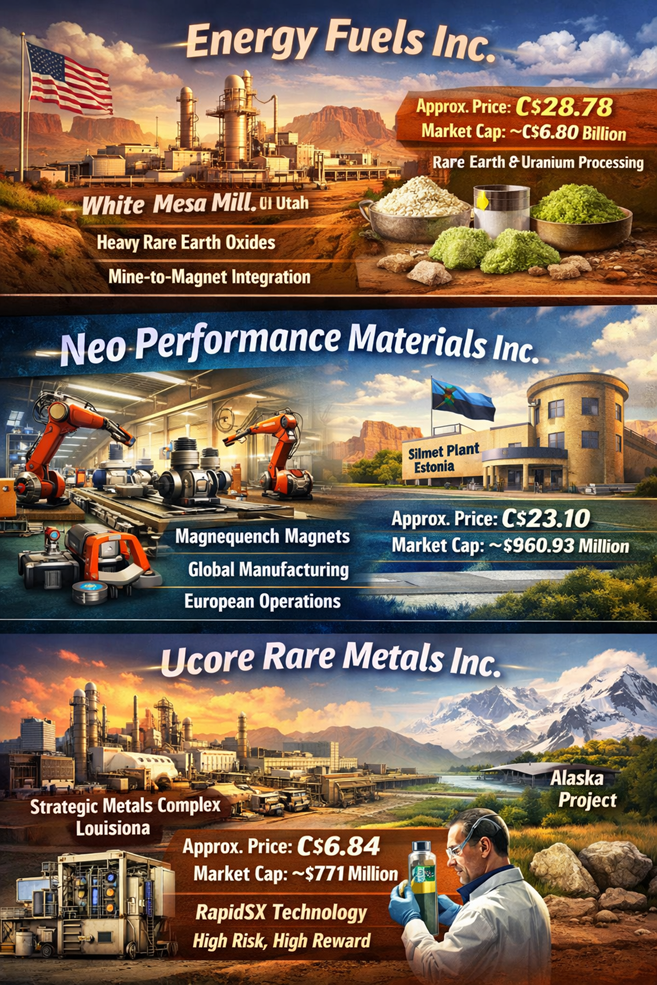
Source: Kalkine Group
Approx. Price: C$28.78
Market Capitalisation: ~C$6.80 billion
Recent Momentum: Strong rally in early 2026
Energy Fuels is widely viewed as one of the most advanced Western rare earth opportunities available to public investors. The company operates the White Mesa Mill in Utah — currently the only fully licensed conventional uranium processing facility in the United States — which is being expanded into a dual-purpose hub capable of processing both uranium and rare earth materials at commercial scale.
The company’s rare earth strategy focuses heavily on heavy rare earth oxides, where Western supply shortages are most acute. During 2025, Energy Fuels achieved pilot-scale production of high-purity dysprosium oxide, successfully meeting qualification standards with a major Asian automotive manufacturer. Terbium oxide production trials are underway, with additional heavy rare earth products planned.
A feasibility study released in early 2026 outlined a significant capacity expansion that could increase rare earth processing output approximately sixfold to around 6,000 tonnes annually. This would position the facility among the largest non-Chinese rare earth separation operations globally. The project’s projected economics — including strong internal rates of return and manageable capital requirements — enhance the investment case, particularly given potential government funding support.
The company also strengthened its strategic positioning through the planned acquisition of an advanced rare earth materials business, aiming to create vertically integrated “mine-to-magnet” capabilities spanning extraction, processing, and metallisation.
While valuation premiums and earnings volatility remain risks, Energy Fuels offers investors exposure to a strategically unique Western asset with tangible commercial progress.
2. Neo Performance Materials Inc.
Approx. Price: C$23.10
Market Capitalisation: ~C$960.93 million
Dividend Yield: ~1.7%
Neo Performance Materials represents a different segment of the rare earth ecosystem — the midstream and downstream manufacturing stages that transform refined materials into functional magnetic components.
Headquartered in Toronto, the company operates globally through three business divisions, with manufacturing facilities across Asia, Europe, and North America. Its flagship Magnequench division is a leading producer of bonded neodymium-iron-boron (NdFeB) magnetic powders used in automotive motors, industrial automation systems, and consumer electronics.
Neo also owns the Silmet processing facility in Estonia, one of the few rare earth separation plants operating outside China. This geographic diversification is increasingly valuable as governments and manufacturers seek supply chain resilience.
Although recent financial performance was impacted by weaker rare earth prices, the company is entering what analysts believe could be a growth phase driven by:
- Rising EV and electrification demand
- Expansion of European magnet manufacturing capacity
- Development of heavy rare earth processing capabilities outside China
Strategic collaborations with major automotive suppliers further strengthen Neo’s competitive positioning. Compared with early-stage rare earth developers, Neo provides investors with established revenue streams, existing industrial infrastructure, and potential valuation upside as Western reshoring trends accelerate.
Approx. Price: C$6.84
Market Capitalisation: ~C$771 million
Risk Profile: High risk, high reward
Ucore Rare Metals is a development-stage company focused on solving one of the most significant bottlenecks in Western rare earth supply chains: processing and separation.
The company’s proprietary RapidSX technology aims to improve upon conventional solvent extraction methods by reducing processing time, complexity, and costs. If successfully commercialised at scale, this innovation could provide a meaningful competitive advantage.
Ucore’s primary initiative is the Strategic Metals Complex in Louisiana, a planned commercial rare earth separation facility expected to ramp capacity in phases toward several thousand tonnes annually. At full throughput, potential revenue could be substantial relative to the company’s current size.
Feedstock supply agreements have been secured through long-term partnerships, addressing a critical requirement for project financing and operational stability. Beyond Louisiana, Ucore’s longer-term pipeline includes additional processing facilities in North America and a mineral development project in Alaska.
Analyst coverage has expanded alongside growing investor interest, particularly after the company achieved strong recognition in Canadian venture rankings due to rapid market capitalisation growth.
However, investors should recognize the risks: Ucore remains pre-revenue, capital-intensive, and must demonstrate consistent commercial performance of its technology. Share price volatility is likely to remain elevated.
Why Rare Earth Stocks Could Be a Long-Term Investment Theme
Global demand for rare earth elements is projected to grow at double-digit annual rates, supported by electrification, renewable energy expansion, defence modernisation, and robotics adoption. Some forecasts suggest demand could double by 2040.
China’s export controls in 2025 highlighted the vulnerability of global supply chains, prompting unprecedented policy responses across North America and Europe. Government subsidies, strategic reserves, and industrial partnerships are accelerating the development of alternative supply networks.
Energy Fuels, Neo Performance Materials, and Ucore Rare Metals collectively provide exposure across different stages of the rare earth value chain:
- Upstream processing and separation
- Midstream manufacturing and magnet production
- Emerging next-generation separation technology
This diversification can help investors participate in the sector while balancing risk profiles.
Investment Considerations
Rare earth investing carries unique risks, including:
- Commodity price volatility
- Technological execution challenges
- Regulatory and geopolitical uncertainty
- Capital intensity and funding requirements
Position sizing, diversification, and long-term investment horizons are important when approaching this sector.
The Bottom Line
Rare earth elements are becoming foundational to the global energy transition and advanced manufacturing economy. As Western nations accelerate efforts to build independent supply chains, companies positioned across mining, processing, and magnet production could benefit significantly.
For investors seeking exposure to one of the most strategically important materials themes of the decade, select TSX-listed rare earth stocks may offer compelling long-term opportunities — provided the associated risks are carefully managed.
This article is for informational purposes only and does not constitute investment advice. Stock prices and performance figures are based on data available as of February 2026 and are subject to change. Always conduct your own research or consult a qualified financial advisor before making investment decisions.


 Jun 24, 2026




 Please wait processing your request...