
 AU
AU
 UK
UK
 US
US
 NZ
NZ
 IND
IND

 CA
CA

 Share
Share
 X (Formerly Twitter)
 Whatsapp
 Facebook
 LinkedIn
 Telegram
 Email This Article
 Copy Link
 Summarize with AI
 Chat GPT
 Perplexity
Key Takeaways
- Structural Transformation: AI is not a temporary trend; it is a capital-intensive industrial shift comparable to electrification, demanding massive infrastructure build-out.
- From Hype to ROI: The focus has moved entirely to monetization. Companies are penalised for "science projects" and rewarded for tangible productivity gains.
- The "Great Divergence": Market valuations are splitting. Winners control data and compute; losers are stuck with generic models and undefined strategies.
- Sovereign Importance: AI is now a matter of national security. Regulation, chip supply chains, and energy access are the new geopolitical battlegrounds.
The AI Explosion: A New Industrial Shift
AI has officially moved past the "hype phase" and into deployment and monetization. This isn't just another tech cycle; it's a structural transformation driven by massive compute demand, enterprise adoption, model breakthroughs, and nation-state strategies. This shift impacts every sector simultaneously, comparable to electrification or the internet, creating broad-based disruption.
Massive Compute
Demand for GPUs, NPUs, and new data centers is exploding.
Enterprise Adoption
Automation, personalization, and productivity are key drivers.
Model Breakthroughs
Moving from LLMs to multi-modal agents that can act.
National Strategy
Global powers are aligning policy and capital behind AI.
Market Size, Growth & Penetration
Global AI Spending (2025-2030)
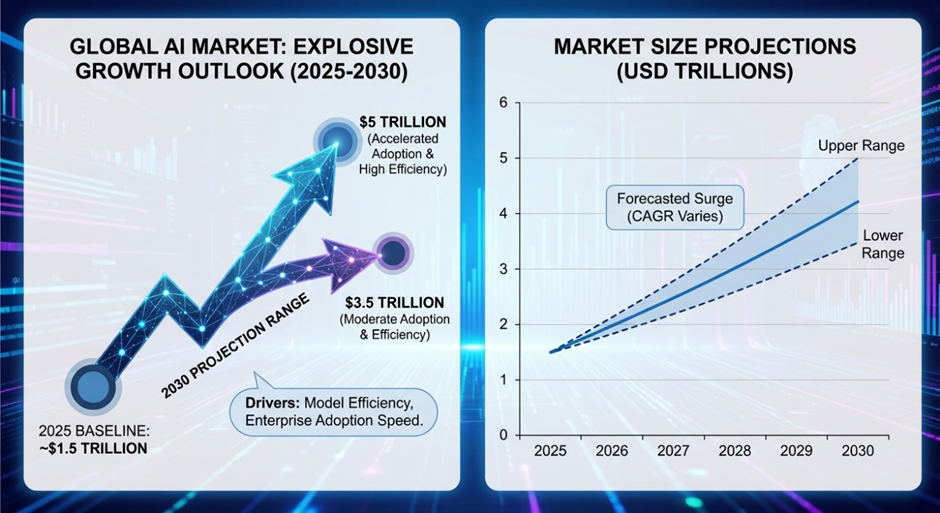
The global AI market is set for explosive growth. Starting from a base of nearly $1.5 trillion in 2025, projections for 2030 range from $3.5 to $5 trillion, depending on model efficiency and the speed of enterprise adoption.
Data Source: Global Reports, Analysis: Kalkine Group
AI Share of IT Spend by 2030
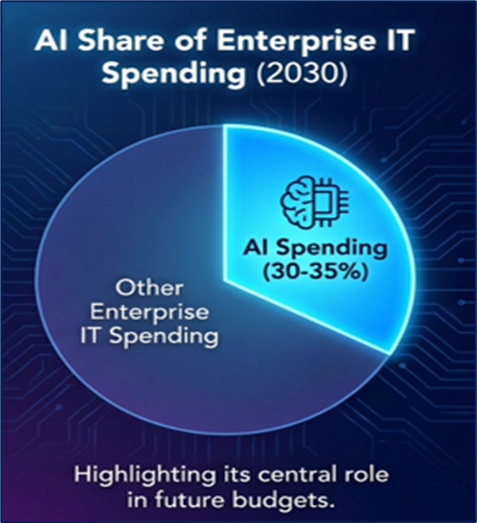
AI is projected to consume 30-35% of all enterprise IT spending by 2030, highlighting its central role in future budgets.
Data Source: Global Reports, Analysis: Kalkine Group
The Engines of Growth
Three primary forces are driving this supercycle: a rapid evolution in enterprise use-cases, the physical infrastructure build-out, and measurable productivity gains.
Enterprise Use-Case Evolution
AI is maturing from simple tools to autonomous systems that actively perform tasks.
Prototypes → Real Workflows
Copilots → Agents That Act
Command Interfaces → Autonomous Systems
Infrastructure Supercycle
The revolution is bottlenecked by compute. This has ignited a supercycle for hardware:
- GPUs, NPUs, and Custom Silicon
- High-Bandwidth Memory (HBM)
- Network Fabrics
- Specialised AI Datacenters
Productivity Uplift (ROI)
AI's primary ROI is time compression, turning days into hours and hours into minutes. This delivers:
- Lower operational costs
- Higher revenue per employee
- Faster product-to-market cycles
Sector-by-Sector Disruption
Top Enterprise Adoption Areas
While AI impacts all sectors, adoption is fastest in areas with clear, immediate ROI. Customer support, supply chain, and marketing are leading the charge in deploying real-world AI solutions.
Who Wins First?
AI adoption is not evenly distributed. Technology and Financial Services are spending the most, while Healthcare and Industrials are showing massive breakthrough potential.
- Technology & Cloud
Semiconductor demand is exploding. SaaS companies are embedding AI to boost ARR.
- Financial Services
Transforming underwriting, fraud detection, and algo-risk management.
- Healthcare
Breakthroughs in genomic modeling, drug discovery, and medical imaging.
- Retail & E-Commerce
Improving recommendation engines, inventory prediction, and pricing intelligence.
- Supply Chain & Industrials
Penetrating logistics, warehouse automation, and predictive maintenance.
The AI Economics: Capex & Valuations
AI is powerful, but not cheap. It requires a massive capital expenditure (Capex) supercycle, which is causing a "Great Divergence" in market valuations.
The Capex Supercycle
Enterprises face rising bills for GPUs, data engineering, and cloud workloads. This leads to:
- ↓
Short-Term: FCF Compression
High upfront costs impact free cash flow.
- ↑
Long-Term: Operating Leverage
Successful AI deployment leads to margin expansion.
The Great Divergence: Valuations
The market is clearly rewarding AI winners and penalizing those without a clear strategy.
Markets REWARD
- Chipmakers (NVIDIA, AMD)
- Cloud Hyperscalers
- SaaS with AI Monetization
- Proprietary Datasets
Markets PENALIZE
- Companies doing AI "for hype"
- Firms without proprietary data
- Weak cost discipline
- Unclear AI ROI
Investment Flows & M&A
Top VC & Private Market Themes
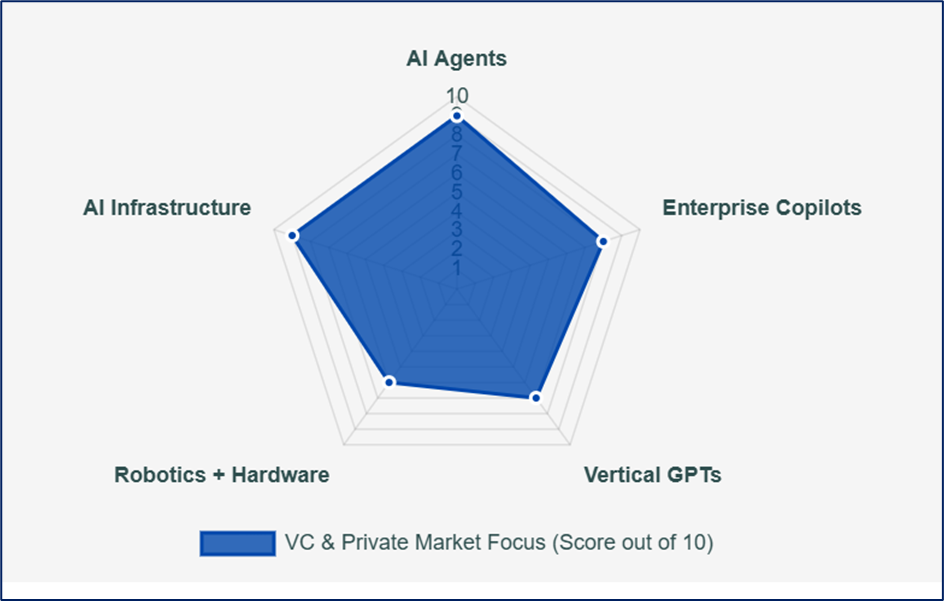
Generative AI attracted tens of billions in funding last year. Investors are chasing specific themes, with a heavy focus on AI agents, enterprise-grade copilots, and the underlying infrastructure needed to run them.
Data Source: Global Reports, Analysis: Kalkine Group
M&A & Investment Banker Tone
Strategic buyers are focused on acquiring datasets, model IP, and specialized AI startups. Investment Banks (IBs) are pro-deal for infrastructure but cautious on overvalued software.
M&A Focus Areas:
- Acquiring unique datasets
- Acquiring model IP and talent
- Roll-ups in Cybersecurity + AI
- Enterprise automation tools
IB Tone:
- Bullish: Hardware/semis for 2-3 more years.
- Cautious: Overvalued early-stage software.
- Optimistic: Cross-border data/AI acquisitions.
Risks & The Regulatory Battlefield
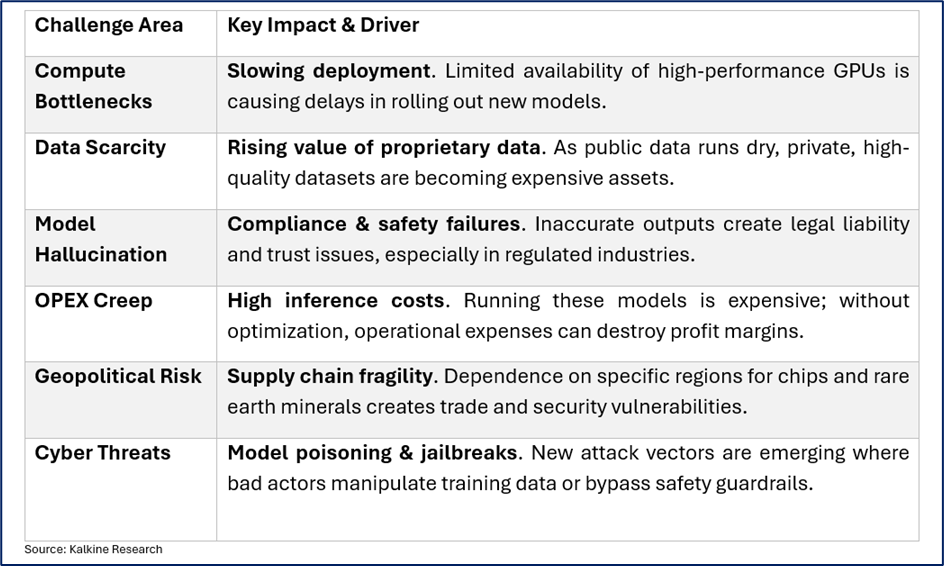
AI is powerful, but also expensive and fragile. Regulation has become a top-3 enterprise risk, while technical and geopolitical bottlenecks pose significant threats to deployment.
Key Risks to Track
The New Battlefield: Regulation
Global powers are taking different approaches, creating a complex compliance landscape.
- EU AI Act: Strictest approach.
- US: Innovation-first, soft regulation.
- UK & Canada: Risk-based, sector-aligned.
- China: State-controlled AI deployment.
Winners will be those who bake compliance into their products from day one.
Canada's Under-the-Radar AI Opportunities
Canada is a global AI research hub (Montreal, Toronto, Edmonton) and home to strong enterprise AI companies. Here are key TSX-listed names with factual exposure to the AI theme.
AI-driven supply chain optimisation, digital twins, and autonomous decisioning.
AI search, recommendations, and personalization for enterprise and e-commerce.
AI-native learning management, automated content creation, and enterprise training copilots.
Canadian General Investments (CGI)
Large integrator deploying AI solutions in government, finance, utilities, and healthcare.
AI-driven merchant tools, storefront personalisation, chat-based selling, and fraud tools.
Embedding AI in enterprise content, cyber, and workflow automation.
The Next 5 Years: What AI Will Disrupt Next
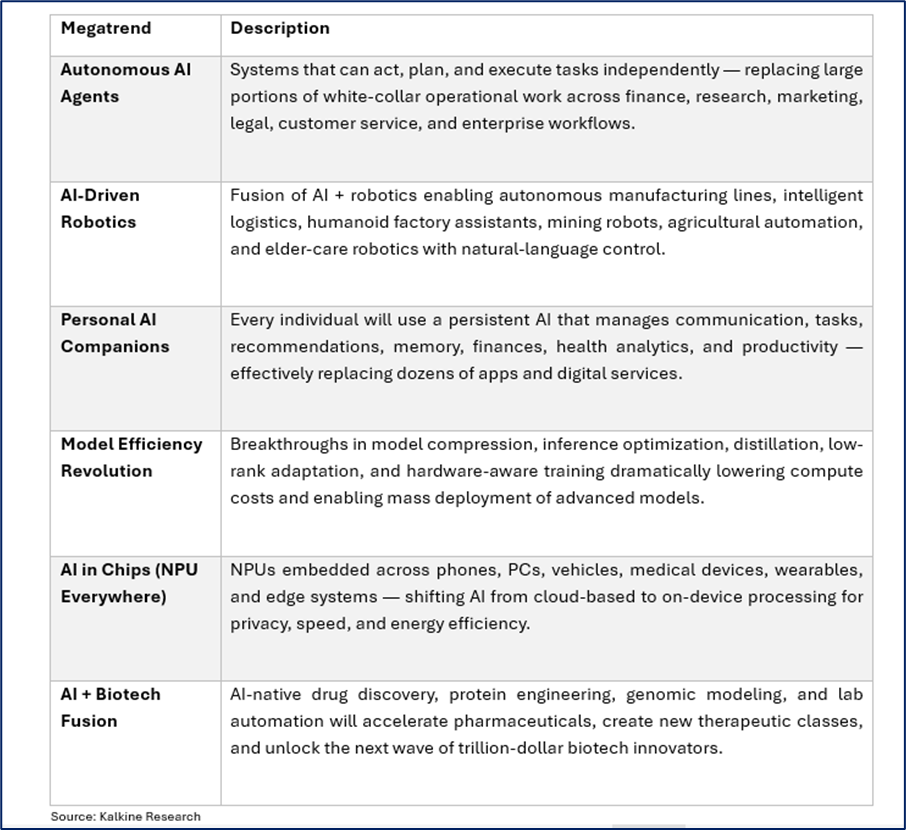
The next waves of disruption are already forming, moving from prediction to action and from the cloud to the device in your pocket.
AI Megatrends (2025-2030)
AI Strategy Framework for Investors
A simple but powerful framework to organize an investment strategy, moving from the core infrastructure to more speculative plays.
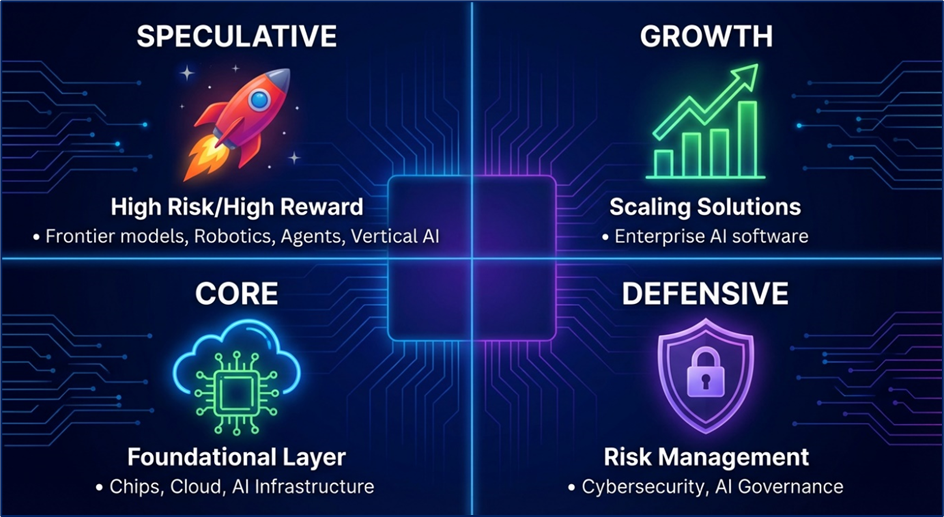
Source: Kalkine Research
Final Takeaway
AI is not a technology trend — it’s an economic shift. It will create new monopolies, new national power hierarchies, massive winners, and rapid obsolescence. Penetration is still early, monetization is accelerating, and regulation is tightening. The next 5 years will determine which companies convert AI into cash flow and market power.


 Jun 24, 2026




 Please wait processing your request...