
 AU
AU
 UK
UK
 US
US
 NZ
NZ
 IND
IND

 CA
CA

 Share
Share
 X (Formerly Twitter)
 Whatsapp
 Facebook
 LinkedIn
 Telegram
 Email This Article
 Copy Link
 Summarize with AI
 Chat GPT
 Perplexity
Key Takeaways (February–March 2026)
- Canadian fintech and commerce technology stocks are gaining renewed investor attention amid improving macro conditions.
• Lightspeed Commerce and Shopify operate in large global digital payments and e-commerce ecosystems.
• Interest rate stabilization and TSX technology sector recovery could act as major catalysts in 2026.
• Both companies show strong long-term growth potential despite short-term volatility.
• Dividend potential remains limited near term as companies prioritize reinvestment and innovation.
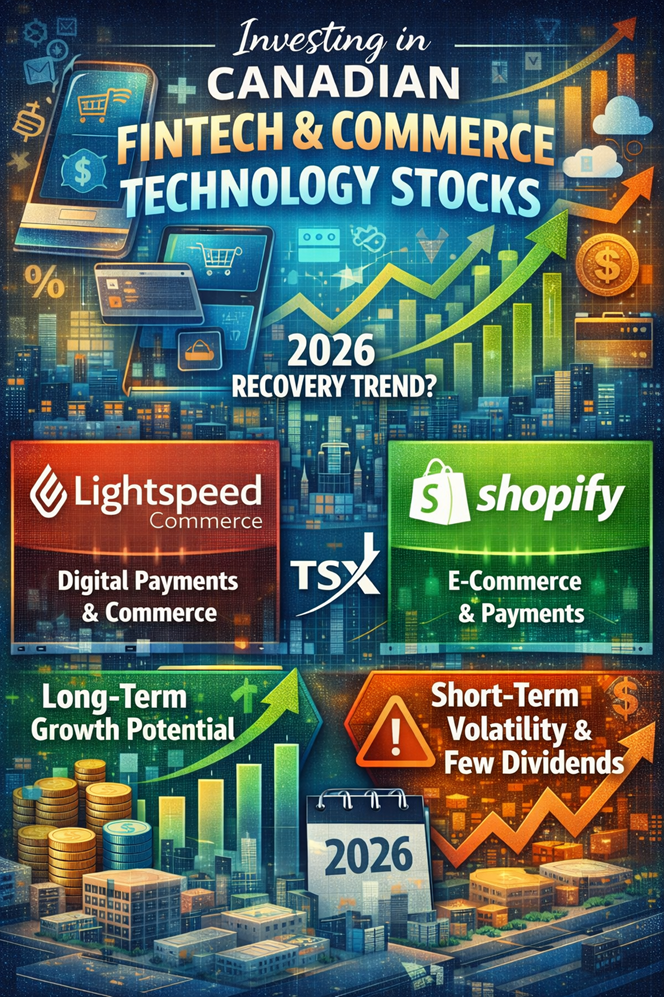
Source: Kalkine Group
Why Are TSX Fintech and Commerce Technology Stocks Trending in March 2026?
TSX fintech stocks, Canadian technology stocks, and global e-commerce platforms are becoming a major investment theme in March 2026 as investors search for high-growth opportunities in a stabilizing interest rate environment. With inflation moderating compared with previous years and expectations that central banks may maintain supportive monetary policies, growth sectors such as fintech, digital payments, and cloud commerce platforms are attracting renewed capital flows. Investors researching the best TSX stocks to buy now, Canadian growth stocks 2026, fintech investment opportunities, and e-commerce trends are increasingly focusing on scalable companies with recurring revenue and international expansion strategies.
The Canadian stock market outlook in early 2026 reflects improving macroeconomic sentiment supported by resilient employment conditions, stabilizing inflation, and expectations that financial conditions may become more favorable compared with the aggressive tightening cycles of 2023–2024. These conditions historically benefit technology and fintech companies, particularly those transitioning toward profitability and stronger cash flow generation.
Globally, fintech and digital commerce remain among the fastest-growing industries due to structural drivers such as online retail expansion, embedded finance adoption, artificial intelligence integration, cross-border payments growth, and financial automation. These megatrends position Canadian fintech leaders for potential multi-year expansion despite near-term volatility.
How Do Global Economic Conditions Influence Fintech and Technology Stocks in 2026?
Key macroeconomic drivers shaping the sector include:
- Expectations of lower borrowing costs improving growth stock valuations
• Continued expansion in global digital commerce and online payments
• Rapid adoption of AI-driven business tools and automation
• Increasing demand for omnichannel commerce solutions
Growth technology companies typically benefit when capital costs decline and consumer activity stabilizes, both of which appear to be emerging trends in 2026.
What Does the Canada Economy and TSX Composite Outlook Suggest for Investors?
Canada’s economy entering 2026 shows signs of stabilization following earlier monetary tightening cycles.
Important indicators include:
- Moderate GDP growth trajectory
• Inflation trending toward central bank targets
• Labour market resilience supporting consumer demand
• Housing market stabilization
The TSX Composite Index has been supported mainly by financial and energy sectors, but technology stocks are beginning to recover as investor sentiment toward growth improves. Historically, Canadian technology equities tend to rebound strongly when interest rate expectations shift toward easing.
The Canadian dollar outlook remains linked to commodity prices and interest rate differentials with the United States. Currency stability generally supports investor confidence and foreign capital inflows into Canadian equities.
Which TSX Fintech and Commerce Stocks Stand Out for March 2026?
Lightspeed Commerce — Integrated Commerce and Payments Platform
Why Is Lightspeed Positioned as a Long-Term Fintech Growth Opportunity?
Lightspeed provides cloud-based commerce solutions integrating point-of-sale software, payments processing, and analytics tools for retailers and hospitality businesses globally.
Key growth drivers include:
- Recurring subscription revenue combined with fintech payments income
• Expansion across North America, Europe, and Asia markets
• Increasing adoption of integrated payments solutions
• Focus on margin improvement and profitability
Recent company updates highlight ongoing cost optimization initiatives and improving financial performance metrics (company financial releases).
Shopify — Global E-Commerce and Fintech Ecosystem Leader
How Is Shopify Expanding Beyond E-Commerce Into Fintech?
Shopify has evolved into a comprehensive commerce ecosystem offering merchants tools for online stores, payments processing, logistics integration, and financial services.
Its fintech and technology growth pillars include:
- Shopify Payments and merchant financial services
• AI-powered commerce tools and automation
• Global merchant expansion across multiple regions
• Subscription and transaction-based revenue streams
Company updates indicate continued growth in merchant adoption and ecosystem expansion supported by innovation investments (company filings and earnings releases).
How Do These Companies Compare With Industry Peers?
Compared with global technology and fintech peers:
- Shopify operates at larger scale with strong global brand recognition
• Lightspeed focuses on specialized retail and hospitality segments
• Both companies operate in large addressable markets with scalable technology platforms
Valuations remain sensitive to macroeconomic conditions and investor sentiment toward growth sectors.
What Is the Sector Outlook Across Short, Medium, and Long Term?
Short-Term Outlook (3–6 Months)
- Market volatility driven by macro uncertainty
• Earnings announcements acting as key catalysts
• Interest rate expectations influencing valuation multiples
Medium-Term Outlook (6–18 Months)
- Profitability improvements becoming clearer
• Continued adoption of digital payments and commerce tools
• Institutional investor re-engagement with technology stocks
Long-Term Outlook (3–5 Years)
- Structural expansion of global digital commerce
• Increasing fintech penetration across industries
• Potential ecosystem consolidation and innovation
What Forward-Looking Strategies Could Investors Consider Across Time Horizons?
Short-Term Perspective
- Monitor earnings momentum and guidance updates
• Track macroeconomic policy signals
• Observe technical trend confirmations
Medium-Term Perspective
- Evaluate margin improvement trajectories
• Assess customer acquisition metrics
• Diversify exposure across fintech and technology sectors
Long-Term Perspective
- Focus on secular digital transformation megatrends
• Consider gradual allocation strategies during volatility
• Monitor competitive positioning and innovation pipelines
Are These Stocks Bullish, Bearish, or Neutral Right Now?
Lightspeed Outlook
- Short term: Neutral due to profitability transition
• Long term: Bullish if execution remains strong
Shopify Outlook
- Short term: Moderately bullish due to strong growth momentum
• Long term: Bullish driven by global commerce ecosystem leadership
These perspectives are based on structural industry trends rather than price forecasts.
What Are the Key Catalysts Driving Recent Momentum?
Major drivers influencing both companies include:
- Interest rate outlook changes
• Earnings performance relative to expectations
• Margin expansion initiatives
• Institutional investor flows into technology stocks
• Growth in global e-commerce and digital payments
What Bull and Bear Scenarios Could Shape Performance?
Bull Scenario
- Strong revenue growth and merchant adoption
• Margin expansion and profitability milestones
• Favorable macroeconomic environment
• Increased fintech sector valuations
Base Scenario
- Moderate growth with steady execution
• Stable economic environment
• Gradual financial improvement
Bear Scenario
- Economic slowdown reducing merchant activity
• Competitive pressures from global technology firms
• Delays in profitability targets
• Regulatory challenges
What Do Analysts Forecast for These Stocks?
Shopify Consensus Estimates
- Analyst targets generally in higher CAD ranges reflecting strong growth expectations
• Ratings typically range from neutral to outperform depending on valuation assumptions
Lightspeed Consensus Estimates
- Analyst targets typically in the low-to-mid CAD 20 range
• Sentiment tied to profitability execution and growth trajectory
(Consensus compiled from broker research including RBC, TD Securities, BMO, National Bank, and Scotiabank reports)
What Risks Should Investors Monitor?
- Macroeconomic slowdown impacting consumer spending
• Competition from large global technology companies
• Execution risks and profitability challenges
• Currency fluctuations affecting international revenue
• Regulatory changes in financial technology markets
Could These Companies Offer Dividends in the Future?
Both companies currently prioritize reinvestment into growth initiatives rather than dividends. Dividend potential could emerge if:
- Free cash flow becomes consistently strong
• Profitability stabilizes
• Capital allocation priorities evolve toward shareholder returns
This scenario is more likely over a longer time horizon.
Frequently Asked Questions (FAQ)
What are the best Canadian fintech stocks in 2026?
Lightspeed and Shopify are widely discussed due to strong growth potential and global expansion strategies.
Are fintech stocks risky investments?
Fintech stocks can be volatile but may offer higher long-term growth potential compared with traditional sectors.
Do fintech companies pay dividends?
Most fintech companies reinvest profits into expansion during early growth stages.
Is the TSX good for technology investing?
The TSX includes several innovative companies with global reach despite having fewer tech firms than U.S. markets.
What Is the Overall Investment Outlook for 2026?
Lightspeed and Shopify represent two compelling fintech and commerce technology narratives within Canada’s equity market — specialized commerce platforms and global e-commerce ecosystems. Both operate in industries supported by powerful structural trends including digital transformation, artificial intelligence adoption, and global online retail expansion.
Short-term volatility may persist due to macroeconomic uncertainty, but long-term industry drivers remain supportive. Investors typically monitor execution performance, profitability milestones, and macro catalysts when evaluating high-growth fintech opportunities.
This content is informational and intended for market analysis purposes only, not financial advice.


 Jun 24, 2026




 Please wait processing your request...