
 AU
AU
 UK
UK
 US
US
 NZ
NZ
 IND
IND

 CA
CA

 Share
Share
 X (Formerly Twitter)
 Whatsapp
 Facebook
 LinkedIn
 Telegram
 Email This Article
 Copy Link
 Summarize with AI
 Chat GPT
 Perplexity
_02_05_2026_14_45_07_063044.jpg)
Is Constellation Software’s disciplined acquisition strategy the real engine behind its market-beating returns—and can it keep compounding shareholder value in an uncertain global macro environment?
Key Takeaways (Latest Update: February 2026)
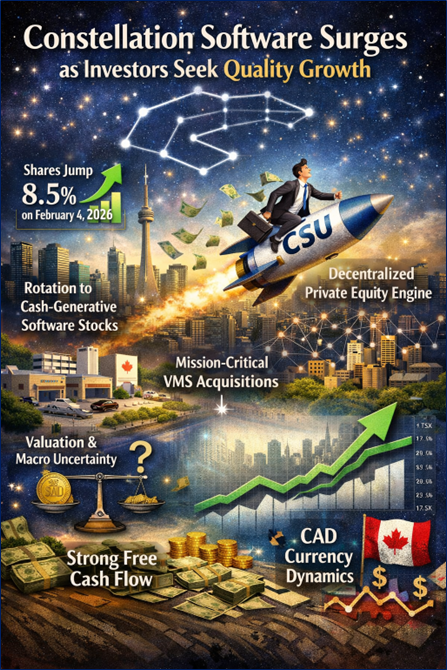
- Constellation Software shares jumped ~8.5% on 4 February 2026, sharply outperforming the TSX Composite Index as investor demand surged for high-quality software compounders
- Canadian equity markets are rotating toward cash-generative, defensive growth software stocks as global interest-rate expectations stabilise
- CSU’s mission-critical vertical market software (VMS) acquisition model continues to deliver resilient margins and strong free cash flow
- Long-term investors increasingly view Constellation Software as a decentralised, permanent-capital private-equity engine rather than a traditional tech stock
- Near-term sentiment remains influenced by valuation sensitivity, macro uncertainty, and CAD currency dynamics
Source: Kalkine Group
Why Is Constellation Software Stock Up 8.5% and Trending Across the TSX, Google Search, and Global Markets?
Search interest in Constellation Software stock, CSU share price, Canadian software stocks today, and vertical market software companies has surged following the sharp rally on 4 February 2026.
The move reflects renewed global appetite for profitable, high-ROIC software compounders, supported by easing bond-yield volatility and sustained confidence in CSU’s decentralised acquisition-driven business model—widely regarded as one of the most scalable capital allocation frameworks in global software markets.
Crucially, this rally aligns with broader strength across North American quality technology equities, as investors reassess long-duration cash flows under a “higher-for-longer but stable” interest-rate outlook. Companies with strong free cash flow, pricing power, and recession-resilient end markets are being re-rated higher.
How Are Global Market Conditions in 2026 Favouring Software Compounders Like Constellation Software?
Global equity markets in early 2026 are navigating a nuanced macro backdrop: moderating inflation, slower—but resilient—economic growth, and cautious central banks. This has shifted investor preference away from speculative growth toward defensive, cash-generative software businesses.
Key tailwinds include:
- Stabilisation in US and global bond yields, reducing valuation pressure on long-duration equities
- Increased rotation into enterprise software, infrastructure technology, and mission-critical IT
- A re-acceleration in global M&A activity, enhancing the strategic advantage of disciplined acquirers
For Constellation Software, this environment reinforces the appeal of steady, long-term compounding rather than cyclical or hype-driven growth.
What Does the Canadian Economic Outlook and TSX Composite Trend Mean for CSU Stock?
Canada’s economy in February 2026 is characterised by modest but stable growth. While consumer demand has softened, business investment remains selective and balance sheets are generally healthy.
Within the TSX Composite:
- Investors are prioritising earnings visibility and free cash flow durability
- Defensive leaders across financials, infrastructure, and software are gaining prominence
- Volatility has increased for cyclical and highly leveraged sectors
Constellation Software fits squarely into this preference set, functioning more like a non-cyclical capital allocator than a conventional technology company.
How Is the Canadian Dollar Affecting Constellation Software Valuation in 2026?
The Canadian dollar (CAD) has remained broadly range-bound against the US dollar, creating a neutral-to-supportive backdrop for globally diversified Canadian firms.
Key implications:
- Reduced earnings translation risk
- Enhanced resilience from international revenue exposure
- Ongoing flexibility in capital deployment across geographies
For Constellation Software, currency movements are not a primary performance driver—but they contribute to overall earnings stability.
What Makes Constellation Software’s Business Model So Different From Other Software Companies?
Constellation Software operates a highly decentralised, acquisition-driven vertical market software model, focused on niche, mission-critical businesses with sticky customers and recurring revenues.
Core pillars of the model:
- Acquiring small, profitable VMS businesses at disciplined return thresholds
- Preserving management autonomy post-acquisition
- Funding growth largely through internally generated cash flow, avoiding dilution
- Prioritising return on invested capital (ROIC) over headline revenue growth
This structure has enabled CSU to compound value over decades—not quarters.
What Recent Financial and Capital Allocation Signals Are Supporting the Stock’s Momentum?
Recent disclosures and market commentary continue to reinforce confidence in Constellation Software’s operating discipline:
- Consistent acquisition cadence funded primarily by internal cash flows
- Stable operating margins despite inflationary pressures
- A conservative leverage profile, preserving strategic optionality
- Continued emphasis on reinvestment over dividends, aligning with long-term compounding
These factors position CSU as a capital allocator first and software operator second—a key reason for its sustained premium valuation.
How Does Constellation Software Compare With Global Software and Compounder Peers?
Relative benchmarking highlights CSU’s differentiation:
- Versus traditional SaaS peers: confirmation over hype, durability over speed
- Versus private-equity roll-ups: permanent capital and decentralised culture
- Versus Canadian tech peers: greater global diversification and operating maturity
This unique positioning often justifies a structural valuation premium, even if short-term volatility persists.
Is Constellation Software Stock Bullish or Bearish in 2026?
- Short term: Constructively bullish, supported by momentum, macro rotation, and earnings confidence—though valuation sensitivity remains
- Long term: Structurally bullish, underpinned by capital discipline, recurring revenue, and a proven compounding engine
This is an analytical interpretation, not investment advice.
Investor Strategy Considerations Across Different Time Horizons
- Short term (3–6 months): Monitor momentum sustainability, macro data, and earnings cadence while managing valuation risk
- Medium term: Focus on acquisition execution, free cash flow growth, and ROIC discipline
- Long term: Prioritise business model durability, decentralised culture, and reinvestment runway
Each horizon carries distinct risk-reward dynamics depending on market conditions.
Bull vs Bear Scenario Framework for Constellation Software in 2026
Bull Case
- Continued high-ROIC acquisitions
- Stable interest-rate environment
- Growing investor preference for compounders
Base Case
- Steady long-term compounding with episodic volatility
Bear Case
- Valuation compression amid rate volatility
- Slower acquisition pipeline
- Capital allocation missteps
What Are Analysts Saying About Constellation Software Stock?
Recent analyst commentary remains constructive but valuation-aware:
- Most major brokers maintain Buy or Outperform-leaning ratings
- Consensus price expectations cluster above current levels, reflecting long-term compounding assumptions
- Analysts focus on ROIC sustainability, not short-term EPS acceleration
Key Risks Investors Should Monitor Closely
- Interest-rate volatility impacting valuation multiples
- Acquisition execution and integration discipline
- Management succession within a decentralised structure
- Currency fluctuations and global macro shocks
Final Investment Perspective on Constellation Software (February 2026)
Constellation Software remains one of the most structurally unique and analytically compelling businesses on the TSX. While short-term price surges—like the 8.5% move on 4 February 2026—grab headlines, the deeper investment case continues to rest on capital allocation excellence, decentralisation, and long-term durability.
For investors focused on compounding rather than speculation, Constellation Software continues to stand apart.
This content is informational and analytical only and does not constitute personal investment advice.


 Jun 29, 2026




 Please wait processing your request...