
 AU
AU
 UK
UK
 US
US
 NZ
NZ
 IND
IND

 CA
CA

 Share
Share
 X (Formerly Twitter)
 Whatsapp
 Facebook
 LinkedIn
 Telegram
 Email This Article
 Copy Link
 Summarize with AI
 Chat GPT
 Perplexity
Executive Summary: The Pulse Check
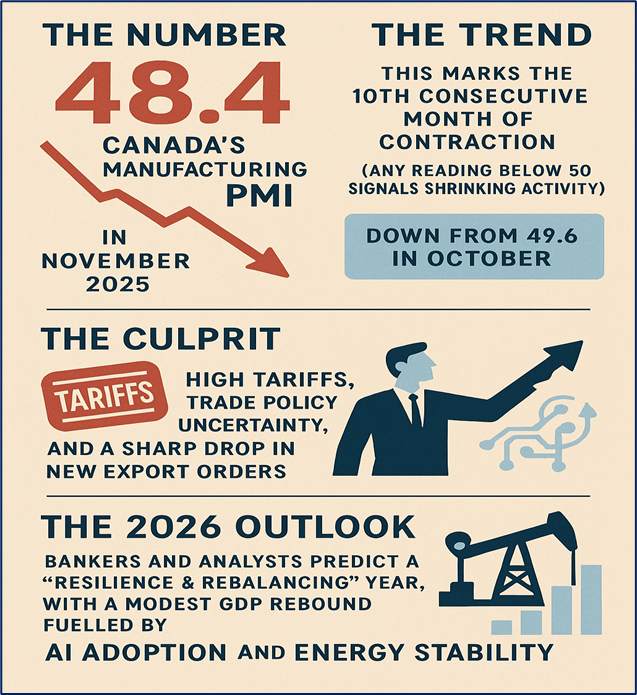
- The Number: Canada’s Manufacturing PMI fell to 48.4 in November 2025 (down from 49.6 in October).
- The Trend: This marks the 10th consecutive month of contraction (any reading below 50 signals shrinking activity).
- The Culprit: High tariffs, trade policy uncertainty, and a sharp drop in new export orders.
- The 2026 Outlook: Bankers and analysts predict a "Resilience & Rebalancing" year, with a modest GDP rebound fuelled by AI adoption and energy stability.
Source: Kalkine Group
The Data: A Tenth Month of Chill
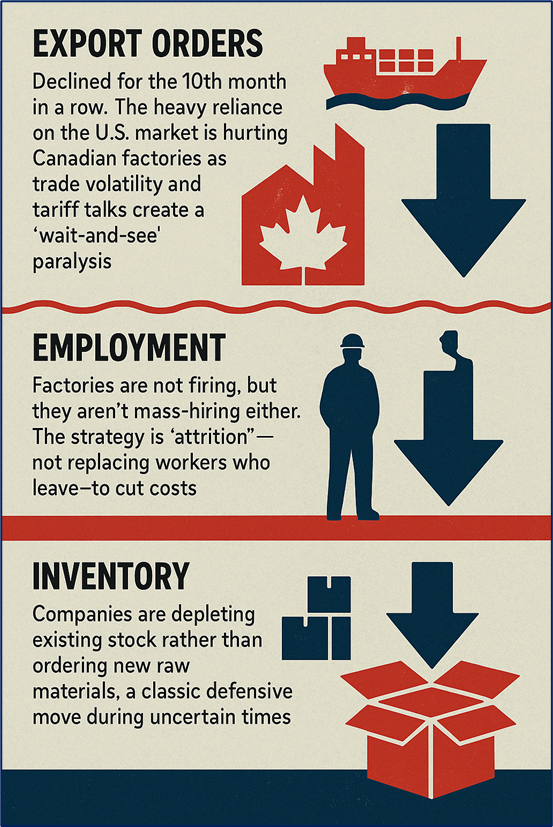
The latest data released on December 1, 2025, by S&P Global paints a picture of a sector in hibernation. Canadian manufacturers are pumping the brakes as output and new orders slid at a steeper rate than last month.
Source: Kalkine Group
Sector Deep Dive: Winners, Losers & The "Hold Outs"
- General Manufacturing & Exports (Struggling)
- Status: Contraction
- Analysis: Makers of consumer goods and intermediate parts are feeling the pinch of reduced purchasing power and tariff barriers.
- Trend: Supply chains are loosening, but only because demand is low. Costs are stabilizing, which is the silver lining for inflation watchers.
- Energy Services (Stable)
- Status: Flat / Stable
- Analysis: According to the fresh CAOEC 2026 Forecast, the Canadian energy sector is holding its ground. Drilling rig activity is projected to rise slightly (+2.9%) in 2026.
- Trend: While not a "boom," the stability here provides a floor for the broader economy. The sector is focusing on efficiency and maintaining headcount rather than aggressive expansion.
- Tech & Automation (Growing)
- Status: Expansion
- Analysis: To combat labor shortages and high costs, manufacturers are aggressively adopting "Agentic AI" (AI that can take independent action) and smart automation.
- Trend: This is the highest growth area in terms of capital expenditure (Capex) commitments for 2026.
Banker Opinion: The 2026 "Rebound" Thesis
- The Consensus: Leading economists (S&P Global Ratings, BDC) do not see a recession, but rather a "soft patch."
- GDP Outlook: Real GDP growth is forecast to improve to ~1.4% - 1.9% in 2026.
- The Caveat: This growth is conditional on trade tensions de-escalating by mid-2026.
- The Strategy: Analysts at major firms suggest a theme of "Resilience". The "easy money" era is over; 2026 will reward companies with strong balance sheets that can self-fund their own modernization.
Banker Quote: "We are not in a recession, but we are working below capacity. The shift to skilled technical roles and AI is undeniable." — General consensus from BDC & Industry Reports.
Watchlist: Stocks & Themes for 2026
This list identifies companies and sectors well-positioned for the trends identified above. This is for informational research only.
Theme 1: The Automation Adopters
- Why watch? Companies providing the "picks and shovels" for the factory automation trend.
- Stocks to Monitor:
- ATS Corp (TSX: ATS): A major player in automation solutions. As factories automate to survive the labor crunch, ATS order backlogs are a key metric to watch.
- Kinaxis (TSX: KXS): Supply chain management software. Volatility in trade requires better software to manage logistics.
Theme 2: Energy Stability
- Why watch? The CAOEC forecast predicts stable drilling days. Service companies benefit directly from this "maintenance mode" activity.
- Stocks to Monitor:
- Precision Drilling (TSX: PD): Highly correlated to the rig count forecasts.
- Suncor Energy (TSX: SU): Integrated model offers resilience against commodity price swings.
Theme 3: Logistics & Infrastructure
- Why watch? Even if manufacturing is slow, the movement of goods remains essential, and these stocks often bottom out before the actual economy recovers.
- Stocks to Monitor:
- CN Rail (TSX: CNR) / CPKC (TSX: CP): Watch their weekly carload data. A pickup in "intermodal" traffic is often the first signal that manufacturing is turning the corner.
Takeaways for the Retail Investor
- Don't Panic on the Headline: A PMI of 48.4 is weak, but not "collapse" weak. It signals a slow bleed, not a cardiac arrest.
- Watch the CAD: Weak manufacturing data often leads to a weaker Canadian Dollar. If you hold US assets, this acts as a natural hedge.
- The Pivot Point: Keep an eye on the New Export Orders sub-index in next month's report. The moment this crosses back above 50, the sector has likely bottomed.
Conclusion
Canada's manufacturing sector is ending 2025 with a limp, burdened by trade uncertainty. However, the roadmap for 2026 suggests a recovery driven not by a sudden boom in demand, but by efficiency, AI adoption, and a stable energy sector. The smart money is watching the companies that help other companies become more efficient.


 Jun 24, 2026




 Please wait processing your request...