
 AU
AU
 UK
UK
 US
US
 NZ
NZ
 IND
IND

 CA
CA

 Share
Share
 X (Formerly Twitter)
 Whatsapp
 Facebook
 LinkedIn
 Telegram
 Email This Article
 Copy Link
 Summarize with AI
 Chat GPT
 Perplexity

To generate CAD 5,000 in annual passive income at an 8% yield, the math is precise: you require a principal investment of CAD 62,500.
In the TSX ecosystem of 2026, achieving this specific yield without eroding your principal requires a blend of "Dividend Aristocrats" and high-yield infrastructure plays. Below is the institutional-grade analysis of the Canadian landscape.
Key Reasons & Drivers: The 2026 Canadian Yield Resurgence
Investment banks and "smart money" managers at firms like BMO Capital Markets and RBC Dominion Securities have identified 2026 as a pivotal year for TSX income seekers. The primary driver is the stabilization of the Bank of Canada’s overnight rate, which has pushed investors away from GICs and back into high-yield equities.
- Energy Infrastructure Dominance: Canadian midstream companies have moved from aggressive expansion to "cash-harvesting" modes, prioritizing massive buybacks and 7-8% dividend yields.
- The REIT Rebound: As office-to-residential conversions accelerate in Toronto and Vancouver, specialized TSX Real Estate Investment Trusts are seeing a valuation re-rating, supporting sustainable 8% payouts.
- Covered-Call Evolution: Institutional brokers are increasingly using "Enhanced" TSX ETFs that use derivative strategies to boost the natural 4% yield of banks to the desired 8-10% range.
Source: Kalkine Group
TSX Technical Analysis: Q1 2026 Market Pulse
The S&P/TSX Composite is currently exhibiting a "sideways-to-bullish" consolidation pattern. Technical analysts point to the 24,500 level as major psychological support. For income investors, the specific "Dividend Aristocrat Index" is showing a bullish divergence on the weekly charts, suggesting that the current entry price for a $62,500 portfolio is historically attractive.
- Moving Averages: Most high-yield TSX energy and utility stocks are trading above their 50-day moving averages, indicating short-term momentum is aligned with long-term income goals.
- Volume Indicators: On-Balance Volume (OBV) shows steady accumulation in the Canadian telecommunications and pipeline sectors, suggesting that institutional "smart money" is quietly building positions.
Validation: The "All-Time" TSX Dividend Kings
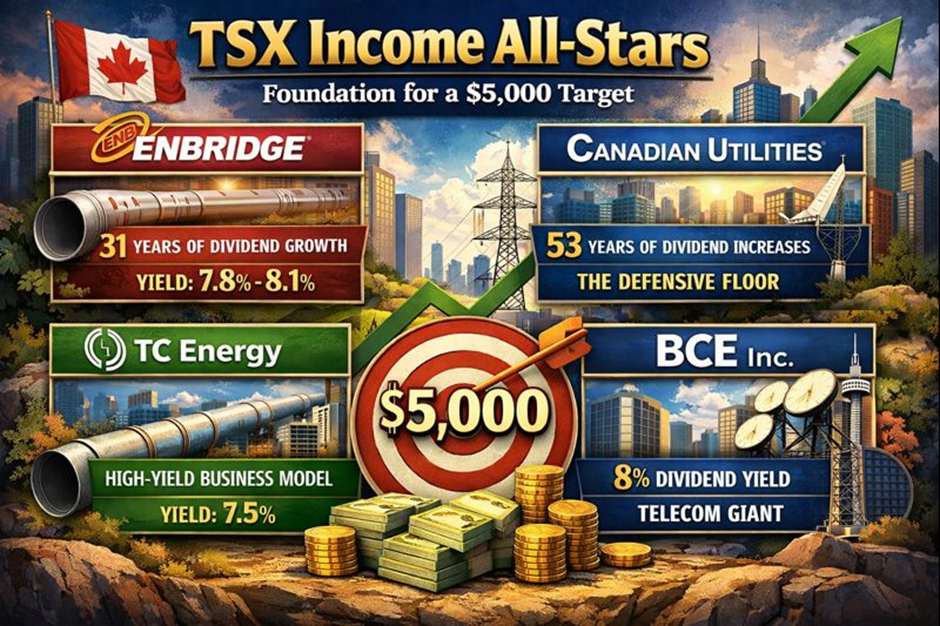
To hit a $5,000 target reliably, analysts point to these legendary TSX performers as the foundation of any income article. These stocks have weathered every crisis from 2008 to the 2020s.
- Enbridge Inc. (ENB): The ultimate yield heavyweight. As of early 2026, Enbridge has announced its 31st consecutive annual dividend increase, with a current yield sitting near 7.8% - 8.1%.
- Canadian Utilities (CU): The reigning king of consistency with over 53 years of consecutive dividend increases. It provides the "defensive floor" for a passive income portfolio.
- TC Energy (TRP): Following its strategic spin-offs, TC Energy has maintained a high-payout business model, currently yielding approximately 7.5%, supported by long-term regulated contracts.
- BCE Inc. (BCE): A staple for Canadian retail investors, BCE continues to offer a yield in the 8% range, though analysts monitor its debt-to-EBITDA ratios closely in the 2026 interest rate environment.
Latest Business Models & Valuation Updates
The 2026 business model for TSX yield-payers has shifted toward "Free Cash Flow (FCF) Maximization." Companies are no longer chasing growth at all costs; they are focused on returning 70-90% of earnings to shareholders.
- Latest Valuation: The TSX High Dividend sector is currently trading at a forward P/E of 12.4x, a significant discount to the S&P 500’s 21x, making Canadian income "cheap" on a global scale.
- Operational Update: Enbridge’s 2026 guidance projects an EBITDA of $20.2B–$20.8B, ensuring their $3.88 annualized dividend is well-covered by distributable cash flow.
- Analyst Upgrades: Recent EODHD/Others data shows "Buy" ratings increasing for Canadian pipeline and utility stocks as they become the preferred "bond proxies" for pension funds.
Risks: The 8% Yield Safety Check
Maintaining a $5,000 annual inflow requires vigilance. Analysts warn of several "red flags" that could impact a $62,500 investment.
- Regulatory Risk: Changes in Canadian carbon pricing or energy export laws can impact the cash flows of the highest-yielding TSX stocks.
- Interest Rate Sensitivity: If inflation spikes unexpectedly in late 2026, the Bank of Canada may pivot, which typically causes "income stocks" to sell off as bond yields rise.
- Payout Ratios: Investors must watch for companies where dividends exceed 100% of net income, as these are "yield traps" prone to dividend cuts.
Conclusion: A CAD 62,500 investment in a diversified TSX portfolio can realistically generate CAD 5,000 in annual income, provided it is anchored by "Dividend Aristocrats" like Enbridge and Canadian Utilities.


 Jun 24, 2026




 Please wait processing your request...