
 AU
AU
 UK
UK
 US
US
 NZ
NZ
 IND
IND

 CA
CA

 Share
Share
 X (Formerly Twitter)
 Whatsapp
 Facebook
 LinkedIn
 Telegram
 Email This Article
 Copy Link
 Summarize with AI
 Chat GPT
 Perplexity
With interest rate trends evolving, Royal Bank of Canada stock could offer both income and growth opportunities.
Key Takeaways — February 2026
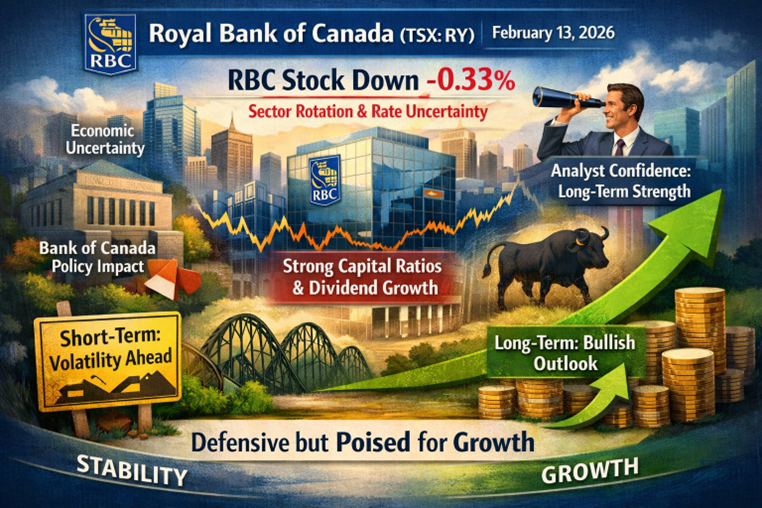
- Royal Bank of Canada (TSX: RY) stock slipped approximately -0.33% on 13 February 2026, mainly due to macroeconomic sentiment shifts, sector rotation, and interest-rate uncertainty rather than company-specific weakness.
- Canadian banking stocks remain highly sensitive to Bank of Canada policy expectations, housing market trends, and global economic outlook.
- RBC continues to deliver strong capital ratios, diversified earnings, and reliable dividend growth, reinforcing its defensive investment appeal (Company filings, latest results).
- Analysts remain broadly constructive on long-term fundamentals due to RBC’s market leadership, wealth management expansion, and capital markets strength.
- Short-term outlook appears neutral with volatility, while medium-to-long-term trajectory remains structurally bullish driven by earnings compounding and dividend reinvestment potential.
Source: Kalkine Group
Why Did Royal Bank of Canada Stock Decline on 13 February 2026?
Royal Bank of Canada stock analysis, TSX bank stocks outlook, Canadian banking sector trends, dividend stocks Canada, RBC share price forecast, TSX Composite performance, Canadian economy February 2026 outlook, Bank of Canada interest rates, global financial sector trends, and passive income investing strategies are among the most searched financial keywords currently influencing investor attention. The modest decline of roughly -0.33% on 13 February 2026 appears primarily driven by macro-level sentiment adjustments, including profit-taking after prior gains, shifting expectations around interest-rate cuts, and short-term sector rotation within the Canadian equity market.
Investors closely track RBC because it represents the largest Canadian bank by market capitalization and one of the most widely held dividend stocks in North America, forming a core holding in ETFs, pension funds, institutional portfolios, and long-term retail investment strategies. Movements in the broader S&P/TSX Composite Index also influence RBC shares because financials carry significant weight within the index.
Another contributing factor is uncertainty surrounding the timing and magnitude of potential monetary easing by the Bank of Canada in 2026, which creates mixed implications for bank profitability. Lower rates can stimulate credit demand but may compress net interest margins temporarily, often leading to cautious investor positioning during transition periods.
How Are Global Economic Trends and Financial Markets Impacting Canadian Banks?
Global macroeconomic conditions entering 2026 are defined by:
- Anticipation of interest-rate cuts across developed economies
- Moderating inflation trends after tightening cycles
- Persistent geopolitical uncertainty influencing capital flows
- Stable but slower global growth expectations
Banks tend to experience valuation volatility during monetary policy transitions because earnings sensitivity to interest rates is significant. This environment often produces consolidation phases in high-quality banking stocks, which appears consistent with RBC’s recent movement.
What Does the Current Canadian Economic Environment Mean for RBC?
Canada’s economy is showing moderate resilience with selective pressure points, including housing affordability concerns and elevated consumer leverage levels. Key themes include:
- Inflation stabilizing closer to central bank targets
- Labour market remaining relatively strong
- Housing market normalization following rate hikes
- Consumer spending slowing but not collapsing
For Royal Bank of Canada, these dynamics matter because personal banking and mortgages represent major revenue sources. However, RBC’s diversified structure — including capital markets and global wealth management — provides meaningful earnings stability compared with smaller or less diversified financial institutions.
How Are the Canadian Dollar and TSX Market Trends Influencing Investor Sentiment?
Currency fluctuations influence financial stocks indirectly:
- A weaker Canadian dollar may reflect economic caution but support exporters
- A stronger dollar signals confidence but impacts multinational earnings translation
Because financial institutions dominate the TSX index, broader market sentiment often drives bank stock performance regardless of company-specific developments.
What Makes Royal Bank of Canada’s Business Model Structurally Strong?
Royal Bank of Canada operates through multiple high-value segments:
- Personal and Commercial Banking
- Wealth Management
- Capital Markets
- Insurance
- Investor and Treasury Services
Recent company disclosures highlighted:
- Strong regulatory capital buffers with CET1 ratios above requirements
- Stable loan and deposit growth
- Continued wealth management expansion globally
- Consistent profitability across business cycles
Diversification across geographies and revenue streams reduces earnings volatility and enhances long-term resilience.
What Is the Future Dividend Outlook for RBC Investors?
Dividend sustainability remains one of RBC’s strongest investment attributes due to:
- Long history of uninterrupted dividend payments
- Strong earnings coverage
- Conservative payout ratios
- Regulatory capital strength
Canadian banks are globally recognized as high-quality dividend growth investments, and RBC remains a leading example of income stability combined with capital appreciation potential.
How Does RBC Compare Against Other Canadian Banking Giants?
Compared with major peers:
- Toronto-Dominion Bank
- Bank of Nova Scotia
- Bank of Montreal
- Canadian Imperial Bank of Commerce
RBC typically demonstrates:
- Higher return on equity
- Greater scale advantages
- Stronger wealth management platform
- More diversified earnings streams
These advantages often justify its valuation premium relative to peers.
What Are the Sector and Stock Outlooks Across Short, Medium, and Long Time Horizons?
Short-term outlook:
- Interest-rate uncertainty
- Market volatility
- Earnings digestion after strong periods
Medium-term outlook:
- Loan growth recovery potential
- Wealth management expansion
- Capital markets normalization
Long-term outlook:
- Canadian banking oligopoly stability
- Immigration-driven population growth
- Digital banking transformation
- Dividend compounding and reinvestment
Is Royal Bank of Canada Stock Bullish, Bearish, or Neutral Right Now?
Short-term sentiment appears neutral due to macro uncertainty and policy transitions.
Long-term sentiment remains bullish based on:
- Market leadership position
- Diversified revenue model
- Strong capital ratios
- Dividend growth track record
- Structural advantages within Canadian banking system
What Forward-Looking Strategies Could Investors Consider Across Time Horizons?
Short-term horizon:
- Monitor interest-rate signals and macroeconomic data
- Observe earnings momentum and credit trends
- Watch volatility for potential entry opportunities
Medium-term horizon:
- Focus on dividend reinvestment potential
- Evaluate valuation relative to historical averages
- Track economic recovery indicators
Long-term horizon:
- Benefit from compounding through dividends and earnings growth
- Leverage defensive characteristics of large banks
- Participate in structural financial sector growth
These perspectives depend on individual financial goals and risk tolerance.
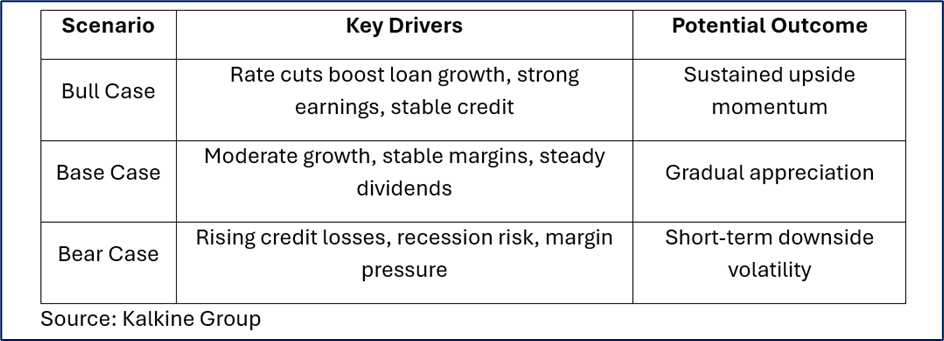
What Could Happen Under Bull and Bear Scenarios?
What Are Analysts Forecasting for RBC Stock?
Major financial institutions maintain generally positive views with expectations of moderate upside supported by dividend yield and earnings stability.
Recent analyst sentiment examples include:
- RBC Capital Markets — Outperform
- TD Securities — Buy
- Scotiabank Global Research — Sector Outperform
- BMO Capital Markets — Outperform
- CIBC Capital Markets — Neutral to Positive
(Broker research reports, latest available)
What Key Risks Should Investors Monitor?
- Economic slowdown or recession
- Housing market stress
- Rising credit losses
- Regulatory changes
- Interest-rate volatility
- Capital markets instability
FAQ Schema
Why did RBC stock fall recently?
Primarily macroeconomic sentiment and sector rotation rather than company-specific issues.
Is RBC dividend safe?
Capital strength and earnings coverage support sustainability.
Is RBC a long-term investment candidate?
Historically considered strong due to leadership and dividend growth.
How do interest rates affect RBC?
Rates influence margins, loan demand, and valuation multiples.
What differentiates RBC from competitors?
Scale, diversification, and global wealth management operations.
Final Informational Perspective — No Investment Advice
Royal Bank of Canada remains one of the most systemically important financial institutions globally, with strong capital buffers, diversified earnings streams, and a long track record of dividend growth. The small February 2026 decline appears consistent with normal market fluctuations rather than structural deterioration. While short-term volatility may persist due to interest-rate uncertainty and macroeconomic conditions, long-term fundamentals remain intact, supporting its reputation as a cornerstone dividend and financial sector holding.


 Jun 24, 2026




 Please wait processing your request...