
 AU
AU
 UK
UK
 US
US
 NZ
NZ
 IND
IND

 CA
CA

 Share
Share
 X (Formerly Twitter)
 Whatsapp
 Facebook
 LinkedIn
 Telegram
 Email This Article
 Copy Link
 Summarize with AI
 Chat GPT
 Perplexity
Views Expressed Disclaimer:
You are reading a free article with opinions that may differ from the recommendation given by Kalkine in its paid research reports. Become a Kalkine member today to get access to our research reports, in-depth technical and fundamental research.
Key Takeaways — Latest February 2026
- Air Canada (TSX: AC) declined about 3% on 23 February 2026 mainly due to oil price fluctuations, macroeconomic uncertainty, and cyclical sector rotation rather than company-specific weakness.
• Canada economic conditions, interest rate expectations, and Canadian dollar volatility are influencing investor sentiment toward airline and travel stocks.
• Travel demand recovery, international route expansion, and operational efficiency improvements remain supportive long-term drivers (company disclosures).
• Balance sheet leverage and fuel cost sensitivity continue to be the biggest near-term investor concerns.
• Analysts remain cautiously optimistic about long-term recovery potential despite ongoing volatility.
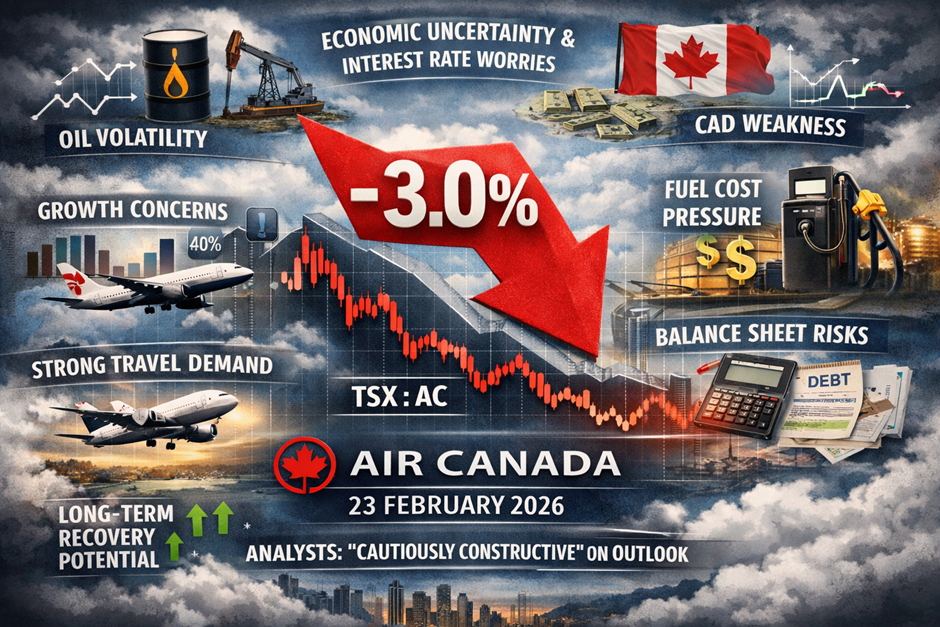
Source: Kalkine Group
Why Is Air Canada (TSX: AC) Stock Falling in February 2026 Despite Strong Travel Recovery Trends?
Air Canada stock, TSX airline stocks, Canada travel recovery stocks, and global aviation sector investments are trending heavily in search engines and financial media during February 2026 as investors evaluate whether cyclical reopening plays still offer upside potential. The approximately 3% decline in Air Canada shares on 23 February reflects a combination of macroeconomic pressures, oil price volatility, interest rate uncertainty, and broader TSX Composite Index weakness rather than deterioration in company fundamentals.
Air Canada remains one of the most widely followed Canadian airline stocks because it provides direct exposure to global travel demand recovery, international tourism growth, and corporate travel normalization. However, airline equities often behave like macro-sensitive assets, meaning external factors such as crude oil prices, GDP growth expectations, and currency movements can significantly influence share prices even when operating performance remains stable.
Search trends including “Is Air Canada stock a buy,” “Air Canada forecast 2026,” and “undervalued TSX stocks Canada” highlight growing investor interest in whether the recent pullback represents a short-term opportunity or signals deeper structural challenges tied to leverage and costs.
How Are Global Market Conditions Influencing Airline Stocks Right Now?
The global airline industry in 2026 continues transitioning from post-pandemic recovery into a normalized growth phase, but several macro forces are shaping investor sentiment:
- Volatile jet fuel and crude oil prices affecting profitability expectations
• Moderating global economic growth creating demand uncertainty
• Persistent inflation impacting operating costs
• Currency movements influencing international revenue conversion
• Interest rate sensitivity due to historically high debt levels across airlines
Because airlines operate with thin margins and high operating leverage, even small macro shifts can drive noticeable stock price volatility.
How Is the Canada Economy Affecting Air Canada’s Share Performance?
Canada’s economic environment in early 2026 presents mixed signals that directly impact airline demand expectations:
- Slowing but still positive GDP growth
• Elevated household debt levels
• Stabilizing housing activity
• Gradually moderating inflation
• Interest rate uncertainty influencing consumer confidence
Airlines depend heavily on discretionary consumer spending and corporate travel budgets, so economic outlook changes can influence investor expectations before actual demand declines occur.
What Role Does the TSX Composite Index Play in Air Canada’s Movement?
The TSX Composite has experienced rotational dynamics in February 2026, with capital flowing toward defensive and commodity sectors such as energy, materials, and utilities.
Cyclical sectors like travel, leisure, and transportation often underperform during periods of market uncertainty, which helps explain Air Canada’s recent share price weakness.
This suggests the decline is largely sentiment-driven rather than operationally driven.
How Does the Canadian Dollar Impact Air Canada’s Profitability?
Currency fluctuations are particularly important for airline economics:
- A weaker Canadian dollar increases fuel, maintenance, and leasing costs denominated in U.S. dollars
• International ticket revenue can benefit from foreign currency conversion
• Exchange rate volatility increases earnings uncertainty for investors
Recent CAD volatility has contributed to cautious investor positioning.
What Are Air Canada’s Latest Business Fundamentals and Strategic Drivers?
Air Canada operates a diversified aviation ecosystem including:
- Passenger transportation across domestic, U.S., and international routes
• Cargo operations supporting logistics demand
• Aeroplan loyalty program monetization
• Premium cabin and long-haul route growth strategies
Recent company disclosures highlight:
- Capacity growth approaching full recovery levels
• Strong passenger load factors on key international routes
• Ongoing debt reduction initiatives to strengthen the balance sheet (company filings)
• Fleet modernization improving fuel efficiency and operating costs (company reports)
The company continues prioritizing financial stability over dividend reinstatement, reflecting a disciplined capital allocation strategy.
How Does Air Canada Compare With Global Airline Peers?
Compared with North American and international airline competitors, Air Canada shows a balanced profile.
Competitive strengths include:
- Extensive international network reach
• Strong brand recognition in Canada
• Premium service positioning
• Loyalty ecosystem revenue opportunities
Key challenges include:
- Higher leverage compared with some U.S. peers
• Exposure to global economic cycles
• Fuel cost sensitivity
Valuation multiples remain discounted relative to several international peers, reflecting perceived risk but also potential upside.
What Is the Airline Sector Outlook Across Different Time Horizons?
Short-Term Outlook (3–6 Months)
- Continued volatility linked to oil prices and macro sentiment
• Seasonal travel demand fluctuations
• Investor sensitivity to economic data
Medium-Term Outlook (1–2 Years)
- Balance sheet improvement through debt reduction
• International travel normalization supporting revenue growth
• Margin improvement from efficiency initiatives
Long-Term Outlook (3–5 Years)
- Structural growth in global air travel demand
• Fleet modernization benefits
• Loyalty program monetization expansion
• Potential dividend reinstatement once leverage declines
What Strategic Actions Could Investors Consider Across Timeframes?
Short-Term Perspective
- Monitor oil price trends and macro indicators
• Expect higher volatility due to cyclical exposure
• Track quarterly demand and margin updates
Medium-Term Perspective
- Evaluate debt reduction progress
• Observe cost discipline and operational efficiency
• Monitor competitive pricing environment
Long-Term Perspective
- Focus on structural travel demand growth
• Assess long-term earnings power
• Watch for dividend reinstatement catalysts
Is Air Canada Stock Bullish, Bearish, or Neutral Based on Current Conditions?
Short-Term View: Neutral to Bearish
Key reasons include macro uncertainty, fuel cost risks, interest rate sensitivity, and cyclical sector rotation.
Long-Term View: Neutral to Bullish
Key reasons include travel demand growth, operational leverage potential, improving balance sheet trajectory, and discounted valuation compared with long-term earnings potential.
This profile aligns with a recovery-oriented cyclical investment rather than a defensive income stock.
What Drivers Could Trigger a Future Stock Recovery?
- Strong peak travel seasons
• Debt reduction milestones
• Oil price stabilization
• Margin expansion from efficiency programs
• Visibility toward dividend reinstatement
What Risks Should Investors Monitor Closely?
- Fuel price spikes
• Global or Canadian economic slowdown
• Currency volatility
• Competitive pricing pressures
• High leverage levels
What Do Analysts Forecast for Air Canada Stock?
Consensus analyst sentiment remains mixed but moderately constructive based on recovery expectations.
Representative estimates from major financial institutions suggest price target ranges approximately between CAD 25 and CAD 34 depending on assumptions regarding fuel costs, margins, and economic conditions (broker research reports).
What Could Bull and Bear Scenarios Look Like?
Bull Scenario Drivers
- Sustained global travel demand growth
• Stable or declining fuel prices
• Faster-than-expected debt reduction
• Significant margin improvement
• Dividend reinstatement timeline clarity
Bear Scenario Drivers
- Economic slowdown reducing travel demand
• Persistent fuel inflation
• Currency headwinds
• Competitive pricing pressure
• Slower deleveraging progress
Scenario Matrix
Bull Factors | Neutral Factors | Bear Factors
Strong demand | Stable economy | Recession risk
Fuel stability | Moderate growth | Fuel spikes
Debt reduction | Gradual improvement | High leverage
Margin expansion | Flat margins | Margin compression
What Is the Dividend Outlook for Air Canada?
Air Canada suspended dividends during the pandemic period to preserve liquidity.
Dividend reinstatement depends primarily on:
- Achieving debt reduction targets
• Sustainable profitability
• Strong free cash flow generation
• Credit rating improvement
A dividend return remains possible over the long term but is unlikely in the immediate future.
Frequently Asked Questions (FAQ Schema)
Is Air Canada stock undervalued right now?
Valuation appears discounted relative to long-term recovery potential, but risks remain elevated due to macro exposure.
Will Air Canada bring back dividends?
Dividend reinstatement could occur after significant balance sheet improvement and consistent profitability.
Why is Air Canada stock volatile?
Airline stocks are highly sensitive to fuel costs, economic cycles, and travel demand trends.
Is Air Canada a cyclical stock?
Yes, airlines typically perform in line with economic expansion and consumer confidence cycles.
Final Investment Perspective — Informational Only
Air Canada represents a high-beta cyclical recovery stock tied closely to global economic activity, travel demand, and fuel prices. The February 2026 share price decline appears largely driven by macro sentiment and sector rotation rather than a deterioration in the company’s operational outlook.
The long-term investment thesis depends on three major pillars:
- Sustained travel demand recovery
• Balance sheet strengthening
• Margin expansion through efficiency and scale
If these factors evolve positively, the company could benefit from significant operating leverage over time. However, volatility is likely to remain elevated due to the inherently cyclical nature of the airline industry.


 Jun 24, 2026




 Please wait processing your request...