
 AU
AU
 UK
UK
 US
US
 NZ
NZ
 IND
IND

 CA
CA

 Share
Share
 X (Formerly Twitter)
 Whatsapp
 Facebook
 LinkedIn
 Telegram
 Email This Article
 Copy Link
 Summarize with AI
 Chat GPT
 Perplexity
Views Expressed Disclaimer:
You are reading a free article with opinions that may differ from the recommendation given by Kalkine in its paid research reports. Become a Kalkine member today to get access to our research reports, in-depth technical and fundamental research.
West Fraser shares offer exposure to housing and construction demand. Explore valuation, risks, and growth potential before investing.
Key Takeaways — February 2026
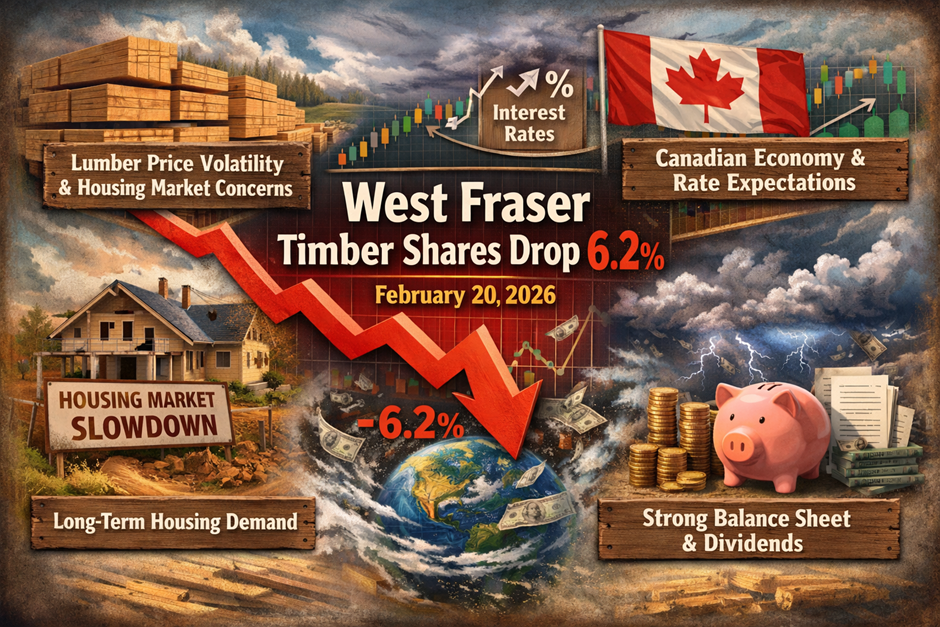
- West Fraser Timber share price fell approximately 6.2% on 20 February 2026 amid cyclical sector weakness and macro uncertainty.
• Lumber price volatility and housing market concerns remain the primary sentiment drivers.
• Canadian economic indicators and interest rate expectations are influencing investor positioning.
• Dividend sustainability remains supported by strong balance sheet flexibility (company disclosures).
• Long-term structural housing demand continues to underpin the broader investment thesis.
Source: Kalkine Group
Why Is West Fraser Timber (TSX: WFG) Stock Down 6.2% Today in February 2026?
West Fraser Timber stock decline, TSX WFG share price fall, Canadian lumber stocks volatility, housing market slowdown concerns, interest rate uncertainty, TSX Composite sector rotation, CAD currency movement, and global economic slowdown fears collectively explain why investors are searching why West Fraser Timber stock is down today. The sharp move lower on 20 February 2026 appears driven primarily by changing expectations around construction demand, commodity pricing cycles, and investor risk appetite toward cyclical materials companies.
Markets in February 2026 remain highly sensitive to macroeconomic signals, especially those tied to interest rates and housing affordability. Because West Fraser Timber operates directly within the wood products and construction supply chain, even small changes in housing outlook expectations can trigger significant share price volatility. Profit-taking activity after previous sector strength may have amplified the decline.
From a digital search trend perspective, high-volume keywords include TSX stocks to buy 2026, Canadian dividend stocks, lumber price forecast 2026, housing market Canada outlook, cyclical stocks recovery, and undervalued TSX opportunities — all of which place West Fraser prominently within investor discussions globally.
How Are Global Market Dynamics Influencing Lumber Stocks in 2026?
Global economic conditions continue to shape demand expectations for building materials and wood products companies.
Important global drivers include:
- Interest rate trajectories in North America and Europe
• Residential housing construction cycles
• Infrastructure spending initiatives
• Supply chain normalisation after pandemic disruptions
• Sustainability trends favouring wood construction
• Commodity price volatility across materials markets
Because lumber demand is economically sensitive, equity markets often price in future expectations rather than current consumption levels.
What Role Is the Canadian Economy Playing in Investor Sentiment?
Canada’s economic environment remains closely tied to housing activity, commodity exports, and monetary policy decisions.
Key influencing factors include:
- Moderating but still elevated borrowing costs
• Slower housing activity compared with peak pandemic levels
• Consumer affordability pressures
• Labour market resilience
• Export-driven industrial sectors
For cyclical companies like West Fraser, economic sentiment can matter as much as actual financial performance in the short term.
How Does the TSX Composite and Sector Rotation Affect the Stock?
The TSX Composite index has experienced sector rotation toward defensive and income-oriented companies as investors manage uncertainty. Materials and cyclical sectors tend to underperform during periods of macro caution, which may partially explain the recent share price movement.
Why Does the Canadian Dollar Matter for West Fraser Timber?
Currency dynamics remain an important earnings variable.
Potential impacts include:
- Weaker CAD improving translated earnings from US revenue
• Stronger CAD reducing competitiveness in export markets
• Currency volatility creating uncertainty in forecasts
Exchange rate movements can therefore influence both financial results and investor sentiment.
What Is West Fraser Timber’s Current Business Model and Strategy?
West Fraser Timber is one of the world’s largest diversified wood products manufacturers, operating across lumber, OSB panels, engineered wood, pulp, and paper segments in North America and Europe.
Strategic strengths include:
- Diversified geographic exposure
• Operational scale and cost efficiency
• Vertical integration across supply chains
• Financial discipline and liquidity strength (company disclosures)
• Flexibility to adjust production during market cycles
The company’s performance remains closely tied to commodity price cycles, which historically creates volatility but also opportunity.
What Is the Latest Dividend Outlook for Investors?
West Fraser maintains a base dividend supported by financial flexibility and cyclical cash flow generation.
Dividend considerations include:
- Commodity price sensitivity of free cash flow
• Conservative payout approach during downturn periods
• Potential upside during favourable lumber cycles
The dividend profile is often viewed as opportunistic rather than purely income-focused.
How Does West Fraser Compare With Industry Peers Globally?
Compared with competitors such as Weyerhaeuser, Canfor, and other global timber producers, West Fraser demonstrates:
- Competitive cost positioning
• Strong balance sheet resilience
• Similar cyclicality exposure
• Diversified product portfolio
Relative valuation often depends on where investors believe the lumber cycle currently sits.
What Are the Short-Term, Medium-Term, and Long-Term Outlooks for the Sector?
Short-term outlook:
- Elevated volatility due to macro uncertainty
• Sensitivity to economic data releases
• Commodity price fluctuations driving sentiment
Medium-term outlook:
- Potential housing demand recovery as rates stabilise
• Infrastructure spending support
• Inventory normalisation across supply chains
Long-term outlook:
- Global housing shortages
• Population growth and urbanisation
• Sustainability advantages of timber construction
• Increasing adoption of engineered wood in construction
What Forward-Looking Strategies Might Investors Consider Across Time Horizons?
Short-term considerations:
- Monitoring macroeconomic data and housing indicators
• Watching lumber price movements
• Evaluating earnings momentum
Medium-term considerations:
- Tracking interest rate trends
• Reviewing valuation relative to historical cycles
• Assessing management capital allocation
Long-term considerations:
- Focusing on structural demand drivers
• Considering cyclical entry opportunities
• Evaluating competitive positioning over full economic cycles
These perspectives are informational frameworks rather than financial advice.
Is West Fraser Timber Stock Bullish, Bearish, or Neutral Right Now?
Short-term sentiment appears:
- Neutral to cautious due to macroeconomic uncertainty
Long-term sentiment may appear:
- Constructive if housing demand improves and commodity prices stabilise
Cyclical stocks frequently experience contrasting short- and long-term outlooks simultaneously.
What Are the Latest Catalysts That Could Move the Share Price?
Potential positive catalysts:
- Housing market stabilisation
• Interest rate easing expectations
• Lumber price recovery
• Shareholder return announcements
• Currency tailwinds
Potential negative catalysts:
- Economic slowdown
• Housing demand weakness
• Commodity price declines
• Policy or trade disruptions
What Do Analysts and Brokers Currently Expect?
Major broker coverage indicates mixed but generally balanced sentiment:
- RBC Capital Markets — Outperform (broker research)
• BMO Capital Markets — Outperform (broker research)
• TD Securities — Hold (broker research)
• Scotiabank — Sector Perform (broker research)
• CIBC — Neutral (broker research)
Consensus price targets imply variability depending on commodity assumptions (Bloomberg consensus).
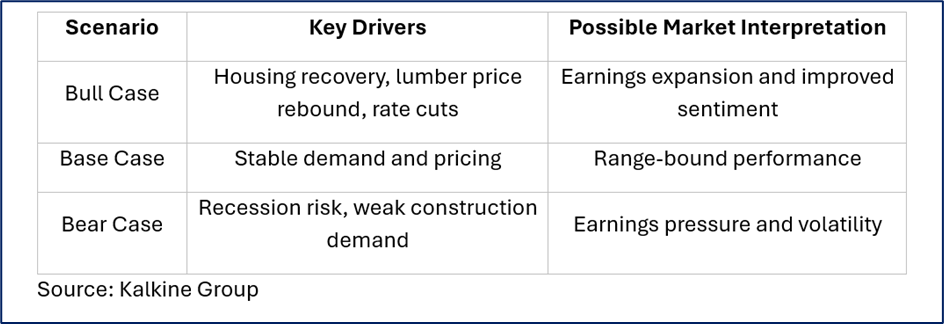
What Does the Bull vs Bear Scenario Analysis Look Like?
What Are the Most Important Risks Investors Should Understand?
- Commodity price cycles
• Housing market downturn
• Interest rate uncertainty
• Currency volatility
• Environmental regulations
• Trade disputes
Cyclicality remains the dominant investment risk factor.
What Questions Are Investors Frequently Asking in 2026?
Is West Fraser Timber cyclical?
Yes, earnings fluctuate with construction demand and lumber prices.
Does currency impact performance?
Yes, US dollar revenue exposure makes CAD movements important.
Is the dividend reliable?
The base dividend is relatively stable but tied to market cycles.
What is the biggest long-term opportunity?
Global housing shortages and sustainable building trends.
What Is the Overall Investment Perspective for 2026 and Beyond?
West Fraser Timber represents a classic cyclical materials company operating at the intersection of housing demand, commodity markets, and macroeconomic conditions. Short-term volatility is common, but long-term structural demand drivers such as population growth, infrastructure spending, and sustainable construction trends may support the broader investment narrative over time.
This content is informational and not investment advice.


 Jun 24, 2026




 Please wait processing your request...