
 AU
AU
 UK
UK
 US
US
 NZ
NZ
 IND
IND

 CA
CA

 Share
Share
 X (Formerly Twitter)
 Whatsapp
 Facebook
 LinkedIn
 Telegram
 Email This Article
 Copy Link
 Summarize with AI
 Chat GPT
 Perplexity
BCE Inc. (TSX: BCE): 2026 Strategic Rebirth and Dividend Sustainability
BCE Inc. has entered 2026 as a reshaped entity, transitioning from a legacy telecommunications provider into a lean, AI-driven infrastructure powerhouse. After a transformative 2025 marked by a significant dividend reset and the landmark acquisition of Ziply Fiber, the company is now demonstrating a renewed focus on free cash flow generation and balance sheet fortification.
As the 6.5% dividend yield catches the eye of income-focused investors, the narrative has shifted from "growth at all costs" to "disciplined capital allocation." With the integration of U.S. assets and a company-wide push toward operational efficiency, BCE is attempting to prove that its "reset" was the necessary catalyst for long-term stability in an increasingly competitive North American landscape.
Latest Drivers and Key Reasons for Recent Surge
Source: Kalkine Group
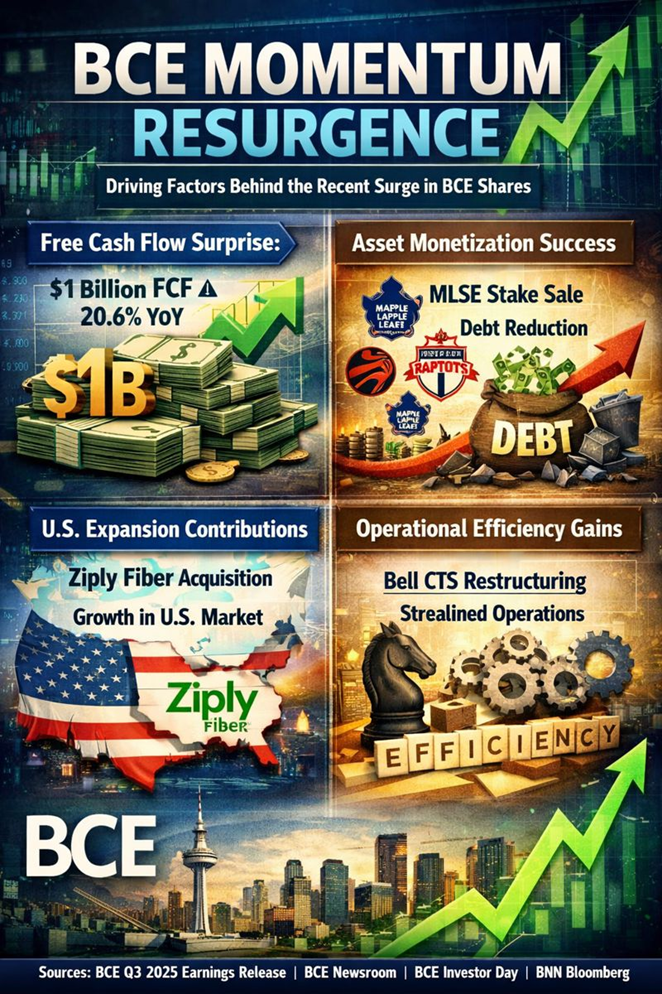
The recent momentum in BCE shares is largely attributed to a stabilization of investor sentiment following the volatility of the previous year. Key drivers include:
- Free Cash Flow Surprise: Recent quarterly results showcased a 20.6% year-over-year jump in free cash flow, reaching $1 billion, which has significantly bolstered confidence in the sustainability of the current dividend policy (BCE Q3 2025 Earnings Release).
- Asset Monetization Success: The successful sale of its minority stake in Maple Leaf Sports and Entertainment (MLSE) provided a massive cash infusion, allowing for immediate debt reduction and a stronger net earnings profile (BCE Newsroom).
- U.S. Expansion Contributions: The acquisition of Ziply Fiber is already contributing to top-line growth, diversifying revenue away from the highly regulated and saturated Canadian market (BCE Investor Day).
- Operational Efficiency Gains: The market is reacting positively to the "Bell CTS" restructuring, which is successfully streamlining the brand portfolio and reducing redundant roles (BNN Bloomberg).
Current Business Model and Operational Updates
BCE’s 2026 business model is anchored by four strategic pillars: putting the customer first, delivering premier fiber/wireless networks, leading in AI-powered enterprise solutions, and scaling digital media.
- Segment Realignment: The company now operates through Bell Communication and Technology Services (Bell CTS), which includes both Canadian and U.S. (Ziply) wireline and wireless operations, and Bell Media.
- Infrastructure Transition: A core component of the model is the aggressive phase-out of legacy copper networks in favor of fiber-to-the-home (FTTH). By reselling salvaged copper and optimizing real estate, BCE aims to extract value while lowering maintenance costs (BCE Investor Day Presentation).
- AI and Enterprise: Through its "Bell AI Fabric" and the "Ateko" service integrator, BCE is targeting high-margin AI automation platforms for Canadian enterprises, moving beyond simple connectivity (BCE 2025 Strategic Plan).
Financial and Dividend Status (Latest Company Sources)
Based on the most recent financial disclosures and the three-year strategic plan released by the company:
- Dividend Policy: Following the May 2025 reset, BCE has committed to a sustainable dividend strategy, anticipating approximately $5 billion in total common share dividend payments between 2025 and 2028 (BCE Press Release, Oct 2024).
- Free Cash Flow Targets: The company is targeting a 15% Compound Annual Growth Rate (CAGR) in free cash flow after lease liabilities through 2028 (BCE Investor Day).
- Revenue and EBITDA: Guidance suggests a revenue CAGR of 2% to 4% and an adjusted EBITDA growth rate of 2% to 3% for the 2025–2028 period (BCE Financial Outlook).
- Cost Savings: Management has doubled its cost-savings target to $1.5 billion by 2028, driven by company-wide digital transformation and workforce optimization (BCE Newsroom).
Latest SWOT Analysis (2026)
Source: Kalkine Group
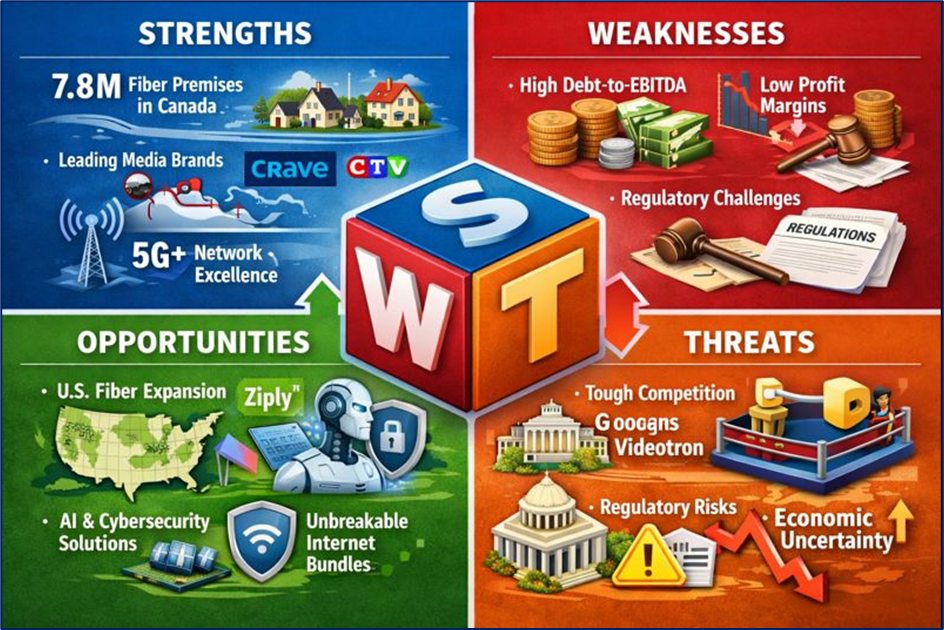
Strengths
- Unrivaled fiber footprint reaching over 7.8 million premises in Canada.
- Diverse revenue streams, including a dominant position in Canadian media (Crave, CTV).
- Market-leading 5G+ network performance and high customer loyalty in the premium segment.
Weaknesses
- High debt-to-EBITDA ratio resulting from years of intensive capital expenditure.
- Low net profit margins compared to global telecom peers.
- Regulatory friction regarding wholesale high-speed internet access mandates.
Opportunities
- Expansion into the U.S. fiber market via Ziply, providing a new growth runway.
- Monetization of AI-powered enterprise services and cybersecurity solutions.
- "Unbreakable Internet" and bundled service offerings to reduce churn in Western Canada.
Threats
- Intense price competition from Rogers-Shaw and regional players like Quebecor (Videotron).
- Potential for further regulatory intervention in wireless and wireline pricing.
- Macroeconomic sensitivity, particularly in Bell Media’s advertising revenue.
Outlook and Risk Factors
The outlook for BCE through the remainder of 2026 remains cautiously optimistic, centered on "execution." The company’s ability to meet its 3.5x net debt leverage target by 2027 is a critical milestone for maintaining its investment-grade credit rating.
- Growth Catalysts: The planned nationwide deployment of direct-to-cell satellite service in 2026 and the full integration of Ziply are expected to be the primary growth engines.
- Key Risks: Elevated interest rates continue to pressure debt servicing costs. Furthermore, any significant shift in federal immigration policy could impact the pace of new subscriber additions, which has historically been a tailwind for the Canadian telecom sector. Competitive intensity in the wireless space remains a "race to the bottom" on pricing, which may challenge ARPU (Average Revenue Per User) targets (S&P Global Ratings).
Conclusion
BCE Inc. has successfully navigated one of the most challenging periods in its corporate history by prioritizing financial flexibility over legacy payout structures. The 2026 landscape for the company is defined by a rigorous focus on efficiency and the strategic expansion of its fiber footprint into the United States. While the path to deleveraging is steep, the early results of the $1.5 billion cost-savings initiative and the robust rebound in free cash flow suggest that the foundational elements of the "new BCE" are beginning to take hold. For observers of the TSX, the company remains a central case study in how a legacy utility-style giant can pivot toward a high-tech, infrastructure-first future.


 Jun 24, 2026




 Please wait processing your request...