
 AU
AU
 UK
UK
 US
US
 NZ
NZ
 IND
IND

 CA
CA

 Share
Share
 X (Formerly Twitter)
 Whatsapp
 Facebook
 LinkedIn
 Telegram
 Email This Article
 Copy Link
 Summarize with AI
 Chat GPT
 Perplexity
Is TD Bank delivering one of the most dependable combinations of income stability, balance-sheet strength, and long-term resilience in the Canadian banking sector? Despite short-term price volatility, income-focused investors continue to show confidence in TD’s dividend sustainability and strategic positioning.
In early February 2026, TSX: TD shares edged lower by approximately 0.15% on 5 February, reflecting broader volatility tied to global macro uncertainty, interest-rate expectations, and sector rotation within financials. However, these near-term fluctuations contrast sharply with TD’s long-term performance strength, highlighted by an estimated ~57.8% year-over-year total return, outperforming broader benchmarks.
Recent disclosures around TD’s participation in global defence finance initiatives further underline its expanding institutional engagement and diversified revenue exposure. For investors navigating central-bank policy shifts and evolving macro cycles, understanding TD’s price action, dividend durability, and strategic direction remains critical.

Source: Kalkine Group
What Is TD Bank’s Latest Dividend Yield and Dividend Outlook for 2026?
For income-oriented investors, TD’s dividend profile remains a core attraction.
- Forward dividend yield: ~3.23%–3.31%
- Dividend frequency: Quarterly
- Most recent payout: ~CA$1.08 per share
TD’s dividend framework is governed by Canadian Bank Act capital and payout regulations, reinforcing disciplined capital management and sustainable distributions. Historically, TD has maintained consistent quarterly dividends, making it a cornerstone holding for long-term income portfolios seeking reliability through economic cycles.
How Does TD Bank’s Business Model Support Revenue, Earnings, and Growth?
TD operates a highly diversified financial services platform, which helps balance risk while supporting multiple income streams:
- Canadian Personal & Commercial Banking
- U.S. Retail Banking
- Wealth Management & Insurance
- Wholesale & Capital Markets
- Digital banking platforms and payment services
This multi-segment structure enables cross-border exposure, growing fee-based income, and resilience across varying economic environments. Ongoing investments in digital transformation and platform modernization are designed to enhance efficiency and sustain long-term growth potential.
What Global Market Forces Are Influencing TSX: TD Stock Performance in Early 2026?
Global financial markets in early 2026 are shaped by several converging dynamics:
- Elevated macroeconomic uncertainty
- Shifting interest-rate and inflation expectations
- Sector rotation toward value and income-producing assets
- Heightened sensitivity to credit quality and regulatory pressures
Within the TSX Composite Index, financial stocks have shown relative resilience, even as commodity-linked sectors experience pressure. TD’s substantial U.S. operations also expose earnings to Canadian dollar (CAD) fluctuations, amplifying cross-border currency impacts.
How Is the Canadian Economy Shaping TD Bank’s Outlook?
Canada’s economy in 2026 shows signs of stabilization, particularly across housing activity, consumer spending, and financial services demand. The rebound in the TSX Composite reflects improving investor sentiment following prior volatility.
For TD, higher interest rates continue to support net interest margins, though investors remain alert to:
- Regulatory developments
- Loan-quality trends
- Potential margin compression if rates begin to decline
These factors will play a decisive role in shaping medium-term earnings expectations.
What Are Analysts’ Ratings and Price Targets for TSX: TD in 2026?
Wall Street and Bay Street analysts present a mixed but moderately constructive outlook:
- Average 12-month price target: ~C$128–C$129
- Bullish targets: ~C$134–C$135
- Bearish targets: ~C$115–C$118
- Consensus rating: Buy / Moderate Buy bias
The dispersion in targets reflects differing assumptions around earnings growth, regulatory costs, and macroeconomic conditions—reinforcing the importance of scenario-based analysis.
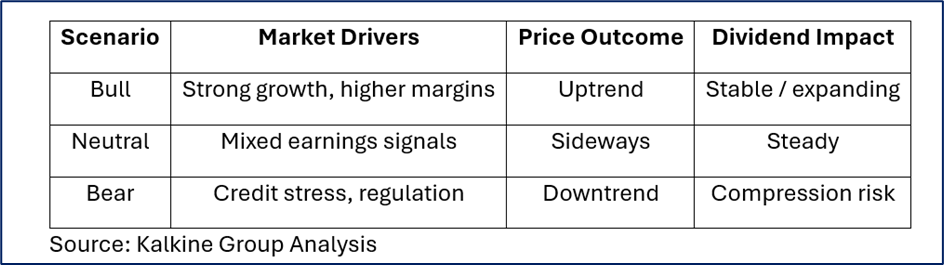
When Is TD Stock Bullish, Neutral, or Bearish?
Bullish Scenarios
- Strong Canadian economic growth boosts loan demand
- Improved U.S. retail banking momentum
- Continued dividend consistency and retention
- Valuation discounts versus intrinsic estimates (models suggest ~24% undervaluation)
Why it matters: Yield plus growth potential often attracts long-term income and total-return capital.
Neutral Scenarios
- Ongoing macro volatility
- Elevated risk premiums in financial stocks
- Currency-driven earnings variability
Interpretation: Attractive valuation balanced by external uncertainties.
Bearish Scenarios
- Credit quality deterioration or recessionary pressure
- Rising regulatory and compliance costs
- Higher government bond yields compress margins
Impact: Valuation compression and reduced risk appetite.
How Does TD Compare With Major Canadian Banking Peers?
TD is commonly benchmarked against:
- Royal Bank of Canada (RY)
- Bank of Nova Scotia (BNS)
- Bank of Montreal (BMO)
Across metrics such as dividend yield, valuation multiples, net interest margins, and growth expectations, TD generally trades in line with peers, though near-term growth expectations can lag if earnings forecasts soften.
What Are the Key Risks Investors Should Monitor?
- Regulatory and compliance risks, including AML-related remediation
- Moderating revenue and EPS growth projections
- Sensitivity to interest-rate cuts
Close monitoring of regulatory updates and macro indicators remains essential.
Investor Strategy Framework: Short, Medium, and Long Term
Short Term (3–6 months)
- Track inflation, employment, and rate expectations
- Monitor earnings (next report expected ~26 February 2026)
- Position around dividend capture and ex-dividend dates
Medium Term (6–18 months)
- Assess earnings revisions as remediation progresses
- Evaluate U.S. and Canadian loan performance
- Reassess valuation versus book value and intrinsic models
Long Term (18+ months)
- Focus on dividend growth and compounding
- Expansion of fee-based financial products
- Participation in broader economic recovery cycles
Investor FAQ: TSX TD Stock
What is TD’s current dividend yield?
Approximately 3.23%–3.31%, paid quarterly.
Is TD undervalued?
Relative valuation models suggest potential undervaluation versus intrinsic estimates.
Does TD benefit from rising or falling rates?
Banks typically benefit from steeper yield curves but may face margin pressure during rate cuts.
Are analysts bullish or bearish?
Overall sentiment leans Buy/Moderate Buy, with varied price targets.
Bull vs. Bear Scenario Matrix
Final Investment View (Unbiased & Informational)
Toronto-Dominion Bank remains a core Canadian financial institution defined by diversified operations, disciplined capital management, and a reliable dividend profile. While regulatory challenges and macro volatility may create short-term uncertainty, TD’s long-term income appeal and intrinsic value potential continue to underpin investor confidence.


 Jun 24, 2026




 Please wait processing your request...