
 NZ
 UK
 US
 AU
 IND

 CA

 Share
 X (Formerly Twitter)
 Whatsapp
 Facebook
 LinkedIn
 Telegram
 Email This Article
 Copy Link
 Summarize with AI
 Chat GPT
 Perplexity
Key Highlights
- No Merger has been announced; neither company has confirmed talks, and no terms, committee or filing exists.
- Barclays says a deal could be announced before Tesla’s annual meeting, which analysts expect by Dec. 6 at the latest.
- Barclays sees SpaceX as the likelier acquirer, with Musk holding about 37% of the Equity and about 56% of the votes.
- Hurdles include Shareholder approval, conflicts of interest, Tesla’s China Business and regulatory scrutiny.
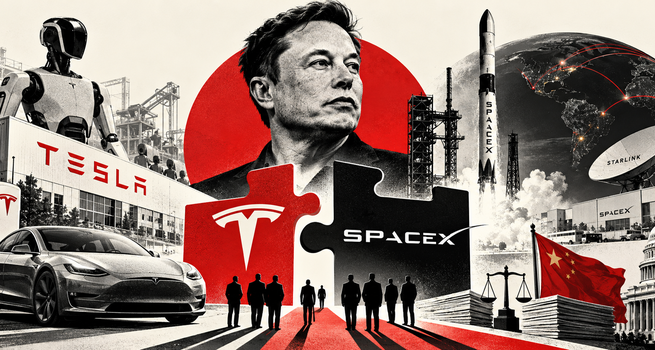
Elon Musk has a habit of answering the question he is asked with a different one. On Tesla’s Earnings Call in July, an analyst asked whether a merger with SpaceX made sense. Mr Musk did not say no. He said that companies cannot simply talk about combining and that any such step would have to follow “the appropriate process”, and he added that there was “more and more overlap, especially with Terafab”. In September, on a podcast, he called the question of why the two firms were still separate a great one. On October 16th he posted three words, “Tesla x SpaceX”, with a link to a livestream of a Tesla Roadster demonstration. Neither company has confirmed that talks exist.
Wall Street has stopped waiting for confirmation. On October 14th analysts at Barclays, led by Dan Levy, argued that a merger could be announced before Tesla’s annual meeting, which they expect to be held on December 6th at the latest. The bank called a combination an increasingly consensus expectation, and thinks SpaceX is the more likely acquirer in an all-stock deal. Dan Ives of Wedbush has put the odds of a deal by 2027 at better than 80%, according to one report. For the timing to work, Barclays reckons, an announcement would have to arrive by late October or early November. Tesla reports earnings on Wednesday; SpaceX does so a day earlier.
The idea is less fanciful than it sounds, because the two companies are already entangled. In January Tesla agreed to invest about $2bn in xAI, Mr Musk’s artificial-intelligence firm. Within weeks SpaceX had acquired xAI, and Tesla’s stake was converted into SpaceX shares. Tesla now holds about 19m of them, under 1% of the company, and its chief financial officer told investors in July that Net Income had benefited from a $1bn mark-to-market gain on its SpaceX holdings. The two firms are also building Terafab, a planned $16.8bn chip-making complex in Texas, and have jointly sued a small Illinois nanotechnology firm over the name. Tesla’s board is not untouched either: Ira Ehrenpreis, who chairs its compensation and governance committees, joined SpaceX’s board in February, according to Tesla’s latest proxy filing, as reported by Electrek.
Why would Mr Musk want to go further? Barclays offers two answers. The first is technology. A merger would join Tesla’s robotaxis and humanoid robots to SpaceX’s AI models and software, and, the analysts argue, the real prize would be this vertical integration rather than any financial synergy. The second is control. Mr Musk owns roughly 13% of Tesla, or up to 20% if he exercised his options, according to Morningstar, but controls some 85% of SpaceX’s votes. He has long said he wants about a quarter of Tesla to keep sufficient sway over its AI and robotics strategy. On Barclays’ numbers, SpaceX buying Tesla at current valuations would leave him with about 37% of the combined firm and about 56% of the votes. Terafab adds a practical argument: Mr Musk has said that separate board approvals for the project could take “a while”, a hurdle a single company would remove.
None of this makes the deal easy. Start with the sums. Tesla was worth about $1.47trn and SpaceX about $1.21trn when Yahoo Finance last tallied them in early October. Both numbers move, and SpaceX’s has been moving the wrong way. Its shares fell 10.6% in the week to October 16th, closing at $146.03, about 17% below their October high and not far above the $135 at which they were sold in June in the largest initial public offering on record. In an all-stock merger the exchange ratio is the whole argument, and a nervous market does not make it easier to settle. Morningstar has suggested that Tesla’s shareholders could hold out for at least half of the combined company, and might also want assurances about liquidity, given SpaceX’s small float, and about future equity raises. Each is a hard thing to concede when your negotiating counterpart is also your chief executive.
That brings up conflicts of interest, the most awkward part of the story. Mr Musk sits on both sides of the table. Any credible process would require independent committees at each board, with their own advisers and the power to say no, and probably a vote among shareholders not tied to him. Barclays itself calls shareholder approval the central obstacle. Tesla’s investors have shown they do not always do as they are told. At the 2025 annual meeting a non-binding proposal asking Tesla to invest in xAI drew about 1.06bn votes in favour and 916m against, with 473m abstentions; it failed because abstentions counted as noes. A shareholder lawsuit over the eventual $2bn Investment alleged that Mr Musk was using Tesla’s Balance Sheet to prop up his private companies. And Tesla’s proxy for this year’s meeting, filed on October 19th, lists three items and no shareholder proposals.
Then there is China. In July the Wall Street Journal reported that some Tesla executives had been told to prepare to separate the firm’s Chinese business, with a spin-off, sale or closure among the Options discussed, ahead of a possible tie-up. The reasoning was geopolitical: SpaceX launches classified payloads for the American government and runs internet connectivity in war zones, which would sit uneasily alongside a large Chinese Manufacturing operation. Mr Musk called the story “absurdly fake news” and said the idea of separating Tesla’s businesses had never come up. Yet analysts at JPMorgan have pointed to a “practical bottleneck” in obtaining regulatory approvals for both companies, particularly in China. Shanghai is no small asset. A Tesla China executive has said the plant achieved the lowest manufacturing costs for the Model 3 and Model Y with the help of more than 400 local suppliers, and more than 60 of them also Supply Tesla globally. Selling it would be costly, and keeping it might make a merger harder.
Finally there is the timetable itself. SpaceX has been public for only a few months. Its first lock-up expiry has passed, Mr Musk’s own shares remain locked until June next year, and it is spending heavily on AI. It reported Capital Expenditure of $18.4bn in the second quarter alone, of which $15.8bn went to artificial intelligence. A company in that position may prefer to be judged on its own results before it is asked to swallow another. Mr Musk has also been quick to deny the more specific reports: the July story about Tesla’s China business was, in his words, fake news.
So when will Tesla and SpaceX merge? The honest answer is that no one outside Mr Musk’s circle knows, and perhaps he does not either. There is no agreement, no term sheet and no special committee in either company’s filings, according to one tracker of the situation. The reasonable reading of the evidence is that a combination makes strategic sense to many analysts and would suit Mr Musk’s appetite for control, but that its obstacles are real and mostly of his own making. The markers to watch are specific: the two earnings calls this week, any announcement of independent committees, a regulatory filing, and the agenda for Tesla’s December meeting. Until one of them appears, “Tesla x SpaceX” remains what it is today: three words and a link.
Disclaimer: This content is for informational purposes only and does not constitute financial advice or a recommendation to buy, sell, or hold any security. No merger between Tesla and SpaceX has been announced or confirmed by either company. Investors should conduct their own research and consult a licensed financial adviser before making investment decisions.


 Nov 20, 2026





 Please wait processing your request...