
 NZ
 UK
 US
 AU
 IND

 CA

 Share
 X (Formerly Twitter)
 Whatsapp
 Facebook
 LinkedIn
 Telegram
 Email This Article
 Copy Link
 Summarize with AI
 Chat GPT
 Perplexity

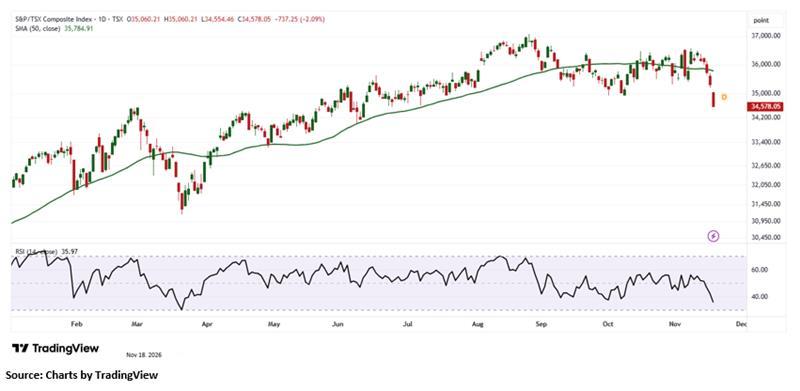
The S&P/TSX Composite index is expected to open lower, weighed down by weakness across the basic materials and enegyr sectors. From a technical perspective, the index continues to trade below its 21-day Simple Moving Average (SMA), which is acting as a key dynamic resistance level and restricting recovery attempts. Immediate support is positioned near 34,200, while resistance is placed around 34,850. A sustained hold above the support level could help stabilise market sentiment, attract renewed buying interest and support a recovery towards recent highs. However, a decisive break below 34,200 could weaken the technical structure, intensify selling pressure and expose the index to further downside risks. Overall, the near-term outlook remains cautious, with the index's ability to defend immediate support likely to determine its next directional move.
Global Macro Backdrop
United States - Political developments and economic outlook
US shares ended Wednesday mixed as investors assessed Nvidia earnings, the outlook for artificial-intelligence spending and the minutes of the Federal Reserve’s October meeting. The index divergence reflected Volatility in technology stocks alongside continued pressure on economically sensitive companies. Higher-for-longer interest-rate expectations remained a risk to global Equity valuations.
The Dow Jones Industrial Average declined 561.25 points (1.11%) to 50,198.17 and the S&P 500 fell 16.90 points (0.23%) to 7,323.63, while the Nasdaq Composite advanced 101.50 points (0.42%) to 24,429.88. The mixed US performance contrasted with the more severe commodity-led retreat in Canadian equities.
Federal Reserve meeting minutes and commentary from US officials reinforced investors’ focus on persistent Inflation and the possibility of additional policy tightening. Treasury yields and the US dollar remained influential for Commodity prices, especially precious metals, which are sensitive to changes in real yields and currency expectations.
Canadian markets were particularly exposed to the decline in resource prices. Weakness in gold, copper and oil overwhelmed isolated advances in Canadian technology and infrastructure stocks. Investors also continued to monitor US–Canada trade discussions and the implications of divergent central-bank expectations.
China - Industrial activity and commodity demand
China’s industrial Demand remained an important variable for copper, aluminium and other metals. Uncertainty around Manufacturing activity and construction demand, together with a firmer US dollar and global growth concerns, weighed on sentiment towards Canadian diversified miners and copper producers.
Copper prices declined as investors assessed softer industrial demand and tightening global financial conditions. The TSX’s largest copper-related decliners included Ero Copper and Lundin Mining. The pullback underlined the sensitivity of Canadian materials stocks to commodity-price movements.
Global bond yields and risk appetite
Risk appetite deteriorated sharply in commodity-linked Canadian shares on Wednesday. Gold and base-metals producers faced pronounced selling, while lower oil prices weighed on energy companies. Broad Market Breadth weakened as investors reassessed the outlook for growth, inflation and financing costs.
Market participants digested the Federal Reserve’s October meeting minutes and continued to evaluate the potential for higher interest rates. Canada’s recently reported October inflation rate of 3.1% remained relevant for domestic policy expectations, but it provided little offset to the global decline in commodity prices.
Canadian Market Focus
The S&P/TSX Composite fell 737.25 points, or 2.09%, to 34,578.05 on November 18. The benchmark reached its lowest closing level in more than five months, with materials, energy and financials leading losses. The sharp correction followed four consecutive declines and illustrated the market’s exposure to global commodity pricing.
Canada’s October consumer price inflation stood at 3.1% year over year, unchanged from September and slightly below market forecasts. The release continued to influence expectations for the Bank of Canada, but Wednesday’s equity performance was dominated by declining resource prices and global monetary-policy concerns.
Precious-metal miners were particularly affected as gold futures dropped around 3.5%. Lower copper prices pressured diversified and base-metal producers, while energy companies weakened as Crude Oil declined. These moves outweighed gains in selected companies outside the resource sectors.
The Canadian dollar remained sensitive to commodity prices and the anticipated interest-rate differential between Canada and the United States. Weaker recent domestic employment data and the latest inflation reading suggested a complicated policy backdrop, while the Federal Reserve’s more restrictive tone supported the US dollar.
Stock-level performance diverged widely. BlackBerry rose 5.33%, Brookfield Infrastructure Partners gained 4.83% and Boyd Group advanced 3.74%. By contrast, Ero Copper declined 11.34%, Trekor Metals fell 10.03% and Lundin Mining lost 9.90%, reflecting sharp weakness among mining-related names.
Commodity view - what moved the TSX
- Crude: Crude oil prices steadied around $83 per barrel on Thursday as investors assessed reports that President Donald Trump was considering additional military strikes against Iran, with Israeli Prime Minister Benjamin Netanyahu reportedly urging him to participate in a four- to seven-day military campaign.
- Gold: Gold prices steadied above $3,700 an ounce on Thursday but stayed close to their lowest levels since September 2025, as the US dollar continued to strengthen on expectations of further Federal Reserve rate hikes.
- Silver: Silver prices steadied above $45 an ounce on Thursday but stayed close to their lowest levels since September 2025, as the US dollar continued to strengthen on expectations of further Federal Reserve rate hikes.
- Copper: Copper futures in the US sank below $5.70 per pound in November, their lowest level in seven months, as risks to Data Center development clouded the demand outlook.
Forex Watch
USD/CAD: The Canadian dollar weakened to around 1.43 per USD in mid-November, its lowest level since March 2025, as softer-than-expected inflation eased bets of another rate hike by the Bank of Canada.
Canada’s October CPI held at 3.1% year over year, while recent employment data pointed to softer labour-market conditions. These developments influenced the Bank of Canada outlook, although Wednesday’s immediate currency backdrop was dominated by a broader decline in commodities.
US dollar: US Dollar Index futures were quoted near 103.72 in Wednesday’s market-close reporting. The firmer dollar added pressure to dollar-denominated metals and reinforced the difficult environment for Canadian resource producers.
Canadian dollar implications: A weaker Canadian dollar can benefit the translated revenues of exporters and multinationals, while increasing imported input and equipment costs. Companies with US-dollar obligations and commodity-linked Earnings remain particularly sensitive to exchange-rate moves.
Key Market Drivers
- TSX closing performance: The Composite fell 737.25 points (2.09%) to 34,578.05, its lowest close since June 10.
- Materials and energy: Falling gold, copper and crude oil prices triggered sharp losses across resource stocks.
- US equities: The Dow and S&P 500 declined, while the Nasdaq advanced modestly amid volatile AI-related trading.
- Interest rates: Federal Reserve meeting minutes and inflation concerns kept tighter monetary-policy expectations in focus.
- Crude oil: January WTI crude futures lost approximately 3.0% to US$82.12 per barrel.
- Gold and silver: December gold futures declined approximately 3.5% to US$3,729.45; silver also faced pressure.
- Industrial metals: Copper weakness weighed heavily on diversified miners and copper producers.
- USD/CAD: The Canadian dollar traded near 70 US cents as a firmer US dollar and lower commodity prices pressured the loonie.
- Corporate stock movers: BlackBerry, Brookfield Infrastructure Partners and Boyd Group gained; Ero Copper, Trekor Metals and Lundin Mining fell.
- Market breadth: Declining TSX stocks outnumbered advancers by 673 to 305, with 60 unchanged.
Market Outlook
The November 18 session saw the TSX Composite plunge 2.09% to 34,578.05, extending the recent selloff to a five-month closing low. Materials, energy and financial stocks led losses as crude oil, gold and copper weakened simultaneously. The session represented the index’s steepest daily drop since early June.
US equities ended mixed: the Dow and S&P 500 declined, while the Nasdaq closed modestly higher. Investor attention focused on Nvidia and the Federal Reserve’s October meeting minutes. Monetary-policy concerns and a firmer dollar added to the pressure on dollar-denominated commodities.
Canada’s October CPI reading of 3.1% remained a key macroeconomic input, alongside softer labour-market conditions and ongoing US–Canada trade discussions. However, domestic economic developments were overshadowed by falling resource prices and global risk aversion.
Commodity weakness was widespread. January WTI crude fell to around US$82.12 per barrel, and December gold futures dropped to approximately US$3,729.45 an ounce. Copper-linked miners experienced particularly sharp declines, while the Canadian dollar traded near 70 US cents.
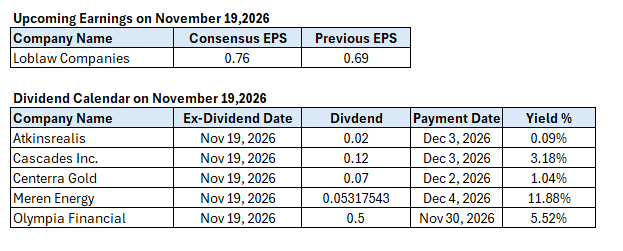
In the near term, investors should monitor whether the TSX can hold the 34,500 area and mount a recovery towards 35,000–35,300. The direction of gold, oil and copper, the US dollar, Treasury yields and upcoming corporate results may help determine the next market move.
Overall view: The near-term outlook is cautious following a fifth consecutive loss and a broad decline in commodity-related stocks. A stabilisation in energy and metals prices would help improve sentiment, but a sustained breach of 34,200 could leave the index exposed to further selling pressure.


 Nov 20, 2026





 Please wait processing your request...