
 AU
AU
 UK
UK
 US
US
 NZ
NZ
 IND
IND

 CA
CA

 Share
Share
 X (Formerly Twitter)
 Whatsapp
 Facebook
 LinkedIn
 Telegram
 Email This Article
 Copy Link
 Summarize with AI
 Chat GPT
 Perplexity
Early indications from U.S. futures suggest Bay Street could open higher on Monday, after President Donald Trump temporarily postponed strikes on key Iranian energy facilities following “productive” talks.
In the previous session, declines were largely driven by weakness in the basic materials and healthcare sectors, adding to broader selling pressure.
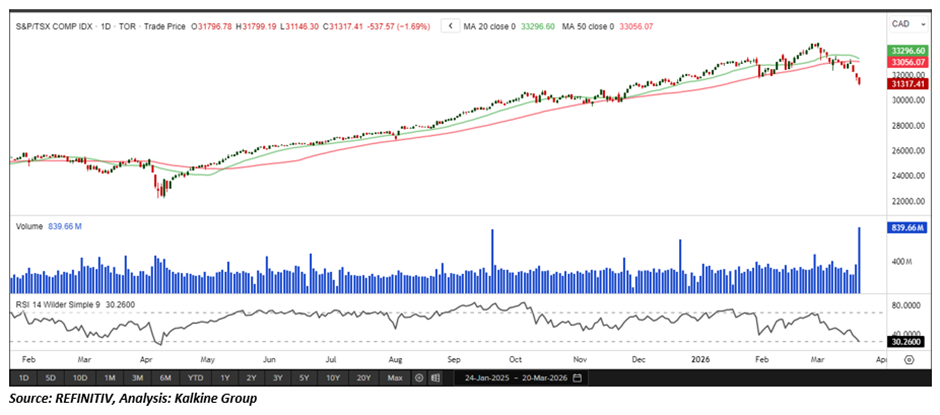
From a technical perspective, the index continues to trade below a key rising trendline resistance near 31,800, indicating persistent near-term weakness in the overall market structure. As long as the index remains below this level, downside risks are likely to persist, potentially resulting in extended consolidation or further corrective movement. Immediate resistance is positioned around 31,800, and failure to reclaim this level may keep the broader market tone defensive in the near term.
Global Macro Backdrop
Global markets have posted mixed signals overnight:
- U.S. economic data showed slightly higher-than-expected durable goods orders, suggesting ongoing industrial strength, though concerns about inflation linger.
- European equities were modestly lower following weaker-than-expected retail sales in the eurozone, offset by optimism in Germany’s manufacturing output.
- Asian markets were broadly higher as China’s PMI data indicated a modest expansion in manufacturing, supporting commodity demand.
Bond yields in North America and Europe edged slightly higher, reflecting persistent inflation expectations and ongoing monetary policy scrutiny, influencing rate-sensitive sectors like financials and real estate.
Macro News Impacting the TSX
The TSX Composite is likely to open with selective sector movements:
- Investors are monitoring domestic macroeconomic data, including retail sales and housing metrics, for indications of potential Bank of Canada guidance.
- Market sentiment will also respond to global growth trends, commodity prices, and currency movements.
Commodity view — what to watch
- Crude oil: WTI crude oil futures plunged more than 10% to around $88.5 per barrel on Monday after President Donald Trump signaled de escalation by ordering a five day pause on planned US strikes against Iranian energy infrastructure.
- Gold: Gold trimmed early losses Monday, trading 3% lower at $4,350 per ounce, after President Trump postponed strikes on Iran for five days, claiming "productive conversations" with Tehran.
- Base metals: Copper futures fell below $5.3 per pound on Monday, marking their lowest levels in over three months as the prolonged Middle East conflict raised concerns about global inflation and growth, weighing on metal demand.
Sector highlights
- Energy: Canadian oil & gas producers could see early support as oil prices gain.
- Materials: Base metal and gold miners may benefit from industrial demand and safe-haven buying.
- Financials: Banks and insurers remain sensitive to interest rate expectations and bond yield movements.
- Technology & Industrials: Likely to follow global equity trends and macroeconomic cues.
Forex watch
- The Canadian dollar (CAD) is trading slightly stronger versus the U.S. dollar, following robust oil prices and positive economic sentiment in Canada.
- Currency movements are expected to influence export-driven sectors and commodity producers, with a stronger CAD potentially limiting earnings in certain materials and energy companies.

Bottom line:
The TSX Composite may open modestly higher, led by energy and materials stocks. Investors are likely to take a selective approach, reacting to overnight global developments, commodity movements, and domestic economic signals.
The combination of rising base metal prices, firm crude oil, and a moderately strong CAD sets the tone for early trading, while financials and technology sectors may move in line with broader macro sentiment.


 Jun 26, 2026


 Please wait processing your request...