
 NZ
 UK
 US
 AU
 IND

 CA

 Share
 X (Formerly Twitter)
 Whatsapp
 Facebook
 LinkedIn
 Telegram
 Email This Article
 Copy Link
 Summarize with AI
 Chat GPT
 Perplexity

The S&P/TSX Composite index is expected to commence trading on a negative note, weighed down by weakness across the basic materials and technology sectors. From a broader technical perspective, the outlook remains cautious, with the index trading below its 21-day Simple Moving Average (SMA), which continues to act as a key dynamic resistance level and may restrict near-term recovery attempts. Immediate support is positioned near 35,300, a crucial level for maintaining the current market structure. A sustained hold above this level could attract buying interest and support an upward move towards the recent high of 36,000. Conversely, a decisive break below 35,300 could weaken market confidence, intensify selling pressure, and expose the index to further downside risks. 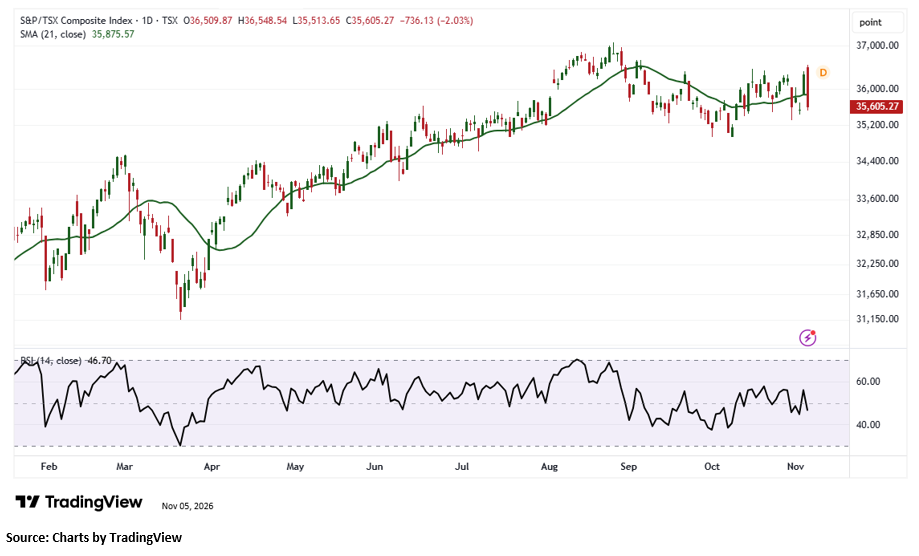
Global Macro Backdrop
United States - Political developments and economic outlook
US political developments continued to influence global risk appetite following the Democratic Party’s strong showing in the midterm elections. Investors shifted their attention from Wednesday’s relief rally to the possibility of tighter regulation of artificial intelligence and technology-related activity, while uncertainty surrounding the administration’s response to the Iran conflict persisted.
US equities suffered a sharp Reversal on Thursday. The S&P 500 fell 4.36% to 7,353.73, the Nasdaq Composite dropped 5.52% to 24,315.00 and the Dow Jones Industrial Average declined 3.44% to 51,523.06. Selling in semiconductor and other AI-linked stocks spilled over into Canadian technology names and contributed to the TSX’s weakest session in five months.
The latest ADP report indicated that US private employment increased by 86,000 positions in October, ahead of market expectations. Investors remained focused on the upcoming official US employment report for further evidence on labour-market momentum, Inflation risks and the Federal Reserve’s next policy decisions.
The combination of US Equity weakness, changing interest-rate expectations and geopolitical uncertainty contributed to a defensive tone in North American markets. Even as Crude Oil recovered, Canadian equities were unable to sustain the previous session’s positive momentum.
China - Industrial activity and Commodity demand
China continued to shape expectations for copper, aluminium, iron ore and other industrial commodities. Investors assessed whether Manufacturing and construction Demand could absorb available supplies amid broader uncertainty over trade conditions and global growth.
Copper futures fell 3.10% to approximately US$6.23 per pound on November 5, reversing part of the prior session’s recovery. The pullback weighed on sentiment toward Canadian base-metal producers, highlighting the sensitivity of the TSX’s materials exposure to shifting expectations for Chinese industrial demand.
Global bond yields and risk appetite
Risk appetite deteriorated markedly on Thursday as a US technology-led selloff spread across equity markets. Canadian financials and industrials also declined, suggesting that investors were reducing exposure to economically sensitive and higher-valuation sectors rather than simply rotating within technology.
Market participants continued to monitor Treasury yields, inflation risks and monetary-policy expectations ahead of the November 6 US employment report. The outcome could influence discount rates, the US dollar and the demand outlook for interest-sensitive equity sectors.
Canadian Market Focus
Domestic attention centered on the federal government’s 2026 budget, released on November 5, alongside the TSX’s broad decline and the upcoming Canadian employment report. The budget emphasized Investment incentives, infrastructure, productivity, energy and critical minerals, although its immediate market impact was overshadowed by global selling pressure.
Canada’s latest merchandise trade figures showed a September surplus of C$5.4 billion, compared with C$5.0 billion in August. Exports rose 0.2% to C$78.6 billion, while imports declined 0.3% to C$73.2 billion. Exports to markets outside the US fell 1.1%, underscoring ongoing trade-diversification challenges.
The federal budget outlined approximately C$142.1 billion in proposed multi-year spending and tax measures, targeting investment, infrastructure, innovation and affordability. The government also highlighted planned Capital Investment and measures to improve tax competitiveness. Investors will assess how these initiatives affect future growth, fiscal balances and interest-rate expectations.
Attention now turns to Canada’s November 6 employment report. With labour-market conditions an important input for Bank of Canada policy, any unexpected weakness or resilience could affect domestic bond yields, the Canadian dollar and valuations across banks, utilities and real estate.
The TSX finished with most sectors in negative territory. Base metals fell 5.2%, information technology declined 3.8% and financials lost 3.2%. Telecoms advanced 2.5% and utilities edged up 0.1%. Individual Earnings reactions amplified the decline, particularly in consumer discretionary, technology and financial stocks.
Commodity view - what moved the TSX
- Crude: December WTI crude rose US$2.40 (2.7%) to US$90.52 per barrel, rebounding from Wednesday’s sharp decline as reports of attacks on tankers in the Strait of Hormuz revived supply-disruption concerns. The recovery did not prevent weakness in Canadian energy equities.
- Gold: December COMEX gold futures advanced around 1.0% to approximately US$4,112 per ounce during Thursday’s North American afternoon trading, supported by demand for defensive Assets amid sharp equity-market volatility.
- Silver: Silver futures traded around US$51.7 per ounce late on November 5, retreating from earlier levels near US$53. Volatility reflected the competing influences of safe-haven interest, a shifting US dollar and concerns over industrial demand.
- Copper: COMEX copper futures declined to roughly US$6.23 per pound, down 3.1% on the session. Weakness in industrial metals was consistent with the steep decline in the TSX’s base-metals segment.
Forex Watch
USD/CAD: The US dollar firmed against the Canadian dollar during the session, with USD/CAD quoted around 1.4013 in late-afternoon market reporting. Broad risk aversion and weakness in Canadian equities tempered the support normally associated with a rebound in crude prices.
The Canadian dollar also faced a mixed domestic backdrop: a stronger September Trade Surplus offered support, but uncertainty over the Canadian growth outlook and the forthcoming employment release remained important considerations for currency markets.
US dollar: The US dollar stabilized after the previous session’s decline, while investors reassessed risk exposure following the broad selloff in American equities. Changes in Treasury yields and the policy outlook remained important for precious metals and foreign-exchange markets.
Canadian dollar implications: Currency fluctuations affect Canadian resource producers, exporters and companies with US-dollar revenues or costs. A softer loonie can raise translated foreign earnings, but it can also increase the cost of imported equipment and other inputs.
Key Market Drivers
- US equity selloff: Sharp declines in AI-linked and semiconductor stocks triggered risk reduction across North American exchanges.
- US political developments: Post-midterm policy expectations, technology regulation concerns and uncertainty over the Iran conflict weighed on sentiment.
- Canadian federal budget: The newly released budget emphasized investment incentives, infrastructure, energy and affordability measures.
- Canadian economic data: September’s trade surplus widened, while investors awaited the November 6 employment figures.
- Crude oil: Renewed Supply concerns lifted oil prices after Wednesday’s sharp correction, although Canadian energy shares remained weak.
- Gold and silver: Investors weighed safe-haven demand against currency fluctuations and a deteriorating global growth outlook.
- Copper and industrial metals: Falling futures prices and softer growth expectations pressured base-metal equities.
- USD/CAD: The Canadian dollar weakened against the US dollar amid broad risk aversion and uncertainty over domestic growth.
- Corporate earnings: Gildan Activewear, Sun Life Financial and Bombardier experienced notable share-price weakness amid company-specific developments.
- Global risk appetite: A steep decline in US indexes and rising volatility overwhelmed Wednesday’s post-election rally.
Market Outlook
The November 5 session represented a decisive reversal in Canadian equity sentiment. The TSX fell 2.03% to 35,605.27 after gaining 2.28% on Wednesday, with broad-based selling and pronounced weakness in technology, financials and base metals. The index closed below the psychologically important 36,000 level after trading as high as 36,548.54 intraday.
The US market selloff was a significant source of pressure, particularly as concerns over potential AI regulation weighed on chipmakers and other technology-linked stocks. The Nasdaq’s 5.52% decline reinforced the cautious tone across North American markets, while uncertainty surrounding Iran and the broader trade outlook added to volatility.
The Canadian federal budget provided a medium-term policy focus through proposed investment incentives and infrastructure spending. However, investors remained more sensitive to immediate market conditions, corporate earnings and the potential implications of the forthcoming Canadian and US employment reports for monetary policy.
Crude oil’s recovery above US$90 per barrel and continued strength in gold offered some commodity support, but weakness in copper and several major equity sectors prevented a broader stabilization. Telecoms and utilities were among the few areas to finish the session higher.
Near term, investors should monitor the index’s ability to defend the 35,500 area and recover 36,000, alongside incoming labour-market data, global technology-sector performance, crude oil volatility and company-specific earnings announcements.
Overall view: A cautious near-term outlook is warranted following Thursday’s broad decline. Renewed pressure below 35,500 could undermine market confidence, while a recovery above 36,000 would provide an initial sign of stabilization. Defensive sectors and selected precious-metal producers may offer relative resilience, but the broader market remains sensitive to global risk appetite and economic data.


 Nov 10, 2026





 Please wait processing your request...