
 NZ
 UK
 US
 AU
 IND

 CA

 Share
 X (Formerly Twitter)
 Whatsapp
 Facebook
 LinkedIn
 Telegram
 Email This Article
 Copy Link
 Summarize with AI
 Chat GPT
 Perplexity

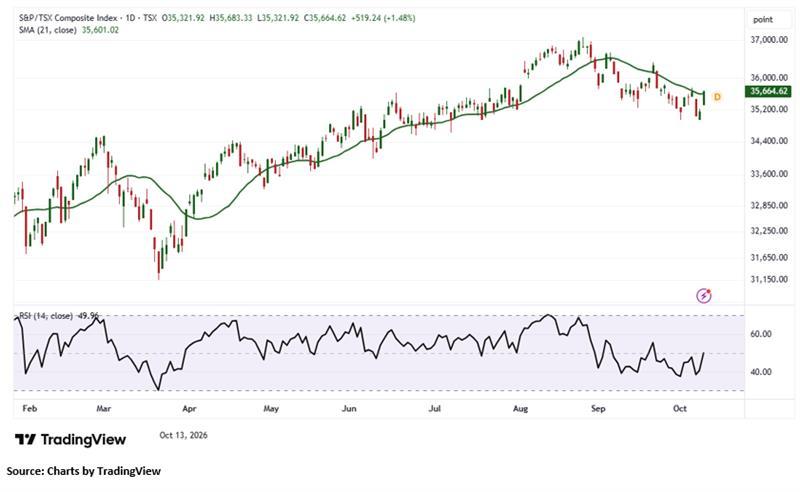
The S&P/TSX Composite index is expected to open on a positive note, supported by strength across the technology and basic materials sectors. Moreover, the index remains above its 21-day Simple Moving Average (SMA), which continues to act as a key dynamic support level. Immediate support is positioned near 35,400, a crucial level for maintaining the current technical structure. Sustained trading above this support could help stabilise market sentiment and preserve the broader technical outlook. A successful rebound from 35,400 could attract renewed buying interest and support a recovery towards the recent high near 35,900. Conversely, a decisive break below this level could weaken the technical setup and increase near-term downside risks.
Global Macro Backdrop
Global markets remain focused on the direction of Monetary Policy as investors assess whether Inflation is easing sufficiently to allow central banks to reduce borrowing costs without compromising price stability. The Federal Reserve’s latest policy decision and subsequent communications remain important for expectations around the timing and pace of future adjustments.
U.S. economic activity, labour-market conditions and inflation data continue to influence Treasury yields and the U.S. dollar. Evidence of moderating growth could strengthen expectations for a less restrictive policy environment, potentially supporting Equity valuations. Conversely, persistent inflation or stronger-than-expected economic activity could keep yields elevated and place pressure on rate-sensitive stocks.
In Europe, investors continue to monitor economic momentum and the implications of monetary policy for Business Investment and industrial demand. China remains particularly important for Commodity markets, with Manufacturing activity, infrastructure spending and the property-sector outlook influencing expectations for copper, nickel and other industrial metals.
For Canada, the Bank of Canada’s policy outlook remains tied to domestic inflation, employment, consumer spending and economic growth. A weaker domestic economy could increase expectations for lower borrowing costs, while persistent inflation could constrain the scope for further easing. This balance is important for Canadian financials, real estate, consumer-facing businesses and other interest-sensitive sectors.
With markets returning to a full Canadian trading week following Thanksgiving, investors will also be assessing developments in overseas markets and North American Assets accumulated during the holiday period.
Canadian Market Focus
The TSX's sector composition leaves it particularly sensitive to movements in commodities and global financial conditions. Energy and Materials stocks can respond quickly to changes in oil and metals prices, while Financials are more directly exposed to Credit conditions, the Yield Curve and the health of Canadian households and businesses.
The Canadian dollar remains another important factor. Its direction reflects the relative outlook for Canadian and U.S. interest rates, movements in oil prices and broader Demand for the U.S. dollar. A weaker loonie can increase the Canadian-dollar value of U.S.-dollar Revenue for some exporters and resource producers, although it can also raise the cost of imported equipment and other inputs.
Investors will also need to distinguish between broad macroeconomic trends and company-specific fundamentals. Production volumes, operating costs, balance-sheet quality, Capital allocation and Earnings guidance can produce substantial differences in performance among companies within the same sector.
Commodity view — what will move the TSX
- Crude: Crude oil fell below $92 a barrel on Tuesday, ending a three-session advance as markets assessed the prospect of additional Russian energy supplies reaching global buyers.
- Gold: Gold held below $4,200 an ounce on Tuesday, remaining under pressure as the US dollar climbed to an 18-month high ahead of key inflation reports that could shape the Federal Reserve’s next Interest Rate decision.
- Silver: Silver fell toward $60 an ounce on Tuesday, extending losses from the previous session as the US dollar climbed to an 18-month high ahead of key inflation reports that could shape the Federal Reserve’s next interest rate decision.
- Copper: Copper futures climbed toward $6.70 per pound, moving closer to record highs as ongoing Supply disruptions bolstered prices.
Forex Watch
The Canadian dollar remains closely linked to oil prices, relative interest-rate expectations and broader U.S.-dollar movements.
A stronger U.S. dollar can create pressure for commodities priced in that currency and influence global risk appetite. At the same time, a weaker Canadian dollar can improve the translated value of foreign revenue for some TSX-listed exporters and resource companies.
For investors, the key is to assess currency movements alongside commodity prices and company cost structures. A weaker loonie is not automatically positive for every Canadian business, particularly those reliant on imported inputs or foreign-currency financing.
The CAD/USD Exchange Rate will therefore remain an important indicator for the Energy, Materials and Industrials sectors as well as companies with substantial cross-border operations.
Key Market Drivers Today
- Federal Reserve outlook: Markets continue to assess the implications of the Fed's latest policy decision and the potential path of future rate adjustments.
- Bank of Canada expectations: Domestic inflation, employment and growth data remain important for the Canadian rate outlook.
- Bond yields: U.S. and Canadian government yields remain critical for equity valuations and rate-sensitive sectors.
- Canadian dollar: CAD movements could influence resource exporters and companies with international operations.
- Global Risk sentiments: U.S., European and Asian equity markets could influence the opening tone in Toronto.
- Fourth Quarter-opening flows: The first Trading session of the fourth quarter could see portfolio repositioning and renewed sector allocation following the close of September.
Market Outlook
The TSX enters Tuesday’s session with its direction likely to depend on the interaction between commodity prices, bond yields and expectations for monetary policy. Energy and Materials remain central to index performance, while Financials and other rate-sensitive sectors will respond to changes in borrowing-cost expectations and assessments of economic resilience.
A combination of firm commodity prices, stable or declining yields and resilient global demand would offer a constructive backdrop for Canadian equities. Conversely, weaker industrial demand, a sustained fall in oil prices or renewed upward pressure on bond yields could weigh on the benchmark and lead to more uneven sector performance.
Investors should pay particular attention to crude oil, gold, copper, the Canadian dollar and North American bond yields. Together, these indicators can help clarify whether the market is being driven primarily by resource-sector momentum, changing rate expectations or concerns about global growth.
Overall, the TSX outlook remains dependent on incoming economic data and market confirmation. Energy and Materials offer direct exposure to commodity developments, while Financials, Technology, Utilities and Real Estate remain sensitive to interest rates and credit conditions. As trading resumes after the holiday, investors should monitor both overnight global developments and company-specific news before drawing conclusions about the session's direction.


 Nov 25, 2026





 Please wait processing your request...