
 AU
AU
 UK
UK
 US
US
 NZ
NZ
 IND
IND

 CA
CA

 Share
Share
 X (Formerly Twitter)
 Whatsapp
 Facebook
 LinkedIn
 Telegram
 Email This Article
 Copy Link
 Summarize with AI
 Chat GPT
 Perplexity
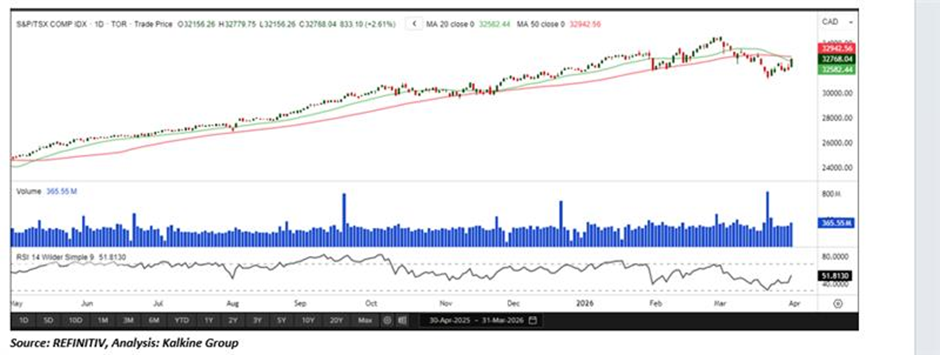
The S&P/TSX Composite Index is expected to open on a positive note following the recent sell-off. In the previous session, gains were primarily driven by strength in the healthcare and basic materials sectors, offering only limited support to the broader market.
However, from a technical standpoint, the index continues to trade below a key rising trendline resistance near the 32,950 level, signalling ongoing fragility in the near-term structure. As long as this barrier remains intact, downside risks are likely to persist, with the potential for further consolidation or corrective movement. Immediate support is seen around 32,500, and a break below this level could keep overall sentiment subdued in the near term.
Global Macro Backdrop
Global equity markets begin April with a moderately constructive tone:
- U.S. markets ended the prior session mixed, with investors balancing strong labor market data against lingering concerns about sticky inflation and delayed rate cuts.
- Federal Reserve commentary continues to signal a data-dependent stance, with policymakers emphasizing that premature easing could risk reigniting inflation pressures.
- European equities are broadly stable, supported by easing energy costs but constrained by weak industrial production data.
- Asian markets are slightly higher, led by optimism around policy support in China and stabilizing export demand trends.
Global bond yields remain elevated but range-bound, suggesting markets are still pricing in a prolonged “higher-for-longer” rate environment rather than aggressive tightening or easing shifts.
Macro News Impacting the TSX
The TSX Composite is expected to open with mild upside bias as April begins:
- Investors are unwinding quarter-end rebalancing trades, potentially reducing short-term volatility.
- Focus is shifting toward Canadian labor data, inflation trends, and GDP momentum to gauge Bank of Canada policy direction.
- Commodity exposure remains a key driver for index direction, particularly energy and precious metals.
Commodity view — what to watch
- Crude oil: WTI crude oil futures slid more than 2.5% below $99 per barrel in the first trading session of April, following a record monthly jump in March, weighed by hopes of de-escalation in the Middle East.
- Gold: Gold prices rose to around $4,700 per ounce on Wednesday amid signs of de-escalation in Middle East tensions, which could lead to lower oil prices and ease concerns over further central bank rate hikes.
- Silver: Silver slipped to around $74 per ounce on the first trading day of April, extending its sharp monthly sell-off of more than 20% in March. This marked the steepest decline since September 2011, and silver now trades nearly 40% below January’s record highs, reflecting inflation concerns amid disrupted energy markets and prompting a hawkish shift by investors and central banks.
- Copper: Copper futures in the US rose past $5.6 per pound, extending the rebound from the three-month low of $5.34 in late March as de-escalatory rhetoric from US and Iranian authorities regarding their war improved the outlook for global manufacturing.
Sector highlights
- Energy: Likely to open stable with slight upside supported by resilient oil prices.
- Materials: Supported by strong gold and stable copper sentiment.
- Financials: Expected to trade cautiously as investors reassess rate expectations and bond yield direction.
- Technology & Industrials: Likely to track broader global risk sentiment and U.S. equity cues.
Forex watch
- The Canadian dollar (CAD) is trading slightly weaker against the U.S. dollar as traders digest firm U.S. economic data and month-end positioning adjustments.
- A softer CAD could offer near-term support to export-heavy sectors such as energy and materials, partially offsetting commodity volatility.
Bottom line:
The TSX Composite is expected to open April with a cautiously constructive tone as month-end distortions fade and investors refocus on macro fundamentals. Stability in commodities—particularly oil and gold—continues to provide a supportive backdrop for Canadian equities, while financials and rate-sensitive sectors remain sensitive to bond yield movements.
Overall sentiment remains balanced, with selective buying likely to dominate as investors position for upcoming economic data releases and the next earnings cycle.


 Jun 26, 2026




 Please wait processing your request...