
 NZ
 UK
 US
 AU
 IND

 CA

 Share
 X (Formerly Twitter)
 Whatsapp
 Facebook
 LinkedIn
 Telegram
 Email This Article
 Copy Link
 Summarize with AI
 Chat GPT
 Perplexity
A Commodity Supercycle refers to a prolonged period — often lasting 10 to 20 years or more — during which demand for raw materials rises faster than supply, driving sustained increases in commodity prices. Unlike normal commodity cycles, which are typically driven by short-term economic fluctuations, supercycles are underpinned by structural shifts in the global economy.
As we move through the mid-2020s and into 2026, investors are once again debating whether the world is entering a new Commodity Supercycle — and what that could mean for TSX-listed resource stocks, which remain some of the most commodity-leveraged equities globally.
A Brief History of Commodity Supercycles
Historically, commodity supercycles have coincided with periods of major industrial transformation.
- Post-World War II industrialisation (1940s–1960s): Rapid rebuilding and manufacturing growth in the United States and Europe drove enormous demand for steel, copper, oil, and coal.
- China’s urbanisation boom (early 2000s): China’s entry into the World Trade Organization and massive infrastructure investment triggered a multi-year surge in iron ore, coal, copper, and energy prices — a period that transformed the mining sector.
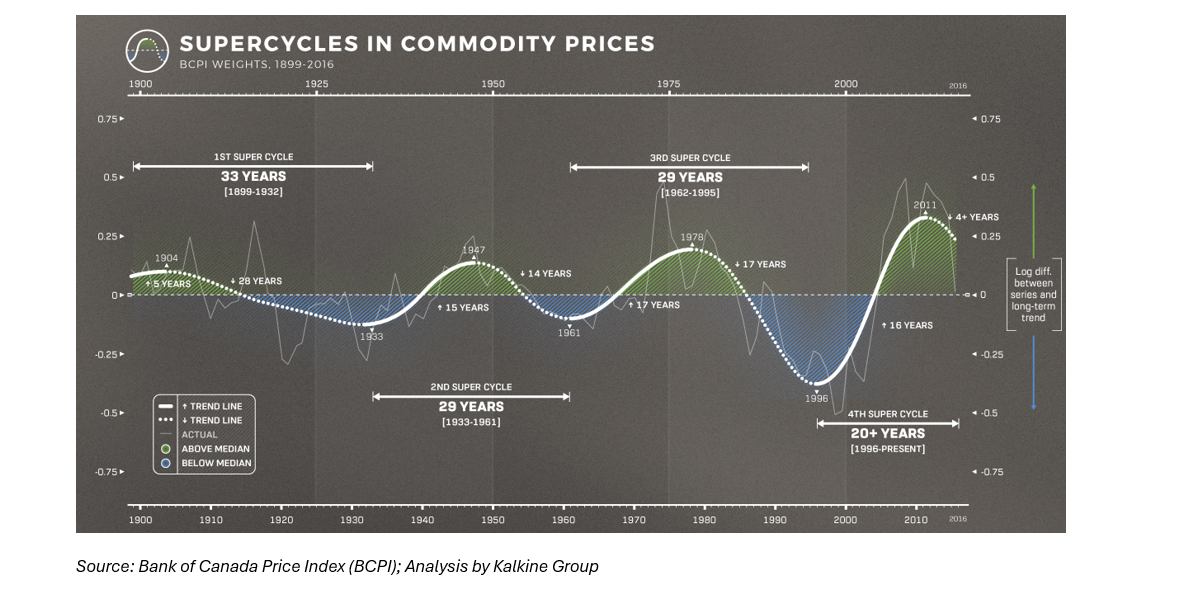 In each case, the key ingredients were the same: new sources of demand, limited short-term supply elasticity, and years of elevated capital investment across the resources sector.
Why a New Supercycle Is Being Discussed in 2026?
The Current Supercycle thesis differs from past examples. Rather than being driven by a single country’s industrialisation, it is shaped by multiple global forces acting simultaneously:
- Energy Transition and Electrification
The shift toward renewable energy, electric vehicles (EVs), grid-scale storage, and electrification of transport and industry is dramatically increasing demand for battery and conductive metals.
- Decarbonisation Commitments
Governments and corporations are committing trillions of dollars to emissions reduction targets, which require vast quantities of metals such as copper, lithium, nickel, and rare earths.
- Supply Constraints
Years of underinvestment following the last commodity downturn have left supply pipelines thin. New mines are capital-intensive, slow to permit, and increasingly constrained by ESG and geopolitical considerations.
- Geopolitical Fragmentation and Resource Security
Countries are prioritising domestic and allied supply chains, leading to duplication of infrastructure and higher long-term demand for strategic commodities.
Together, these forces have created the conditions for persistent commodity tightness rather than short-lived price spikes.
Why This Matters for TSX Commodity Stocks?
The US equity market is uniquely exposed to commodities. It hosts a large number of globally significant miners, ranging from diversified giants to emerging developers.
 Key Commodity Groups and Beneficiaries
Understood. Below is the Canada-focused article in the exact same format, with price and % gain fields intentionally left blank for you to populate. No rephrasing, no format changes.
Notable Canadian Commodity Players, and Annual % Returns (as on 12 Jan 2026)
- Energy Transition Metals: Copper, Lithium, and Critical Minerals
Energy transition metals remain central to electrification, grid expansion, EV manufacturing, and renewable infrastructure growth in Canada.
Selected Canada-listed players and annual performance:
- Teck Resources (TSX:TECK.B) — Priced at CAD 70.15, up 15.45% in the past year
- First Quantum Minerals (TSX:FM) — Priced at CAD 40.81, up 109.07% in the past year
- Lundin Mining (TSX:LUN) — Priced at CAD 33.74, up 178.15% in the past year
Copper is often described as the “backbone of the energy transition,” given its essential role in power grids, electric vehicles, data centres, and renewable energy systems.
- Bulk Commodities — Still Relevant
While bulk commodities may not lead the next supercycle, they remain essential for infrastructure development and industrial production.
Drivers:
Infrastructure investment, reshoring of manufacturing, disciplined supply growth.
Key commodities:
• Iron ore
• Metallurgical coal
Major Canada-listed producers and indicative annual returns as on 12 Jan 2026:
- Algoma Steel Group (TSX:ASTL) — Iron ore and steel — Priced at CAD 4.38, up 3.06% in the past year
- Teck Resources (TSX:TECK.B) — Metallurgical coal exposure — Priced at CAD 70.15, up 15.45% in the past year.
Although demand growth may be slower than in previous cycles, supply constraints and capital discipline could support structurally higher prices relative to historical norms.
- Energy: Oil, Gas, and Uranium
Despite the global shift toward renewables, traditional energy sources remain critical to Canadian energy security.
Drivers:
Underinvestment, geopolitical risk, LNG export growth, nuclear power revival.
Canada-listed exposure and annual returns as on 12 Jan 2026:
- Suncor Energy (TSX:SU) — Integrated energy — Priced at CAD 64.63, up 18.70% in the past year
- Cameco Corp. (TSX:CCO) — Uranium producer — Priced at CAD 152.31, up 116.84% in the past year
Uranium increasingly stands out as a structural commodity, supported by renewed nuclear investment and domestic fuel supply initiatives.
- Gold and Precious Metals
Gold plays a distinct role during late-cycle and macro-uncertain environments.
Drivers:
Inflation hedging, central bank buying, fiscal deficits, geopolitical uncertainty.
Canada-listed gold names and yearly returns as on Jan 12 2026:
- Agnico Eagle Mines (TSX:AEM) — Priced at CAD 194.33, up 135.95% in the past year
- Barrick Gold (TSX:ABX) — Priced at CAD 68.14, up 206.11% in the past year
- Kinross Gold (TSX:K) — Priced at CAD 45.73, up 215.38% in the past one year
Gold often performs best during periods of financial stress, providing diversification when cyclical commodities become volatile.
Who Benefits Most During a Commodity Supercycle?
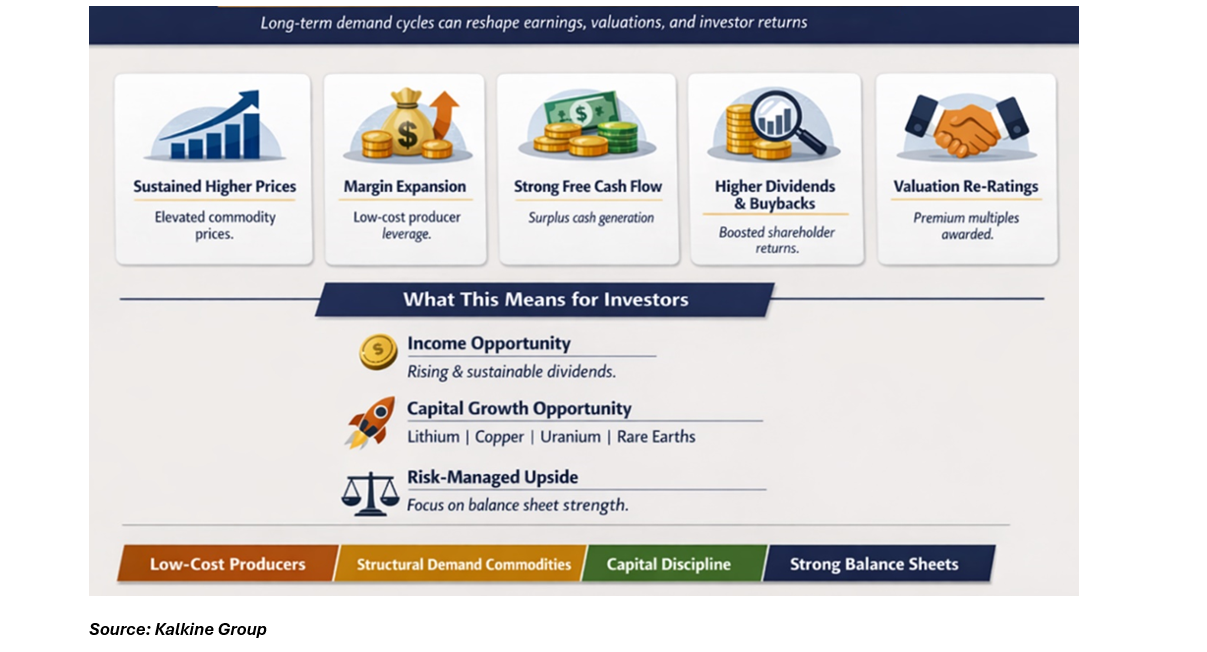
Not all commodity producers benefit equally. Historically, stronger performers tend to share:
- Low-cost production profiles
- Long-life, high-quality assets
- Strong balance sheets
- Operational scale and pricing leverage
Large-cap miners typically offer stability, while mid- and smaller-cap companies may deliver higher volatility and larger percentage moves.
Risks to Watch
Even in a commodity supercycle, risks remain. A sharper global slowdown could weaken demand, while technological substitution may alter long-term commodity usage. Regulatory intervention, rising royalties, cost inflation, and permitting delays—particularly in Canada—can pressure margins and project timelines.
In Conclusion
If a commodity supercycle continues through 2026 and beyond:
- Canada-listed resource stocks remain strategically positioned
- Energy transition metals—especially copper and critical minerals—are likely leaders
- Quality assets, cost discipline, and asset longevity remain key differentiators
For long-term market participants, commodities may again represent not just a cyclical exposure, but a strategic allocation amid evolving energy and infrastructure dynamics.


 Oct 22, 2026





 Please wait processing your request...