
 AU
AU
 UK
UK
 US
US
 NZ
NZ
 IND
IND

 CA
CA

 Share
Share
 X (Formerly Twitter)
 Whatsapp
 Facebook
 LinkedIn
 Telegram
 Email This Article
 Copy Link
 Summarize with AI
 Chat GPT
 Perplexity
As Canada charts a course toward 2026, the market is navigating a complex landscape shaped by technology, trade, and shifting economic fundamentals. Smart money is focusing on resilience, secular growth themes, and active security selection rather than just broad-market bets. This neutral, deep-dive playbook breaks down the latest trends, outlook, and key sectors to watch on the Toronto Stock Exchange (TSX).
Key Takeaways for 2026
- TSX Outlook: Analysts generally forecast the S&P/TSX Composite Index to reach new all-time highs in 2026, supported by easing trade uncertainty and strong demand for resource-based inputs linked to global technological shifts (like AI infrastructure). However, expect slower returns and potentially higher volatility following strong 2025 gains.
- Monetary Policy Shift: Anticipation of continued rate cuts by the Bank of Canada (BoC) and the US Federal Reserve (Fed) is a key tailwind, boosting liquidity and potentially favouring long-duration sectors like Technology.
- The AI Ecosystem: The Artificial Intelligence (AI) theme is broadening, driving massive capital expenditure (capex) in Data Centres and creating high demand for Canadian Energy and Materials (especially minerals like copper, nickel, and lithium).
- Housing & Real Estate: Canada's housing crisis remains a central economic issue, directing capital toward Purpose-Built Rental and Seniors' Housing as long-term, defensive plays.
- Global Fragmentation: Geopolitical shifts are prioritizing resilience over efficiency, emphasizing domestic supply chains, natural resources, and energy security.
Economic Currents and Thematic Shifts
The Canadian economy is poised for improving GDP growth in 2026, following a milder performance in 2025. Investment bank narratives point to a stabilization of trade tensions and a gradual easing of inflation, though the latter is expected to remain slightly above the BoC's 2% target.
Macro Outlook & Broker Narratives
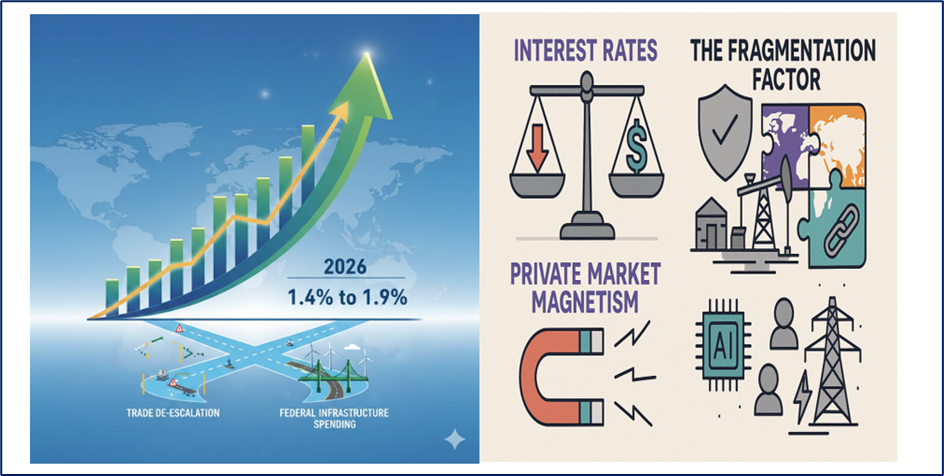
- Growth Trajectory: Real GDP growth is forecast to accelerate to around 1.4% to 1.9% in 2026, conditional on trade de-escalation and supported by federal government infrastructure spending.
- Interest Rates: The BoC's policy rate, following cuts in late 2025, is expected to hold at a neutral level through 2026, balancing economic growth with lingering core inflation. The global narrative is a shift from restrictive to accommodative policy.
- The Fragmentation Factor: Major investment managers highlight "Fragmentation" (the global order splintering into competing economic blocs) as a structural trend. This benefits sectors focused on security, energy, and localized supply chains.
- Private Market Magnetism: There is a significant move by institutional and "smart money" investors to alternatives (private credit, private equity, infrastructure), seeking diversification and thematic exposure (like AI and new infrastructure projects) that are less correlated with traditional public markets.
Source: Kalkine Group
Sectors and Stocks to Watch
The following sectors are attracting investor attention based on fundamental tailwinds, long-term trends, and strategic positioning for the 2026 economic environment.
- Materials & Metals (The AI Resource Fuel)
The massive global buildout of AI infrastructure (data centres, power grids) is creating unprecedented demand for key base and industrial metals. Canada's dominant position as a mining hub makes this a critical sector.
- Latest Trends: Increased capital allocation toward energy transition minerals (Copper, Nickel, Lithium) necessary for electrification and data centres. Geopolitical fragmentation also enhances the appeal of secure, domestic resource supply chains.
- Outlook: Strong pricing and demand are expected to continue, linked directly to global technology capex cycles.
- Potential Stocks to Monitor:
- Teck Resources Ltd. (TECK): A major diversified miner with significant exposure to copper and zinc, benefiting from the electrification theme. Guidance focus: Progress on spin-offs/asset rationalization and copper project timelines.
- First Quantum Minerals Ltd. (FM): High-growth copper producer. Guidance focus: Operational stability and debt management.
- Nutrien Ltd. (NTR): Leading global potash and nitrogen producer. Guidance focus: Agricultural commodity pricing stability and global food security narratives.
- Technology (The Broadening AI Ecosystem)
While the US "Magnificent Seven" dominate, Canada has key players focused on specialized software, AI services, and the infrastructure backbone. Smart money is shifting focus from pure AI hype to the companies providing the picks and shovels.
- Latest Trends: Focus on Agentic AI (autonomous systems) in manufacturing and back-office operations. Also, consolidation plays in specialized software. Lower interest rates are traditionally supportive of this long-duration sector.
- Outlook: Strong earnings growth is projected for firms that can successfully transition AI from isolated experiments to scaled enterprise platforms.
- Potential Stocks to Monitor:
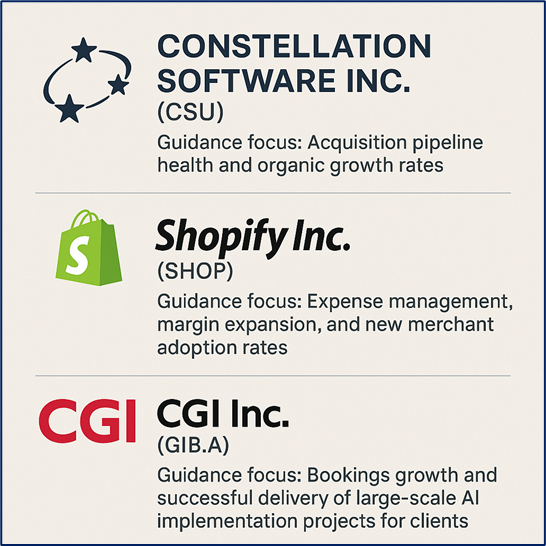
- Constellation Software Inc. (CSU): A serial acquirer of vertical market software companies. Guidance focus: Acquisition pipeline health and organic growth rates.
- Shopify Inc. (SHOP): E-commerce platform. Guidance focus: Expense management, margin expansion, and new merchant adoption rates.
- CGI Inc. (GIB.A): IT consulting and systems integration. Guidance focus: Bookings growth and successful delivery of large-scale AI implementation projects for clients.
Source: Kalkine Group
- Energy (The Electrification & Data Centre Demand)
The energy sector is seeing a bifurcated trend: continued demand for traditional exports and massive domestic demand for electricity to power data centres.
- Latest Trends: Significant capital movement toward power generation (especially Natural Gas and Renewables) to satisfy the immense power requirements of the AI boom. Renewed focus on pipeline security and energy infrastructure.
- Outlook: Energy companies are expected to benefit from high demand and supportive policy aimed at boosting national productivity and resource project construction.
- Potential Stocks to Monitor:
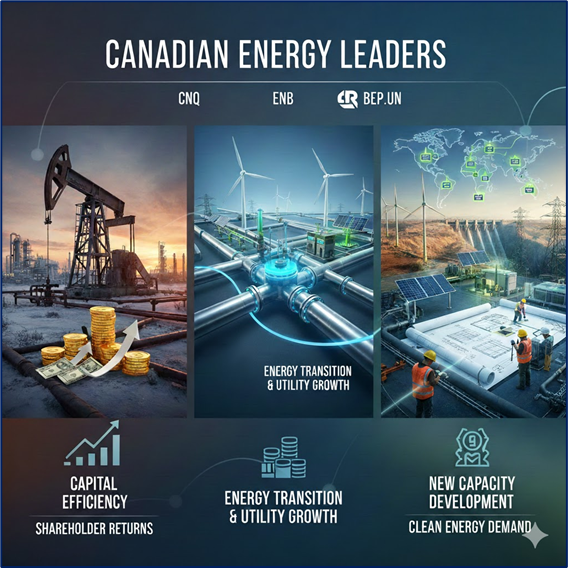
- Canadian Natural Resources Ltd. (CNQ): Large, diversified oil and gas producer. Guidance focus: Capital efficiency, free cash flow generation, and disciplined shareholder returns.
- Enbridge Inc. (ENB): Major energy infrastructure company. Guidance focus: Regulatory certainty on pipelines and successful execution of energy transition/utility growth projects.
- Brookfield Renewable Partners L.P. (BEP.UN): Global pure-play renewable power platform. Guidance focus: Acquisition pipeline and development of new capacity to meet utility and corporate clean energy demand.
Source: Kalkine Group
- Financials (Deregulation & Digitalization)
Canada’s stable banking sector is adapting to a changing rate environment and technological disruption.
- Latest Trends: Focus on deregulation in financials and the integration of AI to streamline operations, reduce costs, and fight financial crime. The return to a more "normal" interest rate environment supports traditional lending margins.
- Outlook: Solid returns are expected, underpinned by strong balance sheets and a resilient Canadian consumer, despite earlier concerns about household debt.
- Potential Stocks to Monitor:
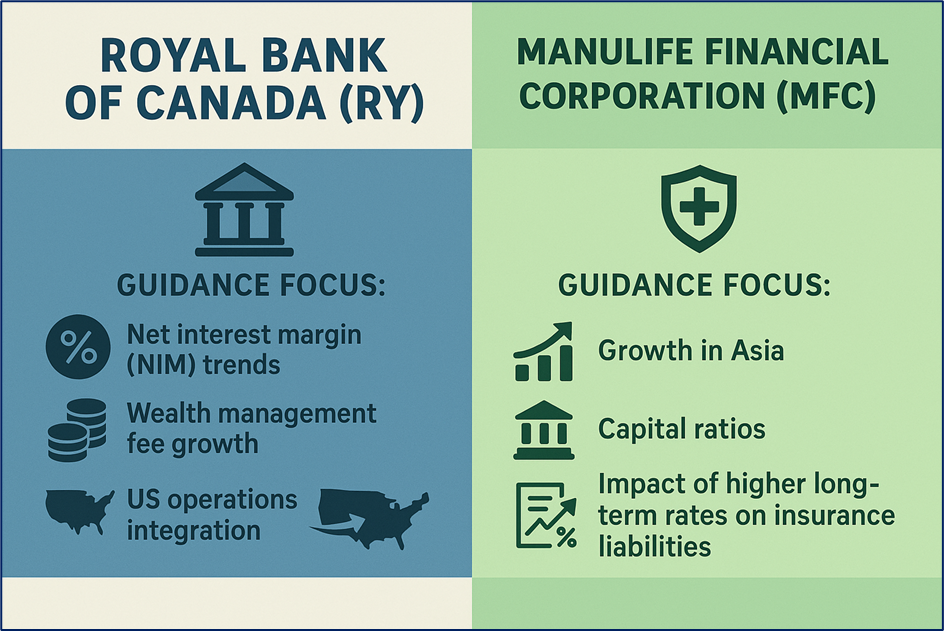
- Royal Bank of Canada (RY): Canada's largest bank. Guidance focus: Net interest margin (NIM) trends, wealth management fee growth, and successful US operations integration.
- Manulife Financial Corporation (MFC): Diversified insurance and wealth manager. Guidance focus: Growth in Asia, capital ratios, and impact of higher long-term rates on insurance liabilities.
Source: Kalkine Group
- Real Estate & Housing (The Defensive Structural Play)
The housing supply deficit is a structural problem driving investment into specific, defensive sub-sectors.
- Latest Trends: Purpose-Built Rental (PBR) housing is a top bet, with foreign and domestic capital willing to accept lower near-term yields for long-term growth. Seniors' Housing is also gaining momentum due to aging demographics.
- Outlook: Residential real estate, particularly rental, is viewed as a resilient, defensive asset class supported by long-term structural supply issues. Commercial office and retail remain a mixed bag.
- Potential Stocks to Monitor (REITs):
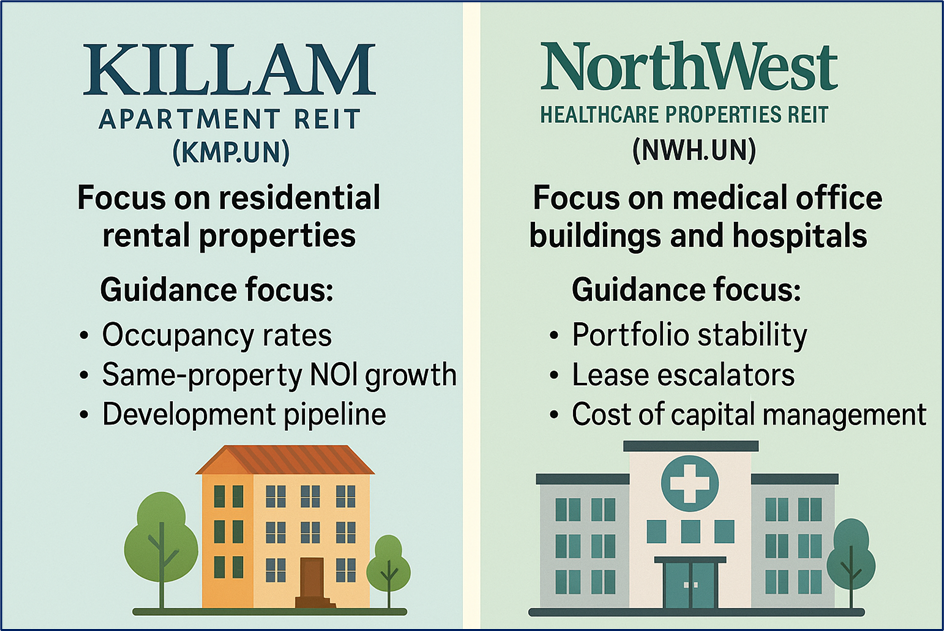
- Killam Apartment REIT (KMP.UN): Focus on residential rental properties. Guidance focus: Occupancy rates, same-property NOI growth, and development pipeline for PBR.
- NorthWest Healthcare Properties REIT (NWH.UN): Focus on medical office buildings and hospitals. Guidance focus: Portfolio stability, lease escalators, and cost of capital management.
Source: Kalkine Group
Smart Money Shift: What the Pros are Doing
The shift from institution-led portfolios reveals a deliberate move away from passive, broad exposure toward active, theme-driven investing.
- Quality First: Institutional investors are prioritizing high-quality companies with deep competitive moats, pricing power, and strong brands to navigate policy uncertainty and volatility.
- The Private Market Pivot: There’s a significant acceleration into private markets (Private Equity, Infrastructure, Private Credit) as alternative funds are predicted to grow significantly. This provides thematic exposure to areas like data centres, clean energy infrastructure, and rental housing.
- The Duration Play: With anticipated rate cuts, "long-duration" assets (those whose value depends heavily on future cash flows, like some Growth Technology stocks) are being favored, though high valuations warrant active stock selection.
- Focus on Income: For fixed income, the preference is for income and security selection over trying to perfectly time rate cuts. Shorter- to mid-duration investment-grade credit is a common strategy to maximize yield while managing risk.
Conclusion: Navigating the New Normal
The Canadian investment landscape for 2026 is defined by a paradox of geopolitical friction and technological boom. The TSX is strategically positioned to supply the world with the resources (materials and energy) needed to power the global AI and electrification revolution, while its domestic economy grapples with structural issues like housing and debt.
For retail investors, the key is to look beyond headline risks and focus on long-term secular growth themes like AI infrastructure, clean energy, and housing supply solutions. The transition from a restrictive to an accommodative monetary environment will add liquidity, but active selection remains paramount as market returns are expected to be slower and volatility higher.


 Jun 24, 2026




 Please wait processing your request...