
 NZ
 UK
 US
 AU
 IND

 CA

 Share
 X (Formerly Twitter)
 Whatsapp
 Facebook
 LinkedIn
 Telegram
 Email This Article
 Copy Link
 Summarize with AI
 Chat GPT
 Perplexity

Key takeaways
- Savaria (TSX:SIS) kept its growth streak intact on 6 August, reporting second-quarter revenue up 8.4% and further margin expansion; the accessibility group carries a defensible niche in an ageing-population market and a monthly dividend.
- Dexterra (TSX:DXT) lifted Q2 revenue 8.0% to C$269.2m and swung free cash flow sharply positive, though a dip in quarterly net earnings and a 3.2% share-price fall on results day show the market wants more.
- Spin Master (TSX:TOY) returned to profit in Q2 with net income of C$29.7m, but a trailing loss per share of C$1.18 — the legacy of a C$250.4m impairment tied to Melissa & Doug in 2025 — makes its headline P/E meaningless for now.
- Black Diamond (TSX:BDI) grew revenue 23% on booming workforce lodging, while Vecima (TSX:VCM) guided to sharply higher full-year profitability as its Entra fibre-access products scale; both still screen as loss-makers or near-breakeven on a trailing basis.
- Draganfly (CN:DPRO)— dual-listed on Nasdaq and Canada's CSE, both under DPRO — is a speculative micro-cap drone play, cash-rich after a 2025 raise but deeply loss-making, and belongs in a different risk bracket from the other five.
Introduction: an odd sextet under one label
"Consumer durables" traditionally means the big-ticket, long-lived goods households buy occasionally — appliances, furniture, vehicles, home fixtures. It is a useful bucket for shoppers, but a leaky one for investors, because stock screeners assign companies to sectors using coarse classification codes that often flatter or mislead. The six names on this watchlist are a case in point. Only Savaria and Spin Master make physical products a consumer might recognise as durable; the rest are better described as business services, industrial rental or communications technology. Where the screener's label stretches, this article says so and describes the real business underneath.
Why cover them together anyway? Because the screener grouped them, because five of the six reported fresh quarterly results in the past fortnight, and because as a set they map a spectrum of risk and quality that is instructive in its own right — from Savaria's steady compounding to Draganfly's binary, story-driven speculation. This is analysis, not advice. Every figure is dated, every rating is described as one data point rather than a verdict, and where information could not be independently verified the text says so plainly.
Screening methodology
The starting point was a single equity screener snapshot dated 6 August 2026, which returned these six Canadian-listed companies under its "consumer durables" heading, each with a price, market capitalisation, trailing price/earnings ratio, trailing earnings per share, an earnings-growth figure, a dividend yield and a consensus analyst label ranging from "Buy" to "Strong buy". Those snapshot figures are treated as a point-in-time reading, not a live feed. Where a number could be corroborated against a company release, a regulatory filing or a reputable news report, it is stated as verified with its source; where it could not, the text flags it as "per the screener as of 6 August 2026" with limited independent verification.
From there, each company was researched from primary sources first — earnings releases, management's discussion and analysis, investor presentations and exchange notices — supplemented by wire and financial-press coverage. The aim is not to rank the six into a league table of "best buys" but to test the screener's framing, verify the headline numbers, and set out the catalysts and risks a reader would want before forming their own view. Consensus ratings and target prices, where mentioned, are reported as sentiment indicators, not forecasts.
Canadian market and sector backdrop, August 2026
Canadian equities entered August 2026 close to record territory, with the S&P/TSX Composite trading in the mid-35,000s after the Bank of Canada held its policy rate steady and signalled that its long easing cycle was effectively over. Lower rates through 2025 had supported valuations across rate-sensitive and cyclical corners of the market; a pause leaves investors leaning more heavily on earnings delivery than on further monetary tailwinds. That shift matters for this group, several of whose members trade on premium multiples that assume continued execution.
Two macro threads run through every company here. The first is the still-unsettled Canada-US trade relationship: tariff measures and counter-measures have raised input costs, complicated cross-border supply chains and injected the sort of uncertainty that pushed Spin Master to write down goodwill on its Melissa & Doug business. The second is demographics and capital spending — an ageing population underpins demand for Savaria's accessibility equipment and Dexterra's care-linked services, while resource-sector and infrastructure activity drives Black Diamond's modular space and workforce lodging. Understanding which tailwind each company rides is the key to reading its numbers.
A word on the sector label itself. Index and screener providers slot companies into sectors using standardised industry codes that were built for broad comparability, not precision, and a firm can end up under "consumer durables" because of legacy classification, a product line that no longer dominates revenue, or simply the closest available bucket. That is why this watchlist mixes a genuine goods maker with a facilities-services group and a communications-equipment vendor. The practical lesson for readers is to look through the label to the revenue model, the customers and the cash flows — which is what the company sections below try to do.
Savaria Corporation (TSX:SIS) — the accessibility compounder
What it does. Savaria, based in Laval, Quebec, is one of the largest players in accessibility equipment: stairlifts, home and commercial elevators, wheelchair lifts, ceiling lifts and, through its Patient Care arm, medical beds, therapeutic surfaces and patient-handling systems. This is the most literal "consumer durable" on the list — long-lived home and mobility equipment — but it is equally an industrial and healthcare supplier, selling through dealers, healthcare institutions and its own distribution across North America, Europe and beyond. An ageing population and a broad shift toward ageing in place give the business a structural demand tailwind that few of its watchlist peers can match.
Latest results. On 6 August 2026 Savaria reported second-quarter revenue up 8.4% year on year, with what management described as continued margin expansion. For context, the comparable quarter a year earlier (Q2 2025) delivered revenue of C$226.7m, net earnings of C$16.3m, diluted EPS of C$0.23 and an adjusted EBITDA margin of 20.6% — itself a record at the time. Applying the disclosed 8.4% growth implies second-quarter 2026 revenue of roughly C$246m (a figure derived from the reported growth rate rather than independently confirmed line by line), with profitability building on that already-high margin base. The direction of travel — mid-to-high single-digit top-line growth paired with rising margins — is exactly what the group's multi-year "Savaria One" efficiency programme was designed to produce.
Revenue and earnings direction. Growth has moderated from the acquisition-fuelled surges of earlier years to a steadier organic-plus-bolt-on cadence, but the quality has improved: the story since 2024 has been margins, not just volume. The screener's trailing EPS of C$1.09 and reported earnings-growth figure of +56.89% reflect that margin-led profit recovery. Accessibility, which typically accounts for around three-quarters of revenue, is the engine; Patient Care is smaller and steadier.
Profitability, cash flow and balance sheet. Savaria has spent two years converting scale into cash. Adjusted EBITDA margins in the low-20s percent, disciplined capital spending and a lighter acquisition pace have supported deleveraging from the elevated debt taken on for its 2021 Handicare purchase. That improving balance sheet is the foundation for the dividend and gives management optionality for further bolt-ons. Investors should still watch working capital and foreign-exchange translation, given the international footprint.
Competitive position. Savaria's edge is breadth and distribution. Few competitors span the full accessibility range — from a stairlift retrofit in a private home to elevators for mid-rise buildings and patient-handling systems for hospitals — under one roof and across North America and Europe. That scale lets it serve dealers, healthcare procurement channels and builders alike, spreading demand across the discretionary home-modification market and the more defensive institutional-healthcare market. The Handicare integration widened that European reach, and management's current emphasis on manufacturing efficiency and sourcing under Savaria One is designed to turn the enlarged footprint into structurally higher margins rather than a one-off boost.
Dividend and valuation. Savaria is one of the few Canadian small-to-mid caps paying a monthly dividend, which annualises to roughly C$0.54 a share and works out near the screener's 1.87% yield at the 6 August price of C$30.25. On a trailing P/E of 27.65 (per the screener) the stock is not cheap; it is priced as a quality compounder, which raises the stakes on continued delivery. Recent announcements centre on the Q2 print and the ongoing Savaria One rollout. Catalysts: further margin gains under Savaria One; demographic-driven demand for home elevators and stairlifts; selective bolt-on acquisitions funded by improving cash flow. Risks: a premium multiple that leaves little room for a stumble; currency translation; and any softening in discretionary home-modification spending if consumer confidence weakens. On the August watchlist, Savaria stands out as the group's clearest example of consistent, margin-led execution.
Dexterra Group (TSX:DXT) — facilities services wearing a durables label
What it does. Dexterra is not a durables maker at all; it is a Canadian support-services company. Its Support Services segment provides integrated facilities management — cleaning, maintenance, food services and building operations — for institutional, commercial and government clients, plus workforce accommodation and camp services for remote sites. Its Asset Based Services arm owns and rents modular workforce housing and related infrastructure. The screener's "consumer durables" tag is a misclassification worth flagging: think business-to-business services and industrial assets, not household goods.
Latest results. For the second quarter ended 30 June 2026, Dexterra reported revenue of C$269.2m, up 8.0% from C$249.3m a year earlier, and adjusted EBITDA of C$32.8m, up 9.3%, for a 12.2% margin. Net earnings, however, slipped to C$10.3m (C$0.16 per share) from C$11.8m, and adjusted EPS eased to C$0.20 from C$0.23. The market reaction was cool: the shares fell 3.18% on the 6 August screener snapshot, consistent with reports that results narrowly missed expectations even as the top line grew.
Segment detail. Support Services did the heavy lifting, with revenue up 10.3% to C$226.5m and segment adjusted EBITDA up 12% to C$23.0m (a 10.1% margin), helped by new contract wins. Asset Based Services was softer on the top line, down 2.9% to C$42.7m, but far more profitable, lifting its adjusted EBITDA margin to 40.3% from 37.6% — a reminder that the owned-asset rental business, though smaller, carries the group's fattest margins.
Cash flow and balance sheet. The standout was cash generation: free cash flow swung to C$21.8m from a C$3.7m deficit a year earlier, and management expects adjusted-EBITDA-to-free-cash-flow conversion to exceed 50% for the full year. Net debt stood at C$205.8m, a comfortable 1.5x trailing adjusted EBITDA, and trailing return on equity was a healthy 15.4%. This is a balance sheet with room to fund both the dividend and growth.
Dividend and valuation. Dexterra declared a quarterly dividend of C$0.10 a share, payable 15 October 2026, supporting the screener's 2.54% yield — the highest of the six — at the 6 August price of C$15.22. On a trailing P/E of 21.16 and EPS of C$0.72, it is more modestly valued than Savaria. Recent announcements: the Q2 results and commentary that recently won business should ramp over coming quarters. Catalysts: contract wins converting to revenue; the high-margin asset-based book; the prospect of steadier earnings as facilities management proves defensive. Risks: thin net margins that make earnings sensitive to cost inflation and contract timing; client concentration in government and resources; and the labour-intensive nature of services work. Dexterra earns its watchlist place as the group's income anchor with visibly improving cash conversion — provided it can turn revenue growth back into earnings growth.
Spin Master Corp. (TSX:TOY) — a genuine durables name, mid-turnaround
What it does. Spin Master is a Toronto children's-entertainment company spanning three segments: Toys (brands such as PAW Patrol, Hatchimals, Bakugan and the recently acquired Melissa & Doug wooden and educational lines), Entertainment (television and film content that feeds the toy brands) and Digital Games (led by the Toca Boca app franchise). Toys are a legitimate consumer durable, and the integrated "play-and-media" model — where a hit show drives toy sales, which fund more content — is the company's distinguishing feature.
Why the P/E is blank. The screener shows no P/E and a trailing EPS of minus C$1.18, and the explanation is a single event: in 2025 Spin Master booked C$250.4m of non-current-asset impairments, largely a goodwill write-down on Melissa & Doug, citing trade-policy uncertainty and softer cash-flow projections. That pushed the full year to a net loss of C$148.5m on revenue of C$2,112.9m. A trailing P/E on a loss-making year is arithmetically meaningless, which is why the screener leaves it blank rather than showing a negative multiple — a point that applies equally to Vecima and Draganfly below.
Latest results. The turnaround, though, is visible. For Q2 2026 Spin Master reported revenue of C$436.4m, up 8.9%, with Toys up 12.0% to C$361.1m on the strength of PAW Patrol and Monster Jam, even as Entertainment (C$31.2m, down 2.8%) and Digital Games (C$44.1m, down 4.8%) softened. Crucially, the company swung to operating income of C$45.7m from a year-earlier operating loss, adjusted EBITDA rose to C$51.6m (an 11.8% margin, up from 7.2%), and net income reached C$29.7m, or C$0.29 per diluted share, reversing a C$46.5m loss. Chief executive Christina Miller framed it as a "return to profitable growth".
Cash flow, balance sheet and capital returns. Operating cash flow more than doubled to C$57.8m and free cash flow turned positive at C$19.2m. Since the Melissa & Doug deal, Spin Master says it has cut debt by C$350m while returning C$200m to shareholders, including a Q2 buyback of C$9.3m and a declared dividend of C$0.12 a share, payable 9 October 2026 — consistent with the screener's 2.32% yield. Management reiterated full-year guidance of stable-to-low-single-digit revenue growth and mid-to-high-single-digit adjusted EBITDA growth.
Valuation, catalysts and risks. At C$20.77 and a C$2.08bn market cap on 6 August, the stock trades on forward earnings and cash flow rather than a trailing multiple. Catalysts: a full year of Melissa & Doug free of impairment noise; the content pipeline feeding toy demand; continued buybacks and debt reduction. Risks: the toy industry's hit-driven volatility; tariff exposure on globally sourced product; and further softness in Entertainment and Digital Games. Spin Master makes the watchlist as the clearest turnaround story of the six — profitable again, but still proving the recovery is durable.
Black Diamond Group (TSX:BDI) — modular space and workforce lodging
What it does. Black Diamond is a Calgary-based specialist in modular buildings and remote workforce accommodation, again an industrial-rental business rather than a consumer-goods maker. Its Modular Space Solutions (MSS) segment rents and sells modular structures — site offices, classrooms, sales centres — across North America, earning high-margin recurring rental income plus value-added products and services (VAPS). Its Workforce Solutions (WFS) segment operates lodges and camps for resource, infrastructure and disaster-response clients. Bolted on top is LodgeLink, a fast-growing digital marketplace for crew travel and accommodation.
Latest results. For Q2 2026 (ended 30 June), Black Diamond reported consolidated revenue of C$129.2m, up 23%, and adjusted EBITDA of C$30.4m, up 4%. Reported net income, however, collapsed to just C$0.9m (C$0.01 per share) from a year earlier, dragged down in part by a C$3.6m provision for British Columbia provincial sales-tax assessments the company is appealing; adjusted EPS was C$0.09. That gap between strong revenue and weak headline profit explains the screener's optically high trailing P/E of 53.03 on EPS of C$0.35.
Segment detail. WFS was the growth driver, with revenue up 55% to C$72.2m as lodge-services revenue jumped 174%, and management pointed to more than C$2bn of outstanding formal bids — a large potential pipeline, though bids are not backlog. MSS delivered rental revenue of C$28.6m (up 8%) at 77.9% utilisation and an average monthly rate of C$910, with VAPS up 35%. LodgeLink continued to scale rapidly: total transaction value rose 69% to C$43.5m, net revenue climbed 64% to C$5.4m, and travel segments sold rose 44% to more than 215,000.
Why LodgeLink matters. Beyond the rental and lodging assets, LodgeLink is the part of Black Diamond that could re-rate the whole company. It is an asset-light digital marketplace matching crews needing beds with accommodation providers, earning a margin on each booking — a capital-efficient, network-effect business bolted onto an otherwise capital-heavy group. Its 69% jump in transaction value and 12.4% net-revenue margin hint at the operating leverage on offer if it keeps scaling. For now it is small relative to WFS and MSS, but a marketplace growing at that pace inside an industrial rental company is an unusual and potentially valuable combination.
Cash flow and balance sheet. Free cash flow was C$14.6m, down 25% as capital spending and growth investment continued. Net debt rose to C$351.0m, up 7% since year-end, but leverage of 2.4x sits within the company's stated 2.0x-3.0x target, and it expanded its asset-based revolving credit facility to C$550m from C$425m, leaving roughly C$197m of liquidity. This is a capital-intensive model where growth is deliberately debt-funded, so leverage discipline matters.
Dividend, valuation and risks. Black Diamond declared a quarterly dividend of C$0.045 a share (a modest 0.94% yield at C$18.37), reflecting a business that prioritises reinvestment over payout. Catalysts: conversion of the C$2bn-plus bid pipeline; LodgeLink's marketplace economics as it scales; MSS rate and utilisation gains. Risks: exposure to cyclical resource and construction activity; rising leverage; and one-off items — like the BC PST provision — that can distort quarterly profit. The screener's "Strong buy" label and the shares' rise on results day suggest the market is looking through the weak headline earnings to the growth underneath; Black Diamond earns its place as the highest-growth of the more established names.
Vecima Networks (TSX:VCM) — cable-to-fibre technology, not a durable
What it does. Vecima, based in Saskatoon, designs broadband access and video-delivery technology for cable and telecom operators. Its flagship Entra product family enables the industry's shift to "distributed access architecture" and fibre, letting operators push more bandwidth over existing networks. A Content Delivery and Storage business (MediaScaleX) serves video streaming, and a small Telematics unit tracks fleet and asset data. Calling this a consumer-durables company is a stretch; it is a business-to-business communications-equipment and software firm whose fortunes track cable operators' capital-spending cycles.
The industry backdrop. Vecima's opportunity is a once-in-a-generation upgrade cycle. Cable operators worldwide are moving intelligence out of the headend and toward the network edge — distributed access architecture — and extending fibre deeper into their footprints to compete with fixed-wireless and pure-fibre rivals. Entra sits squarely in that transition. The catch is timing: operators control the pace of their own capital budgets, so a supplier like Vecima can build a large engagement funnel yet see revenue arrive in uneven bursts as individual customers move from trials to volume deployment. That dynamic explains how a quarter can be nearly flat on revenue while management simultaneously lifts full-year guidance.
Latest results. For its fiscal third quarter ended 31 March 2026, Vecima reported revenue of C$64.8m, up a modest 1.3% year on year, but with sharply better profitability: adjusted EBITDA rose 9.2% to C$11.3m, a 17.4% margin, on a gross margin of 47.3%. The company posted a small net loss of C$0.2m, or minus C$0.01 per share, while adjusted net income was C$1.6m (C$0.06). That thin trailing loss is why the screener shows no P/E and an EPS of minus C$0.54 — the same loss-maker caveat that applies to Spin Master and Draganfly, and the reason a price/earnings ratio conveys nothing useful here.
Segment detail and outlook. The Video and Broadband Solutions segment, home to Entra, generated C$52.2m (up 9.6%), with Entra distributed-access products up 13.5% to C$49.3m; the company now counts 147 operator engagements, of which 73 have placed orders — a widening funnel that underpins its confidence. Content Delivery fell 24.1% to C$10.7m and Telematics was flat-to-lower. The forward story is the eye-catching part: management raised calendar-2026 revenue-growth guidance to 22.5%-30.0%, expects the full-year adjusted EBITDA margin to exceed 20%, and guided to adjusted EBITDA growth of 74%-85% over 2025 — a steep ramp as Entra orders convert to shipments.
Balance sheet, dividend and risks. Net debt of C$54.4m is well down from prior-year levels, and Vecima pays a small dividend supporting the screener's 1.69% yield at C$13.07. Catalysts: the Entra order-to-revenue conversion; operators' multi-year fibre and DAA upgrade cycles; margin leverage as volumes rise. Risks: lumpy, project-driven revenue that missed on a quarterly basis even as guidance rose; heavy dependence on a handful of large cable customers' spending decisions; and execution risk in scaling production to the guided ramp. The screener's "Strong buy" reflects the growth guidance rather than the trailing numbers; Vecima is on the watchlist as the group's highest-conviction turnaround-into-scaling story, and its next print will test whether the promised ramp is arriving on schedule.
Draganfly Inc. (CN:DPRO) — the speculative outlier
Listing check. Because the brief flagged it, the listing detail is worth stating precisely. Draganfly is dual-listed: its shares trade on the Nasdaq Capital Market and on Canada's Canadian Securities Exchange (CSE), in both cases under the ticker DPRO, and additionally on the Frankfurt Stock Exchange as 3U8. It is not a TSX or TSX Venture company. To keep its Nasdaq listing compliant, Draganfly has carried out share consolidations, most recently a reverse stock split that took effect on 5 September 2024. The screener's C$6.14 price reflects the CSE line; the Nasdaq shares trade in US dollars at a broadly equivalent level. Investors should treat any single-currency price with care given the two active listings.
What it does. Draganfly, based in Saskatoon, is a small unmanned-systems maker — drones, payloads and related software — increasingly focused on defence, public safety and industrial applications. Its product line spans FPV (first-person-view) and heavy-lift drones, and in June 2026 it acquired Skip Dynamix to add low-cost, mass-producible fixed-wing capability. This is not a consumer-durables business in any meaningful sense; it is a pre-profit technology and defence micro-cap whose valuation rests on future contracts rather than current earnings.
Latest verified results. Draganfly's most recent reported quarter is the first quarter of 2026 (ended 31 March), a record for the company but tiny in absolute terms: revenue of C$2.31m, up 49.4%, at a slim 15.0% gross margin (19.6% excluding an inventory write-down), with a net loss of C$5.63m. Its second-quarter 2026 results had not been published as of 6 August 2026, so no verified Q2 figures are available here. The screener's trailing EPS of minus C$1.36 and blank P/E capture the reality: this is a deeply loss-making company, and its +68.42% growth figure sits on a tiny revenue base.
The thematic tailwind. Draganfly's pitch rides a real trend: heightened defence spending across NATO members, hard lessons from recent conflicts about the value of cheap, attritable drones, and growing interest from police, border and campus-security buyers in unmanned systems. A domestically based North American manufacturer can pitch itself as a supply-chain-secure alternative to foreign-made drones that face procurement restrictions. The gap between that narrative and the financials, however, remains vast — quarterly revenue is still measured in low single-digit millions — so the thematic case is best read as optionality, not as a business already scaled to the opportunity.
Balance sheet and recent announcements. The one genuinely striking number is cash: Draganfly reported roughly C$147m of cash at 31 March 2026, up from C$90m at year-end, after capital raising. Against a market capitalisation of about C$228m, that cash cushion is unusually large for a company this size and buys considerable runway. Recent announcements have been contract- and programme-oriented rather than financial: US defence orders for its Flex FPV drones, an award linked to US Air Force Special Operations Command, and drone-readiness programmes with law-enforcement and campus-security associations. These are encouraging signals of demand but, individually, small.
Catalysts, risks and framing. Catalysts: conversion of defence and public-safety interest into sizeable, recurring orders; accretion from the Skip Dynamix acquisition; and the optionality that a large cash balance provides. Risks: persistent losses and cash burn; extreme share-price volatility and a history of reverse splits to maintain listing standards; tiny revenue that makes any single contract outsized; and dilution risk despite the current cash pile. There is no dividend. The screener's "Strong buy" should be read with caution — a rating on a micro-cap is a fragile signal, not a guarantee. Draganfly belongs on the watchlist only as a high-risk, story-driven speculation, in a wholly different bracket from the other five names, and is suitable only for investors comfortable with the possibility of total loss.
The six at a glance
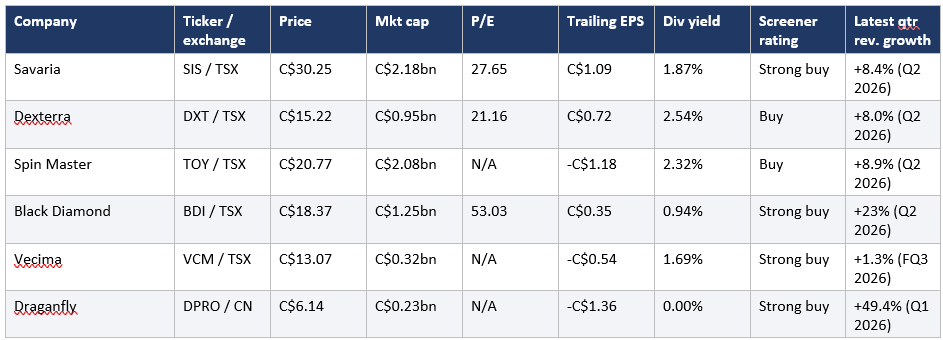
The table below summarises the screener snapshot dated 6 August 2026 alongside each company's most recently reported quarterly revenue growth. Three of the six — Spin Master, Vecima and Draganfly — show no price/earnings ratio because they are loss-making on a trailing basis; a P/E divides price by earnings, so when earnings are negative the ratio is either negative (and misleading) or simply undefined, which is why "N/A" is the honest entry rather than a number that would imply a valuation the earnings cannot support.
Rankings by category
These orderings are analytical shorthand drawn from the verified data above, not recommendations. They are one way to see how the six differ.
By profit quality and consistency (steadiest first): 1) Savaria, on record margins and reliable growth; 2) Dexterra, profitable with strong cash conversion; 3) Spin Master, freshly returned to profit; 4) Black Diamond, growing fast but with lumpy headline earnings; 5) Vecima, near-breakeven and awaiting its ramp; 6) Draganfly, deeply loss-making.
By dividend income (highest yield first): Dexterra (2.54%), Spin Master (2.32%), Savaria (1.87%), Vecima (1.69%), Black Diamond (0.94%), Draganfly (nil).
By top-line growth momentum (fastest first): Draganfly (+49.4%, off a tiny base), Black Diamond (+23%), Spin Master (+8.9%), Savaria (+8.4%), Dexterra (+8.0%), Vecima (+1.3% last quarter but guiding to 22.5%-30% for the full year).
By risk (lowest first): Savaria and Dexterra sit at the defensive end; Spin Master and Black Diamond carry cyclical and turnaround risk; Vecima adds customer-concentration and execution risk; Draganfly is in a class of its own for volatility and cash burn.
What to monitor for the rest of August 2026
- Savaria's full Q2 detail and call: confirmation of the exact revenue, net earnings and adjusted EBITDA margin behind the 8.4% headline, and any update to Savaria One targets, would firm up the margin-expansion thesis.
- Dexterra's contract pipeline: watch for commentary on when recently won business converts to revenue, and whether net earnings can reaccelerate after this quarter's dip.
- Spin Master's second-half read-through: early signals on holiday-season toy demand, tariff impacts on sourcing, and continued buyback pace against the reiterated guidance.
- Black Diamond's bid conversion and leverage: any move of the C$2bn-plus bid pipeline into firm contracts, plus updates on the appealed BC PST provision and net-debt trajectory.
- Vecima's Entra order flow: evidence that the 73 ordering operators are translating into the guided 22.5%-30% full-year revenue ramp; the next quarterly report is the key test.
- Draganfly's Q2 release and any new defence orders: the pending second-quarter numbers, cash-burn rate, and whether public-safety and defence interest converts into materially larger contracts.
Conclusion
The screener's "consumer durables" label unites six companies that have little in common beyond a coarse classification code. Read as businesses, they span a defensive accessibility compounder (Savaria), a cash-generative services group (Dexterra), a recovering toy maker (Spin Master), a fast-growing industrial-rental operator (Black Diamond), a scaling broadband-technology firm (Vecima) and a speculative drone micro-cap (Draganfly). Their quarterly results, almost all delivered in the past fortnight, show genuine operational progress at the top of that quality spectrum and unproven promise at the bottom.
None of that constitutes advice. A consensus "Buy" or "Strong buy" label is a snapshot of sentiment, not a guarantee of returns, and the three loss-makers here — Spin Master, Vecima and Draganfly — show why a headline rating must always be weighed against the underlying financial reality. The right next step for any reader is to check the primary filings, consider how each business fits their own objectives and risk tolerance, and treat the screener's grouping as a starting point for research rather than a conclusion. Prices, ratings and valuations cited here are dated to 6 August 2026 and will move.


 Nov 26, 2026





 Please wait processing your request...