
 NZ
 UK
 US
 AU
 IND

 CA

 Share
 X (Formerly Twitter)
 Whatsapp
 Facebook
 LinkedIn
 Telegram
 Email This Article
 Copy Link
 Summarize with AI
 Chat GPT
 Perplexity

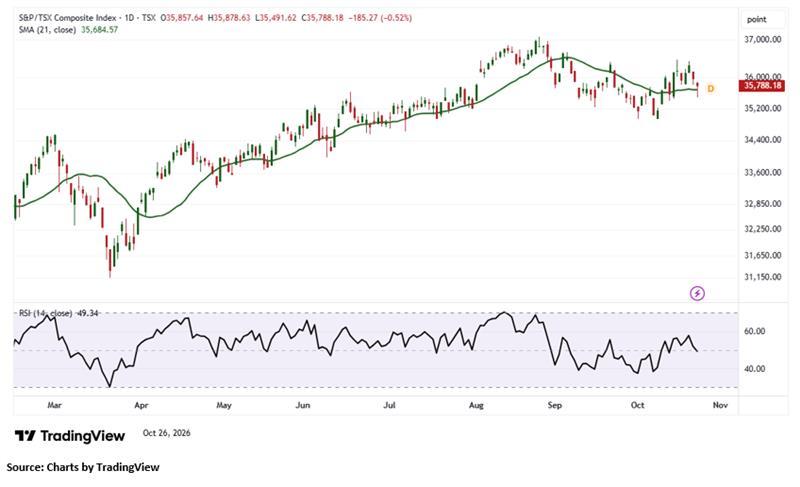
The S&P/TSX Composite index is expected to commence trading on a negative note, weighed down by weakness across the basic materials and technology sectors. Nevertheless, the index continues to trade above its 21-day Simple Moving Average (SMA), which serves as a key dynamic support level and helps preserve the improving technical structure. Immediate support is located near 35,600, a critical level for sustaining the ongoing recovery. A sustained hold above this level could help stabilise market sentiment and encourage renewed buying interest, potentially supporting a rebound towards the recent high near 36,000. Conversely, a decisive break below 35,600 could intensify selling pressure and expose the index to further downside risks.
Global Macro Backdrop
Federal Reserve and interest-rate expectations: The U.S. monetary-policy outlook remains a key driver of global financial conditions. Investors will assess the latest available Inflation and labour-market indicators, economic activity data and central-bank commentary for clues about the future path of interest rates. Persistent inflation could keep yields elevated and weigh on rate-sensitive equities, while softer inflation accompanied by resilient growth could improve the outlook for risk assets.
Bank of Canada and domestic conditions: Canadian inflation, employment, consumer spending and economic growth remain central to expectations for monetary policy. The balance between cooling price pressures and the resilience of domestic Demand will influence bond yields, borrowing costs and the outlook for interest-sensitive sectors. For Canadian banks, the implications extend to Loan demand, funding costs and Credit quality.
China and global industrial demand: China remains an important influence on Commodity markets, particularly copper and other industrial metals. Expectations for manufacturing, construction and infrastructure activity can affect Canadian miners and diversified resource companies. Evidence of stronger demand could support industrial metals, while concerns about property-sector weakness or slower activity could weigh on prices.
Global yields and risk appetite: Government bond yields remain an important transmission channel between macroeconomic developments and Equity valuations. A rise in yields can put pressure on high-dividend and long-duration stocks, while falling yields may provide support. The broader interpretation matters: falling yields associated with easing inflation may be constructive, whereas a sharp decline driven by Recession concerns may be less favourable for cyclical equities.
Canadian Market Focus
The TSX Composite’s performance will depend on the interaction between commodity-linked Earnings and the domestic interest-rate environment. Energy and materials companies can benefit from supportive commodity prices, but their share prices also reflect operating costs, Capital discipline, production guidance and expectations for global demand.
Canadian financial stocks remain sensitive to the economic outlook and the Yield curve. Investors will watch for signs of changing credit quality, household financial stress, Business lending demand and net interest Margin pressure. Bank earnings and management commentary may offer important clues about the resilience of the Canadian consumer and business sector.
The Canadian dollar is another key variable. A weaker currency can increase the translated value of foreign earnings for Canadian companies with substantial international operations, including some miners and energy producers. At the same time, it can raise Import costs and complicate the inflation outlook. Movements in oil prices and the relative outlook for U.S. and Canadian interest rates will be important influences.
As earnings season progresses, company-specific developments may drive performance independently of the broader index. Revenue growth, margins, free cash flow, balance-sheet strength and forward guidance deserve particular attention, especially where valuations already assume a favourable operating environment.
Commodity view — what will move the TSX
- Crude: Crude oil fell toward $101 per barrel on Monday, retreating from recent highs despite fears that strikes against Iran could resume following this week’s Israeli elections and next week’s US midterm elections.
- Gold: Gold traded around $4,000 an ounce on Monday, hovering near its lowest level in more than three months as investors weighed escalating geopolitical tensions in the Middle East and prepared for key Central Bank decisions this week.
- Silver: Silver held around $54 an ounce on Monday, hovering near its lowest level in eleven months as investors weighed escalating geopolitical tensions in the Middle East and prepared for key central bank decisions this week
- Copper: Copper futures held below $6.5 per pound on Monday, trading near multi-week lows as persistent concerns over the artificial intelligence sector dampened risk appetite for the industrial metal.
Forex Watch
USD/CAD: The Canadian dollar will remain sensitive to relative U.S. and Canadian interest-rate expectations, oil prices and changes in global risk appetite. A stronger Canadian dollar can reduce the translated value of foreign earnings for some exporters, while a weaker loonie may support those earnings but raise the cost of imported inputs.
U.S. dollar: Broad dollar strength can create headwinds for dollar-priced commodities, although individual commodity markets also respond to supply, demand and geopolitical factors. A softer dollar may offer support to bullion and some industrial metals, depending on the wider macroeconomic backdrop.
Government bond yields: The direction of U.S. Treasury and Canadian government yields will be important for the TSX’s interest-sensitive sectors. Investors should assess whether yield movements reflect improving inflation conditions, changing growth expectations or a repricing of central-bank policy.
Key signal: A combination of USD/CAD movements, oil prices and bond yields may provide a useful indication of whether the market environment is becoming more supportive of resource producers, domestic financials or rate-sensitive equities.
Key Market Drivers Today
- Central-bank expectations: Any verified updates on inflation, economic activity or policy guidance that affect the expected paths of the Federal Reserve and Bank of Canada.
- Bond yields: Changes in U.S. Treasury and Canadian government yields, particularly for financials, technology, utilities and real estate.
- Crude oil: Supply developments, inventory information and revisions to global demand expectations.
- Gold and silver: Movements in real yields, the U.S. dollar and safe-haven demand.
- Copper and base metals: Chinese economic conditions, industrial activity and the balance between supply and demand.
- USD/CAD: Currency movements that can affect commodity sentiment and the translated earnings of internationally exposed companies.
- Corporate earnings: Results, forward guidance, margins, Capital Expenditure and shareholder-return announcements.
- Global risk sentiment: Developments affecting expectations for economic growth, geopolitical risk and investor demand for cyclical versus defensive assets.

Market Outlook
dThe TSX Composite enters the new week facing a familiar balance of opportunities and risks. Firm commodity prices and resilient corporate earnings would provide support, particularly for energy and materials shares. A stable interest-rate outlook could also help financials and other domestic sectors maintain momentum.
The less favourable scenario would involve rising yields, a stronger U.S. dollar and weaker industrial demand. That combination could weigh on rate-sensitive stocks and base-metal producers, while leaving the index more dependent on the performance of gold and selected energy companies. A deterioration in the Canadian economic outlook would add another source of uncertainty for banks and consumer-facing businesses.
Investors should look for confirmation across sectors rather than relying on the direction of a single commodity or index heavyweight. Broad participation, constructive earnings guidance and stable bond markets would provide a more convincing signal of improving sentiment than a rally concentrated in a narrow group of resource stocks.
Bottom line: The TSX’s near-term direction will depend on the balance between commodity support, global growth expectations and the interest-rate outlook. Oil, gold, copper, USD/CAD, government bond yields and corporate earnings guidance are the key variables to monitor. In the absence of verified live-market information, a cautious, fundamentals-led approach is appropriate, with particular attention to free cash flow, balance-sheet resilience and the quality of earnings.


 Nov 16, 2026





 Please wait processing your request...