
 NZ
 UK
 US
 AU
 IND

 CA

 Share
 X (Formerly Twitter)
 Whatsapp
 Facebook
 LinkedIn
 Telegram
 Email This Article
 Copy Link
 Summarize with AI
 Chat GPT
 Perplexity

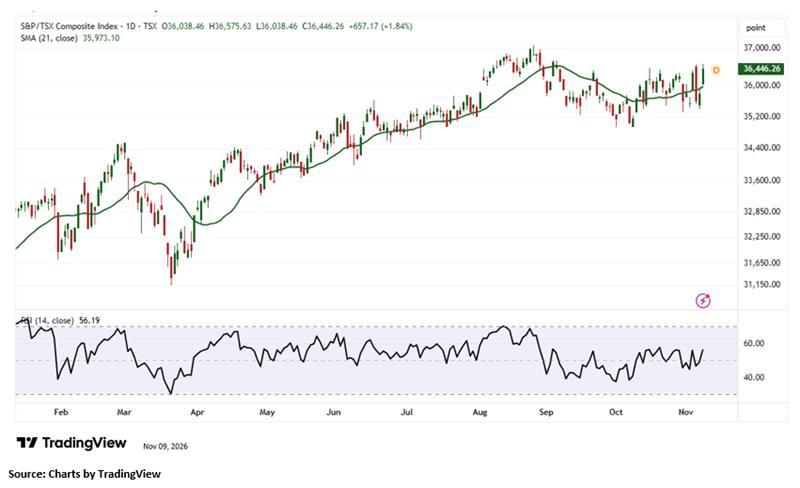
The S&P/TSX Composite index is expected to commence trading on a positive note, supported by strength across the basic materials and industrial sectors. From a technical perspective, the index continues to trade above its 21-day Simple Moving Average (SMA), which acts as a key dynamic support level and reinforces the prevailing positive market structure. Immediate support is positioned near 36,200, a crucial level for sustaining the ongoing recovery. A sustained hold above this level could attract further buying interest and support an upward move towards the recent high of 36,700. Conversely, a decisive break below 36,200 could undermine market confidence, intensify selling pressure and expose the index to further downside risks. Overall, the near-term outlook remains cautiously positive as long as the index sustains above key support.
Global Macro Backdrop
United States - Political developments and economic outlook
US equities rebounded decisively on Monday as sharply lower oil prices relieved some concerns about Inflation and borrowing costs. The recovery followed Volatility surrounding the US midterm elections, expectations for tighter scrutiny of artificial intelligence Investment and uncertainty related to the Iran conflict. Investors favored a broader recovery in equities even though some major technology names remained under pressure.
The S&P 500 rose 2.35% to 7,549.94, the Nasdaq Composite gained 2.74% to 25,253.14 and the Dow Jones Industrial Average advanced 2.15% to 52,389.75. The broad-based rebound supported Canadian risk appetite, with industrial and material producers benefiting from an improvement in sentiment across North American markets.
Investors continued to assess the latest US employment indicators and the resulting outlook for Federal Reserve policy. The strength of the US economic backdrop remained relevant to Treasury yields, the US dollar and Equity valuations, while the sharp retreat in oil prices helped ease concerns about persistent inflation pressures.
The recovery in US stocks provided a supportive external backdrop for the TSX. However, uncertainty surrounding technology investment, geopolitical developments and the path of interest rates remained potential sources of volatility. Canadian equities outperformed the broader US indexes in selected resource-related areas.
China - Industrial activity and Commodity demand
China remained a key source of Demand for copper, aluminium and other industrial commodities. Developments in manufacturing, construction and infrastructure continued to influence Canadian Mining valuations, while improving risk appetite and supply-side conditions supported interest in resource producers.
Canadian metal-mining stocks advanced strongly on Monday, supported by a recovery in precious-metal prices and broader demand for cyclical assets. Mining equities outperformed despite continued uncertainty over the strength of industrial demand in China and the direction of global trade policy.
Global bond yields and risk appetite
Global appetite for risk improved substantially on Monday as US and Canadian shares rallied together. Falling Crude Oil prices helped moderate inflation concerns, while an easing in bond-market yields supported rate-sensitive Assets and non-yielding precious metals.
Canada’s benchmark 10-year Bond Yield traded near 3.65%, below the three-year peak reached in October. Investors continued to monitor the implications of Canadian and US labour-market conditions for monetary-policy expectations and the relative attractiveness of equities and fixed income.
Canadian Market Focus
Canadian stocks surged on November 9 as lower oil prices, firmer precious metals and a broad US equity rally supported investor confidence. The S&P/TSX Composite rose 1.84% to 36,446.26, recording its strongest close in more than two months. Industrial and metal-mining companies were prominent contributors, while the energy sector lagged.
The latest Canadian employment report remained part of the domestic macro backdrop. October employment declined by approximately 4,700 positions and the Unemployment rate increased to 6.7%, suggesting some cooling in the labour market. These figures continued to influence expectations for the Bank of Canada’s next monetary-policy steps.
The federal government’s November 5 budget remained a medium-term consideration for Canadian investors, particularly measures aimed at infrastructure, productivity, energy and critical minerals. The market also weighed whether easing inflation pressures could improve the outlook for Capital Investment and financing conditions.
Falling oil prices reduced short-term inflation worries and contributed to an improvement in risk appetite, despite the negative effect on certain energy producers. Canadian bond yields remained below their recent highs, offering some relief for rate-sensitive companies and supporting optimism around domestic financial conditions.
Materials, industrials and financials led the TSX advance. Barrick Mining gained approximately 4.5% following stronger quarterly profit, while Hammond Power Solutions rose 10.6%, Energy Fuels advanced 9.8% and Silvercorp Metals added 9.1%. Constellation Software declined 3.8% after reporting weaker quarterly free cash flow, highlighting uneven performance within technology stocks.
Commodity view - what moved the TSX
- Crude: Crude oil fell below $85 per barrel on Tuesday, extending losses from the previous session and reaching its lowest level since late August amid diplomatic efforts to end the Middle East conflict.
- Gold: Gold prices edged lower to around $4,120 per ounce on Tuesday, giving back part of the previous session’s gains as investors awaited a key US inflation report that could shape expectations for Federal Reserve monetary policy.
- Silver: Silver prices edged lower toward $53 an ounce on Tuesday, giving back part of the previous session’s gains as investors awaited a key US inflation report that could shape expectations for Federal Reserve monetary policy.
- Copper: Copper futures climbed above $6.30 per pound, recovering from near four-month lows as signs of tightening Supply in China, the world’s largest copper consumer, provided support, with Import premiums reaching record highs.
Forex Watch
USD/CAD: The Canadian dollar weakened to near 1.41 per USD in November following weaker-than-expected domestic jobs data and stronger US employment figures.
Canadian employment fell by 4,700 in October, improving from September’s 68,300 decline but missing forecasts for a 13,600 increase. Private-sector employment dropped by 53,000 (-0.4%), its first decline since February.
US dollar: The US Dollar Index softened by approximately 0.6% on Monday as improving market sentiment and changing interest-rate expectations reduced demand for the greenback. The weaker dollar helped support dollar-denominated precious metals.
Canadian dollar implications: Exchange-rate changes continue to shape the outlook for Canadian exporters and importers. A softer loonie can raise the Canadian-dollar value of foreign revenues, while also increasing imported equipment and operating costs. Resource producers remain particularly sensitive to currency and commodity-price interactions.
Key Market Drivers
- TSX rally: The Composite surged 657.17 points, or 1.84%, to 36,446.26, reaching its highest close since September 4.
- US equity rebound: The S&P 500, Nasdaq Composite and Dow Jones Industrial Average all advanced more than 2% as markets recovered from last week’s volatility.
- Canadian employment: The October decline of approximately 4,700 positions and 6.7% unemployment rate remained relevant to monetary-policy expectations.
- Bond yields and inflation: Lower oil prices helped ease inflation worries, while Canada’s 10-year yield traded around 3.65%.
- Mining and industrial leadership: Precious-metal producers, equipment manufacturers and transportation-related names drove broad gains on the TSX.
- Gold and silver: Stronger precious metals supported miners, including Barrick Mining and Silvercorp Metals.
- Crude oil: A sharp decline in WTI and Brent prices restrained energy shares even as it supported broader equity sentiment.
- USD/CAD: The Canadian dollar was broadly unchanged near 70.82 US cents as weaker crude offset a softer US dollar.
- Corporate developments: Barrick Mining gained after earnings, Greenfire Resources surged on a Takeover agreement and Constellation Software fell following its cash-flow update.
- Global risk appetite: A broad rally in US equities and easing energy-led inflation pressures lifted Canadian stocks to a two-month high.
Market Outlook
The November 9 session marked a significant acceleration in the Canadian equity recovery. The S&P/TSX Composite climbed 657.17 points, or 1.84%, to 36,446.26, reaching its highest closing level since September 4. Strong performance in industrial and mining stocks helped more than offset weaker energy shares as investors reacted positively to lower crude prices.
US markets also rallied substantially, with the S&P 500, Nasdaq and Dow Jones each advancing more than 2%. Falling oil prices eased inflation concerns and helped reverse some of the previous week’s risk aversion. Nevertheless, lingering uncertainty around artificial intelligence capital spending, geopolitical developments and interest rates could continue to generate volatility.
Domestic economic conditions remained mixed. Canada’s October employment figures pointed to softer labour-market activity, while the November federal budget continued to frame longer-term expectations for investment and infrastructure spending. Lower bond yields offered an additional source of support for selected financial and rate-sensitive equities.
Commodity markets showed sharp divergence. WTI crude fell to approximately US$86.92 per barrel in late trading, weighing on energy shares, while gold futures advanced to around US$4,153 per ounce. Mining names benefited from precious-metal strength, with Barrick rising after Earnings and Silvercorp among the session’s leading gainers.
Near term, the TSX’s ability to sustain its advance above 36,000 will be important for assessing the durability of the rebound. Investors should monitor oil-price developments, US inflation data, Canadian bond yields, mining-sector momentum and company-specific results. Renewed weakness in energy or technology could lead to uneven performance across the index.
Overall view: A cautiously constructive outlook is appropriate following Monday’s strong rally. Mining, industrials and financials provided broad support, while lower oil prices reduced inflation concerns but weighed on energy producers. Maintaining the recovery above 36,000 would strengthen near-term sentiment; a renewed pullback below this level would Warrant closer attention to downside risks.


 Nov 10, 2026





 Please wait processing your request...