
 NZ
 UK
 US
 AU
 IND

 CA

 Share
 X (Formerly Twitter)
 Whatsapp
 Facebook
 LinkedIn
 Telegram
 Email This Article
 Copy Link
 Summarize with AI
 Chat GPT
 Perplexity

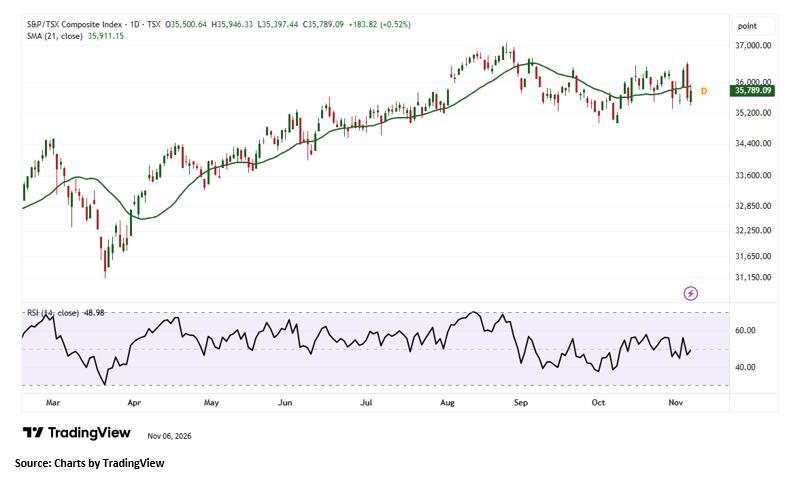
The S&P/TSX Composite index is expected to commence trading on a negative note, weighed down by weakness across the financial and industrial sectors. From a broader technical perspective, the outlook remains cautious, as the index continues to trade below its 21-day Simple Moving Average (SMA), which acts as a key dynamic resistance level and may constrain near-term recovery attempts. Immediate support is positioned near 35,500, a crucial level for maintaining the current market structure. A sustained hold above this level could attract buying interest and support an upward move towards the recent high of 36,000. Conversely, a decisive break below 35,500 could undermine market confidence, intensify selling pressure and expose the index to further downside risks.
Global Macro Backdrop
United States - Political developments and economic outlook
US political developments continued to influence risk appetite after strong Democratic gains in the midterm elections prompted expectations of closer oversight of artificial intelligence businesses. The US technology sector recovered on Friday following the previous day’s sharp decline, but uncertainty surrounding regulation, trade policy and the conflict involving Iran remained important considerations for North American investors.
US stock indexes finished mixed on Friday as technology shares rebounded. The S&P 500 gained 0.3% to 7,376.86 and the Nasdaq Composite advanced 1.1% to 24,579.42, while the Dow Jones Industrial Average declined 0.5% to 51,285.73. Despite the recovery, the Nasdaq and S&P 500 both ended the week lower, underlining continued Volatility in AI-linked stocks.
The October US employment report indicated stronger Job Growth and a lower Unemployment rate of 4.1%, reinforcing expectations that the Federal Reserve could maintain a restrictive monetary stance. The contrast between resilient US employment and weaker Canadian labour-market conditions added to divergence in North American policy expectations.
The stabilization in US technology shares helped the TSX recover from Thursday’s selloff, although elevated Treasury yields, the currency response to employment data and geopolitical risks continued to constrain risk appetite. Market participation was uneven, with Canadian materials and technology shares outperforming economically sensitive sectors.
China - Industrial activity and Commodity demand
China remained central to the outlook for copper, aluminium, iron ore and other industrial metals. Demand from manufacturing, infrastructure and construction continued to shape investor expectations for Canadian resource producers, even as global growth uncertainty and shifting trade policies affected industrial commodity sentiment.
COMEX copper futures settled around US$6.24 per pound on Friday, edging down approximately 0.2%. The subdued price movement underscored continued caution in industrial metals, although the TSX materials sector nonetheless advanced strongly as precious-metal and other Mining shares attracted buyers.
Global bond yields and risk appetite
Global risk appetite improved modestly as technology stocks recovered, but the rebound followed one of the sharpest Equity selloffs in months. Investors continued to reassess the outlook for AI-related businesses, Treasury yields and geopolitical risk, with demand for defensive Assets remaining relevant.
Stronger US employment data contrasted with weaker Canadian job creation, potentially sustaining a divergence between Federal Reserve and Bank of Canada policy expectations. Canadian bond yields and the Canadian dollar remained sensitive to the labour-market figures, with implications for interest-sensitive equities.
Canadian Market Focus
Canadian markets rebounded on Friday as investors assessed the October employment report, the federal budget presented on November 5 and the outlook for Bank of Canada policy. The TSX Composite gained 0.52% after its sharp decline on Thursday, while the materials and technology sectors led the recovery.
Statistics Canada reported that Canadian employment declined by approximately 4,700 positions in October, marking a third consecutive monthly decrease, while the unemployment rate increased to 6.7% from 6.5%. The weaker labour-market outcome raised questions over the resilience of domestic demand and reduced expectations of further near-term Bank of Canada tightening.
The federal government’s November 5 budget remained an important medium-term backdrop, with proposed measures targeting infrastructure, productivity, investment, energy and critical minerals. Investors continued to assess their implications for economic activity, financing requirements and domestic competitiveness, although immediate trading was more sensitive to employment figures and global market movements.
The soft October labour-market report came after the Bank of Canada’s recent policy-rate increase. With job creation weak and the unemployment rate at a six-month high, investors reassessed the likelihood of additional tightening. By contrast, stronger US employment data supported the US dollar and highlighted divergent economic conditions across the border.
The TSX materials sector advanced 2.6%, bringing its gain for the week to 11.4%, while information technology rose 1.8% as US technology shares recovered. Energy added 0.2%. Industrials declined 0.9% and financials slipped 0.2%. Trisura Group shares plunged approximately 29.9% after weaker-than-expected quarterly results.
Commodity view - what moved the TSX
- Crude: Crude oil prices fell to around $90 per barrel on Monday, extending losses from last week after President Donald Trump said it was “highly unlikely” that he would authorize further strikes on Iran if negotiations over its nuclear program and the reopening of the Strait of Hormuz make significant progress.
- Gold: Gold climbed above $4,100 per ounce on Monday, extending last week’s gains as weaker oil prices eased inflationary pressures, although expectations of a more hawkish Federal Reserve capped further upside.
- Silver: Silver climbed above $53 per ounce on Monday, extending last week’s gains as weaker oil prices eased inflationary pressures, although expectations of a more hawkish Federal Reserve capped further upside.
- Copper: Copper futures climbed above $6.30 per pound on Monday, recovering from near four-month lows as signs of tightening Supply in China, the world’s largest copper consumer, provided support, with Import premiums reaching record highs.
Forex Watch
USD/CAD: The Canadian dollar weakened to near 1.41 per USD in November following weaker-than-expected domestic jobs data and stronger US employment figures. Canadian employment fell by 4,700 in October, improving from September’s 68,300 decline but missing forecasts for a 13,600 increase.
Canadian employment declined by 4,700 in October and unemployment increased to 6.7%, reducing expectations for another near-term Bank of Canada rate increase. This labour-market weakness outweighed the support ordinarily offered by a modest rise in Crude Oil prices.
US dollar: The greenback strengthened as better-than-expected US employment data reinforced the outlook for relatively firm US interest rates. Stronger Treasury-yield expectations added to pressure on precious metals and the Canadian currency during Friday’s session.
Canadian dollar implications: A softer Canadian dollar can increase translated Earnings for exporters and businesses receiving US-dollar revenues, while raising the local cost of imported equipment and materials. Its weakness also highlights the potential effect of diverging North American economic conditions on Canadian-listed companies.
Key Market Drivers
- TSX rebound: The Composite recovered 183.82 points to 35,789.09 following Thursday’s steep selloff, with a modest gain for the week.
- US technology recovery: A rebound in semiconductor and AI-linked shares helped lift Canadian technology stocks, although regulatory concerns remained.
- Canadian employment: October payrolls declined by 4,700 and the unemployment rate reached 6.7%, softening expectations for further Bank of Canada tightening.
- US employment and policy: Stronger US jobs data supported the dollar and reinforced expectations for a relatively firm Federal Reserve policy stance.
- Materials leadership: The TSX materials sector rose 2.6% and finished the week with an 11.4% gain amid strong mining-share performance.
- Gold and silver: Both metals retreated on Friday as investors evaluated stronger US data and the resulting currency and interest-rate implications.
- Copper and industrial metals: Copper futures edged lower as investors weighed Chinese industrial demand against wider global growth concerns.
- USD/CAD: The Canadian dollar fell toward a three-week low as the US and Canadian employment reports diverged.
- Corporate earnings: Trisura Group plunged approximately 29.9% after quarterly results disappointed, demonstrating the importance of stock-specific earnings risk.
- Global risk appetite: US technology shares recovered on Friday, but markets remained volatile following a sharp post-election selloff.
Market Outlook
The November 6 session marked a partial recovery for Canadian equities following Thursday’s sharp decline. The TSX Composite advanced 0.52% to 35,789.09, supported by gains in technology and metal mining shares. The benchmark finished the week approximately 0.5% higher, ending a two-week run of weekly losses.
The rebound was supported by a recovery in US technology stocks after the previous day’s severe selloff. However, uncertainty surrounding prospective US oversight of the AI industry and geopolitical conditions continued to influence sentiment. US indexes were mixed at Friday’s close, emphasizing the selective nature of the recovery.
Canada’s October labour data pointed to softness in domestic activity, with a 4,700 decline in employment and an increase in unemployment to 6.7%. The figures tempered expectations for additional Bank of Canada tightening, even as stronger US employment data supported the US dollar. The recently announced federal budget remained a medium-term consideration for Investment and growth.
In commodities, December WTI crude finished around US$90.83 per barrel, while gold and silver futures declined on Friday. The materials sector nevertheless led TSX gains, demonstrating that equity performance reflected a broader combination of weekly precious-metal strength, company fundamentals and changing market sentiment.
Near term, investors should monitor the TSX’s ability to sustain gains above the 35,500 area and reclaim 36,000, along with developments in US technology shares, the Canadian labour market, the path of interest rates and fluctuations in precious metals and crude oil. Results from individual companies may continue to drive pronounced stock-level volatility.
Overall view: A cautiously balanced near-term outlook is appropriate following Friday’s recovery. Materials and technology provided meaningful support, while weaker Canadian employment, currency pressure and losses in industrial and financial stocks revealed ongoing vulnerabilities. A sustained recovery through 36,000 would improve sentiment, whereas a renewed retreat below 35,500 would increase attention on downside risk.


 Nov 10, 2026





 Please wait processing your request...