
 NZ
 UK
 US
 AU
 IND

 CA

 Share
 X (Formerly Twitter)
 Whatsapp
 Facebook
 LinkedIn
 Telegram
 Email This Article
 Copy Link
 Summarize with AI
 Chat GPT
 Perplexity

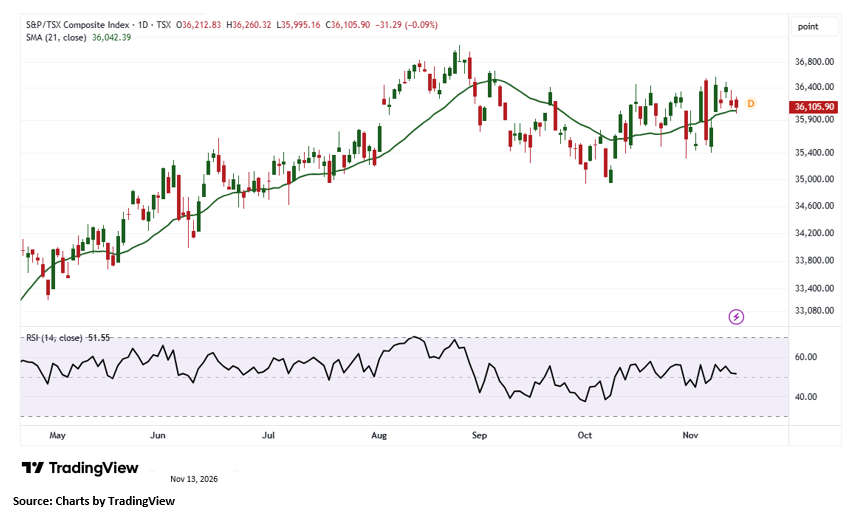
The S&P/TSX Composite index is expected to open higher, supported by strength across the industrial and energy sectors. From a technical perspective, the index continues to trade above its 21-day Simple Moving Average (SMA), which is acting as a key dynamic support level and helping preserve the broader bullish structure. Immediate support is positioned near 35,900, while resistance is placed around 36,400. Sustained trading above support could attract additional buying interest and drive the index towards recent highs. However, a decisive breakdown below 35,900 could weaken market sentiment, trigger renewed selling pressure and expose the index to further downside risks. Overall, the near-term outlook remains cautiously positive.
Global Macro Backdrop
United States - Political developments and economic outlook
US investor sentiment remained cautious on Friday as investors continued to assess the implications of uncertainty surrounding Nvidia and the outlook for artificial-intelligence-related spending. Concerns over valuation, corporate Investment returns and the likely path of US interest rates weighed on technology shares. Inflation risks and geopolitical developments continued to influence risk appetite across global markets.
US stocks ended the session mixed to lower. The Dow Jones Industrial Average gained 50.46 points to 52,347.55, while the S&P 500 declined 30.73 points to 7,561.67 and the Nasdaq Composite fell 229.82 points to 25,136.27. The technology-heavy Nasdaq underperformed as investors reduced exposure to AI-linked stocks, a development that spilled into several Canadian technology names.
October US producer-price inflation continued to highlight persistent price pressure, contributing to expectations that the Federal Reserve may need to maintain restrictive policy for longer. The combination of inflation uncertainty and relatively elevated bond yields remained relevant to Equity valuations, currency markets and the outlook for precious metals.
Despite the uneven performance in US equities, the TSX avoided a broad retreat. Canada’s relatively large exposure to financial, energy and other established businesses helped moderate index losses. However, Celestica fell sharply, highlighting the sensitivity of Canadian technology stocks to developments across the US semiconductor and AI ecosystem.
China - Industrial activity and Commodity demand
China continued to play an important role in shaping Demand expectations for copper, aluminium and other industrial inputs. Investors weighed uneven Manufacturing and construction activity against conditions in physical commodity markets. Changes in the US dollar and bond yields added to the uncertainty for Canadian base-metal producers.
Copper and related Mining shares remained under pressure at the end of the week as investors assessed global industrial demand and the prospect of tighter monetary conditions. Capstone Copper was among the Canadian-listed companies that weakened on Friday, reflecting the cautious backdrop for industrial metals.
Global bond yields and risk appetite
Risk appetite remained selective after a volatile week in North American equities. Technology stocks faced renewed selling, while several defensive and value-oriented segments attracted attention. Market Participants continued to evaluate whether corporate Earnings were sufficiently resilient to offset concerns about inflation and discount rates.
US monetary-policy expectations remained an important influence on market sentiment. Higher Treasury yields can increase the discount rate applied to future earnings and weigh disproportionately on richly valued growth stocks. This dynamic contributed to the divergence between technology shares and comparatively defensive Canadian market segments.
Canadian Market Focus
Canadian equities finished Friday marginally lower after Thursday’s more pronounced decline. The S&P/TSX Composite closed at 36,105.90, losing 31.29 points or 0.09%. Nevertheless, the index gained 316.81 points, or approximately 0.9%, for the week, extending its run of weekly advances to two. The day’s performance reflected weakness in technology, materials and consumer discretionary stocks rather than a uniform decline across all sectors.
Statistics Canada reported that September wholesale sales, excluding petroleum and grain-related categories, increased 0.7% month over month to CAD 92.5 billion. The increase was supported by machinery, equipment and supplies as well as motor-vehicle-related activity. However, wholesale sales volumes slipped 0.2%, indicating that nominal growth did not translate into a broad-based improvement in real activity.
Domestic manufacturing sales were essentially unchanged in September, reinforcing a mixed picture for Canadian economic momentum. The November 5 federal budget remained a medium-term consideration for infrastructure, investment, energy and critical minerals. More immediate attention shifted toward Canada’s October consumer price index, scheduled for November 16.
The Bank of Canada’s rate outlook continued to reflect the tension between inflation concerns and a softer labour market. October employment declined by approximately 4,700 and the Unemployment rate rose to 6.7%. Currency and interest-rate developments remained significant for Canadian companies with cross-border revenues, imported costs and Debt exposure.
Individual stock reactions were notable. Stantec surged 13.79% following better-than-expected quarterly results, while G Mining Ventures gained 9.89% and Kelt Exploration advanced 8.81%. By contrast, Americas Gold and Silver declined 10.80%, Lithium Americas fell 7.83% and Celestica lost 5.42%. The mixed performance illustrated the importance of company-specific news even as technology shares weighed on the broader benchmark.
Commodity view - what moved the TSX
- Crude: Crude Oil fluctuated near $88 per barrel on Monday, struggling for clear direction as investors assessed renewed hostilities in the Middle East alongside signs of strong global oil supplies.
- Gold: Gold weakened toward $3,800 an ounce on Monday, sinking to its lowest levels in more than a year as a stronger US dollar and elevated Treasury yields continued to pressure the precious metal.
- Silver: Silver dropped toward $47 an ounce on Monday, falling to its lowest levels in a year as a stronger US dollar and elevated Treasury yields continued to pressure the precious metal.
- Copper: Copper futures declined to around $6.00 per pound on Monday, reaching their lowest levels since June as concerns surrounding the artificial intelligence sector and a strengthening US dollar weighed on the metal.
Forex Watch
USD/CAD: The Canadian dollar weakened to around 1.42 per USD in November, nearing a one month low amid prospects of a wider US-Canada interest-rate differential.
Canada’s September wholesale-sales increase provided some evidence of nominal activity, although flat manufacturing sales and softer employment underscored a mixed economic backdrop. Investors continued to evaluate the implications for Bank of Canada decisions and the relative outlook for Canadian and US interest rates.
US dollar: The US Dollar Index futures traded around 103.3 late Friday, reflecting support from elevated US interest-rate expectations. A firmer greenback can add pressure to precious metals and influence the Canadian dollar’s performance against the US currency.
Canadian dollar implications: A weaker loonie can raise the Canadian-dollar value of foreign sales for exporters and multinational companies while increasing the cost of imported machinery, technology and other inputs. Currency hedging and debt denominations therefore remain important for company-level analysis.
Key Market Drivers
- TSX closing performance: The Composite slipped 31.29 points (0.09%) to 36,105.90 on Friday but advanced approximately 0.9% for the week.
- Technology weakness: Pressure on US AI and semiconductor shares spilled over into Canada; Celestica declined 5.42%.
- US market divergence: The Dow finished slightly higher, while the S&P 500 and Nasdaq closed lower amid selling in technology shares.
- Inflation and rates: Persistent US producer-price pressures kept expectations for restrictive Federal Reserve policy in focus.
- Crude oil: December WTI crude traded near US$89 per barrel, providing some support to energy-related sentiment.
- Gold and silver: Gold remained near US$3,880 per ounce while silver hovered around US$50, reflecting pressure from the dollar and interest-rate outlook.
- Industrial metals: Copper remained sensitive to Chinese demand expectations and dollar movements, while some Canadian base-metal stocks declined.
- USD/CAD: The Canadian dollar traded around 70.07 US cents as markets balanced oil prices against the US rate outlook.
- Corporate stock movers: Stantec, G Mining Ventures and Kelt Exploration advanced; Americas Gold and Silver, Lithium Americas and Celestica declined.
- Canadian economic releases: September Wholesale Trade increased 0.7%, while manufacturing sales were little changed; October CPI remained the next key release.
Market Outlook
The November 13 session saw the TSX Composite edge down 0.09% to 36,105.90, extending Thursday’s decline but showing relative resilience compared with US technology-heavy benchmarks. The index nevertheless finished the week approximately 0.9% higher, marking a second consecutive weekly gain.
US technology weakness continued to influence Canadian equities as the Nasdaq fell while the Dow finished modestly higher. Concerns around AI-related investment and the direction of interest rates remained significant, but selective buying across established Canadian businesses helped limit the broader index decline.
Canada’s September wholesale sales increased 0.7% to CAD 92.5 billion, while manufacturing sales were essentially unchanged. Together with the softer October employment report, the releases provided a mixed view of activity ahead of the next inflation update. Investors continued to monitor the Bank of Canada’s policy outlook and the federal budget’s longer-term investment implications.
Commodity performance remained uneven. December WTI crude traded near US$89 per barrel and gold futures near US$3,880 per ounce, while silver hovered around US$50. A relatively firm US dollar and interest-rate expectations continued to weigh on metals, even as some energy and industrial names outperformed.
Near term, investors should watch whether the TSX can defend 36,000 and recover the 36,200–36,400 area. The November 16 Canadian consumer price index, North American interest-rate expectations, AI-related corporate developments and movements in crude oil and gold may influence the next directional move.
Overall view: The TSX ended Friday only modestly lower and retained a weekly gain, suggesting that selling pressure was concentrated rather than universal. Defensive sectors and selective corporate earnings offered support, while technology and portions of the materials sector remained vulnerable. A sustained move above 36,200 would improve short-term sentiment; a break below 36,000 would Warrant greater caution.


 Nov 17, 2026





 Please wait processing your request...