
 NZ
 UK
 US
 AU
 IND

 CA

 Share
 X (Formerly Twitter)
 Whatsapp
 Facebook
 LinkedIn
 Telegram
 Email This Article
 Copy Link
 Summarize with AI
 Chat GPT
 Perplexity

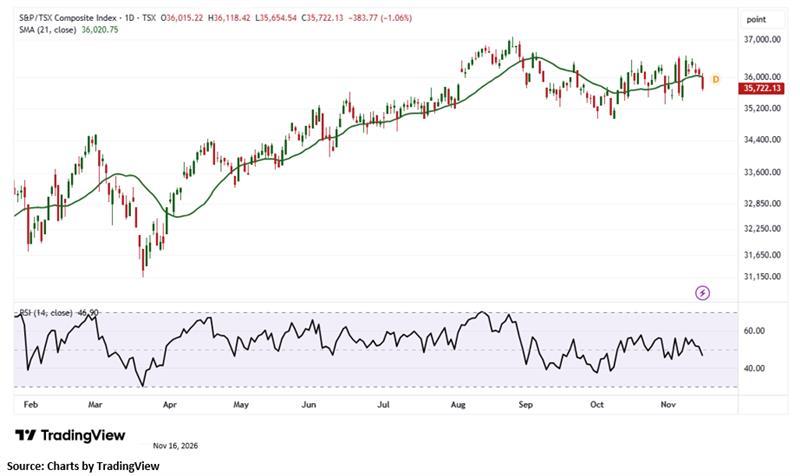
The S&P/TSX Composite index is expected to open lower, weighed down by weakness across the basic materials and energy sectors. From a technical perspective, the index continues to trade below its 21-day Simple Moving Average (SMA), which is acting as a key resistance level. Immediate support is positioned near 35,500, while resistance is placed around 36,000. Sustained trading above the support level could attract renewed buying interest and support a recovery towards recent highs. However, a decisive break below 35,500 could weaken market sentiment, trigger further selling pressure and expose the index to additional downside risks. Overall, the near-term outlook remains cautiously positive, provided the index holds above its immediate support level.
Global Macro Backdrop
United States - Political developments and economic outlook
US Equity markets declined on Monday as renewed selling in artificial-intelligence-linked technology stocks weighed on broader risk appetite. Investors remained focused on corporate valuations, the outlook for AI infrastructure spending and forthcoming company results. Inflation pressures and uncertainty around the Federal Reserve’s policy path continued to influence equity and Commodity markets.
Wall Street closed lower across all three major benchmarks. The Dow Jones Industrial Average fell 739.38 points to 51,608.17, the S&P 500 declined 145.08 points to 7,416.59 and the Nasdaq Composite lost 626.51 points to 24,509.76. The technology-heavy Nasdaq led the declines, reinforcing caution in North American growth stocks.
The persistence of US inflation concerns remained an important macroeconomic consideration. Investors weighed the possibility of restrictive Federal Reserve policy against signs of weaker risk appetite. Changes in Treasury yields and the US dollar continued to influence discount rates, precious metals and the valuation of longer-duration growth businesses.
Canadian equities followed the broader North American retreat, though the main sources of TSX weakness differed from the US technology-led selloff. Declines in oil, gold and base-metal prices weighed on resource companies. Individual takeover-related share movements in Canadian energy stocks provided exceptions to the broad market weakness.
China - Industrial activity and commodity demand
China’s manufacturing, infrastructure and construction outlook remained an important influence on Demand for copper, aluminium and other industrial commodities. Investors continued to weigh potential Supply tightness against uncertainty about global growth and trade conditions. Currency fluctuations also affected industrial-metal pricing.
Copper futures hovered near US$6.00 per pound during Monday trading, with weakness in industrial metals adding pressure to Canadian miners. Hudbay Minerals and Energy Fuels were among the day’s largest TSX decliners, underscoring how resource shares remained exposed to commodity and risk-sentiment changes.
Global bond yields and risk appetite
Global risk appetite deteriorated on Monday as US equities sold off and Canadian resource shares weakened. The pullback occurred ahead of closely watched technology-sector Earnings and against a backdrop of changing monetary-policy expectations. Investors also adjusted positions after Canada’s latest consumer-price data.
The interplay between inflation and borrowing costs continued to affect market valuations. Canada’s slightly softer-than-expected inflation reading reduced some pressure for additional Bank of Canada rate increases, but the broader decline in North American equities and commodities limited any immediate positive market response.
Canadian Market Focus
Canadian stocks closed broadly lower on Monday. The S&P/TSX Composite declined 1.06% to 35,722.13, its third consecutive daily loss and lowest closing level since November 5. Materials, energy and clean-technology stocks were among the weakest groups. On the Toronto Stock Exchange, decliners substantially outnumbered advancers, reflecting negative market breadth.
Statistics Canada reported that consumer prices rose 3.1% year over year in October, matching September’s pace and coming in below the 3.2% consensus estimate. On a seasonally adjusted basis, the CPI increased 0.2% month over month. Higher natural gas, gasoline, grocery and clothing prices contributed to inflation, while slower rent inflation and cheaper cellphone plans provided offsets.
The October inflation release pointed to a mixed price environment. Excluding energy, CPI increased 2.0% year over year, down from 2.1% in September. Combined with softer recent employment data, the release lessened immediate pressure on the Bank of Canada to tighten policy further, although headline inflation remained above the central bank’s target range.
Bank of Canada rate expectations continued to influence the Canadian dollar and interest-sensitive sectors. Employment had declined by roughly 4,700 in October, with Unemployment reaching 6.7%. Investors weighed these labour-market signals against still-elevated headline inflation and the potential implications for consumer spending, corporate financing and future policy decisions.
Company-specific moves were pronounced. Advantage Energy surged 23.74% after news of its proposed Acquisition by Canadian Natural Resources, while TELUS advanced 12.85% and Kelt Exploration gained 10.70%. Quebecor Class B fell 15.33%, Hudbay Minerals declined 8.27% and Energy Fuels slipped 8.19%. The mixed energy-sector response highlighted the influence of transaction news alongside lower oil prices.
Commodity view - what moved the TSX
- Crude: Crude Oil pared earlier losses to trade near $86 a barrel on Tuesday, as investors weighed escalating Middle East tensions against signs of a growing global supply surplus.
- Gold: Gold prices traded around $3,850 per ounce on Tuesday, hovering at their lowest levels since September 2025 as a stronger US dollar and elevated Treasury yields continued to weigh on the precious metal.
- Silver: Silver prices traded around $47 an ounce on Tuesday, hovering at their lowest levels in a year as a stronger US dollar and elevated Treasury yields continued to weigh on the precious metal.
- Copper: Copper futures declined to below $6.00 per pound on Tuesday, reaching their lowest levels since June as concerns surrounding the artificial intelligence sector and a strengthening US dollar weighed on the metal.
Forex Watch
USD/CAD: The Canadian dollar weakened towards 1.43 per USD in mid-November, its lowest level since March 2025, as softer-than-expected inflation eased bets of another rate hike by the Bank of Canada.
October CPI held at 3.1% year over year, reducing pressure for another immediate Bank of Canada rate increase. However, weaker commodity prices and the North American equity retreat were important offsetting influences on the currency. Markets also monitored the interest-rate differential with the United States.
US dollar: The dollar remained relatively firm as investors evaluated US monetary-policy expectations and broad market volatility. US Dollar Index futures were quoted around 103.5 late Monday, contributing to a less favourable backdrop for dollar-denominated precious metals.
Canadian dollar implications: A weaker loonie can increase the Canadian-dollar value of foreign revenues for exporters and multinational companies, while raising the cost of imported machinery, technology and other inputs. Commodity prices, currency hedges and USD-denominated Debt remain significant for company-level analysis.
Key Market Drivers
- TSX closing performance: The Composite fell 383.77 points (1.06%) to 35,722.13, an 11-day closing low and its third straight daily decline.
- Materials and energy: Lower oil and gold prices weighed on major resource shares, while clean-technology stocks also lagged.
- US market decline: The Dow, S&P 500 and Nasdaq all fell, with AI-linked technology stocks leading the broader retreat.
- Canadian inflation: October CPI rose 3.1% year over year, below the 3.2% market forecast and unchanged from September.
- Crude oil: December WTI fell US$2.84 to US$85.72 per barrel, adding pressure to Canadian energy producers.
- Gold and silver: December gold futures slipped to US$3,853 per ounce; silver traded near US$47 per ounce.
- Industrial metals: Copper held close to US$6.00 per pound as global industrial-demand expectations remained uncertain.
- USD/CAD: The loonie traded at approximately 69.94 US cents versus 70.14 US cents at Friday’s close.
- Corporate stock movers: Advantage Energy, TELUS and Kelt Exploration advanced; Quebecor, Hudbay Minerals and Energy Fuels declined.
- Market breadth: Declining TSX issues outnumbered advancing stocks by 670 to 323, with 48 unchanged.
Market Outlook
The November 16 session extended the TSX’s losing streak to three days, with the benchmark falling 1.06% to 35,722.13. The index closed at its lowest level since November 5, as lower crude and precious-metal prices dragged on major resource shares. The decline was broad, although takeover-related buying lifted selected energy companies.
US equities also suffered considerable losses as technology-linked selling intensified. The Nasdaq Composite fell approximately 2.5%, the S&P 500 declined 1.9% and the Dow lost 1.4%. The weak global backdrop and expectations for the Federal Reserve limited the support that Canadian shares might otherwise have received from domestic economic news.
Canada’s October CPI rose 3.1% year over year, slightly below market forecasts and in line with September. The reading, alongside weaker labour-market conditions, eased some concern about an imminent Bank of Canada rate increase. Nevertheless, the more favourable inflation surprise could not counter the downward pressure from commodities and global equity markets.
Commodity performance was largely negative. December WTI crude declined to US$85.72 per barrel, while December gold futures fell to approximately US$3,853 per ounce. Silver traded near US$47 and copper around US$6.00 per pound. The Canadian dollar weakened to roughly 69.94 US cents as energy prices and risk appetite deteriorated.
In the near term, investors should watch whether the TSX can defend support around 35,700 and 35,500, and whether it can reclaim 36,000. Movements in oil, gold, the US technology sector, and Bank of Canada policy expectations could determine the next direction. Corporate earnings and energy-sector acquisition developments may also produce pronounced individual stock moves.
Overall view: The near-term outlook is cautious following a third successive decline and deterioration in market breadth. The softer Canadian CPI reading offers some relief on interest-rate expectations, but resource-price weakness and US equity Volatility remain substantial headwinds. A sustained recovery above 36,000 would improve sentiment; further weakness below 35,500 would elevate downside risk.


 Nov 16, 2026





 Please wait processing your request...