
 NZ
 UK
 US
 AU
 IND

 CA

 Share
 X (Formerly Twitter)
 Whatsapp
 Facebook
 LinkedIn
 Telegram
 Email This Article
 Copy Link
 Summarize with AI
 Chat GPT
 Perplexity

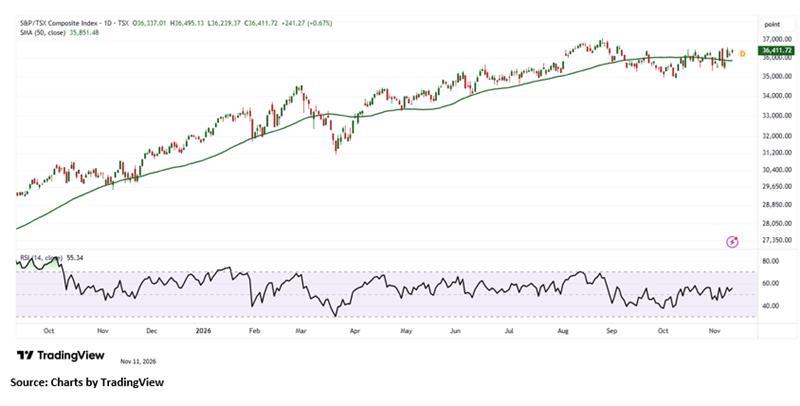
The S&P/TSX Composite index is expected to open on a positive note, supported by strength across the technology and energy sectors. From a technical perspective, the index continues to trade above its 21-day Simple Moving Average (SMA), which acts as a key dynamic support level and maintains the broader bullish structure. Immediate support is positioned near 36,200, while resistance is placed around 36,600. Sustained trading above support could encourage further buying interest and drive the index towards recent highs. However, a decisive break below 36,200 could weaken market sentiment, trigger renewed selling pressure and expose the index to further downside risks. Overall, the near-term outlook remains cautiously positive.
Global Macro Backdrop
United States - Political developments and economic outlook
US investors returned to technology and artificial-intelligence-related shares on Wednesday after a sharp selloff in the previous session. Better-than-expected results from cloud-computing provider CoreWeave helped ease concerns about the pace of Investment in AI infrastructure. Geopolitical tensions involving the United States and Iran remained a separate consideration for energy prices and global risk appetite.
US equities advanced at Wednesday’s close. The S&P 500 rose to 7,619.38, the Nasdaq Composite climbed to 25,466.19 and the Dow Jones Industrial Average finished at 52,486.49. Gains in AI-linked technology companies supported a broad recovery in risk appetite, which carried over to Canadian technology stocks.
Investors continued to assess the implications of recent US Inflation data and the Federal Reserve’s rate outlook. Inflation concerns had weighed on US shares earlier in the week, and the prospect of elevated borrowing costs remained important for growth-company valuations and corporate investment decisions.
CoreWeave’s positive Earnings surprise helped reverse part of the recent technology-sector weakness. Nevertheless, questions around AI capital expenditure, future profitability and financing costs remained relevant. US bond markets were closed for Veterans Day, limiting fresh Treasury-market signals during the session.
China - Industrial activity and Commodity demand
China continued to influence the outlook for copper, aluminium and other industrial metals through developments in manufacturing, construction and infrastructure demand. Global trade uncertainty and uneven industrial activity remained potential constraints on sustained price increases, despite tightness in parts of the physical commodity market.
Copper futures traded around US$6.26–6.29 per pound late Wednesday, modestly higher on the day. The move provided a more supportive backdrop for industrial-metal producers than Tuesday’s session, although Canadian Equity performance was led more decisively by technology and energy stocks.
Global bond yields and risk appetite
Global risk appetite improved as technology shares recovered and North American equity benchmarks advanced. The rally followed renewed concerns about US inflation and AI-related valuations earlier in the week, illustrating the market’s sensitivity to earnings surprises and monetary-policy expectations.
Treasury-market trading was limited by the US Veterans Day holiday. Investors nevertheless continued to consider how higher energy costs, sticky inflation and divergent US–Canadian monetary-policy expectations could affect exchange rates and equity valuations over the coming weeks.
Canadian Market Focus
Canadian equities recovered most of Tuesday’s decline as the TSX Composite increased 0.67% to 36,411.72. The technology sector rose approximately 2.85% and was the main driver of the advance. Higher crude prices also lifted energy producers, while precious-metal miners remained under pressure from weaker gold prices.
The Canadian economic outlook remained influenced by softer October employment figures. Employment declined by approximately 4,700 in October, while the Unemployment rate rose to 6.7%. This divergence from more resilient US labour-market conditions continued to shape expectations for Canadian interest rates and the currency.
The federal government’s November 5 budget remained an important medium-term backdrop for infrastructure, investment, energy and critical-minerals activity. The near-term market reaction, however, was more closely tied to corporate results, Crude Oil and technology-sector sentiment.
The Bank of Canada’s published summary of deliberations drew attention to persistent uncertainty around energy-driven inflation and trade developments. Policymakers had previously raised the policy rate, and Market Participants continued to assess whether additional tightening might be required despite a softer domestic labour market.
Technology shares gained around 2.85% on Wednesday, led by Celestica and Kinaxis. Energy stocks also advanced: Canadian Natural Resources rose 1.9%, Suncor gained 2.2%, Imperial Oil increased 3.1% and Cenovus added 3.0%. By contrast, Agnico Eagle declined 2.0% and Barrick lost 1.3% as gold weakened. Company-specific news contributed to losses in Boyd Group and Lithium Americas.
Commodity view - what moved the TSX
- Crude: Crude oil rose toward $87 per barrel on Thursday, recouping some losses from earlier in the week as the US and Iran remain deadlocked in negotiations while avoiding further escalation.
- Gold: Gold weakened below $4,000 an ounce on Thursday, sliding for the third straight session as a stronger US dollar weighed on the precious metal.
- Silver: Silver fell toward $51 an ounce on Thursday, extending recent losses as a stronger US dollar weighed on the precious metal.
- Copper: Copper futures declined toward $6.20 per pound on Thursday, approaching fresh four-month lows as the US dollar strengthened amid growing expectations of more aggressive Federal Reserve rate hikes following hotter-than-expected inflation data.
Forex Watch
USD/CAD: The Canadian dollar weakened towards 1.42 per USD on November 10th, nearing a one month low amid prospects of a wider US-Canada interest-rate differential. Hotter-than-expected US inflation data in October reinforced expectations of further Federal Reserve rate hikes, supporting the greenback against the loonie on prospects of carry trade into the US.
Canada’s weaker October employment figures and uncertainty surrounding future Bank of Canada action remained relevant for the loonie. A recovery in crude oil offered partial support, but did not fully offset the impact of a firmer US dollar.
US dollar: The greenback strengthened in Wednesday trading, with US Dollar Index futures reported near 102.86. Interest-rate expectations and a cautious interpretation of recent US inflation data contributed to the move, adding pressure to gold prices.
Canadian dollar implications: Currency weakness can increase translated foreign Revenue for Canadian exporters and companies with US-dollar sales. It can also raise costs for imported goods, equipment and capital investment, making hedging and geographic revenue exposure important for company-level analysis.
Key Market Drivers
- TSX recovery: The benchmark gained 241.27 points (0.67%) to close at 36,411.72, recovering most of Tuesday’s decline.
- Technology leadership: The TSX information-technology sector advanced approximately 2.85% as CoreWeave results revived AI-related sentiment.
- US equity rebound: The Nasdaq and S&P 500 rose as AI-linked stocks recovered, helping improve Canadian market sentiment.
- Bank of Canada policy: Policymakers’ deliberations highlighted uncertainty over inflation, energy prices and trade conditions.
- Energy strength: Higher crude oil prices lifted Canadian Natural Resources, Suncor, Imperial Oil and Cenovus.
- Gold and silver: Gold futures declined toward US$4,000 per ounce, while silver held around US$52 per ounce.
- Copper and industrial metals: Copper moved modestly higher as investors monitored Chinese Demand and Supply tightness.
- USD/CAD: The Canadian dollar weakened to approximately 70 US cents amid US dollar strength and policy divergence.
- Corporate earnings and news: Celestica and Kinaxis gained, while Boyd Group and Lithium Americas faced pronounced company-specific declines.
- Global risk appetite: A technology-led rebound improved confidence, but inflation, interest rates and geopolitical developments remained key risks.
Market Outlook
The November 11 session saw the TSX Composite rise 0.67% to 36,411.72, regaining most of Tuesday’s decline. Technology gained approximately 2.85% as investor enthusiasm for artificial intelligence recovered, while firmer crude prices supported Canadian energy equities.
US market strength reinforced the recovery, with the S&P 500, Nasdaq and Dow Jones Industrial Average all finishing higher. CoreWeave’s results helped ease concerns about AI spending, but elevated valuations and interest-rate expectations continued to create a potentially volatile environment for technology shares.
Canadian investors continued to evaluate a softer domestic labour market and the Bank of Canada’s inflation assessment. The federal budget’s investment incentives offered a medium-term policy backdrop, although immediate TSX direction depended more heavily on corporate earnings and international market sentiment.
Commodity moves were mixed. WTI crude rose to approximately US$86.53 per barrel, supporting Canadian energy companies, while December gold futures eased toward US$4,000.50 per ounce and weighed on precious-metal miners. Copper showed modest gains and the Canadian dollar softened against the US dollar.
Near term, market participants should monitor whether the TSX can remain above the 36,200 area and approach the 36,700 resistance zone. Developments in US technology earnings, crude oil, precious metals, interest rates and Canadian inflation data due November 16 may influence the next move.
Overall view: The TSX outlook remains cautiously constructive following Wednesday’s recovery. Technology and energy provided the primary support, while weaker gold-mining shares and company-specific earnings disappointments highlighted uneven breadth. Holding above 36,200 would be encouraging, whereas a renewed break below that level could expose the index to further volatility.


 Nov 17, 2026





 Please wait processing your request...