
 NZ
 UK
 US
 AU
 IND

 CA

 Share
 X (Formerly Twitter)
 Whatsapp
 Facebook
 LinkedIn
 Telegram
 Email This Article
 Copy Link
 Summarize with AI
 Chat GPT
 Perplexity

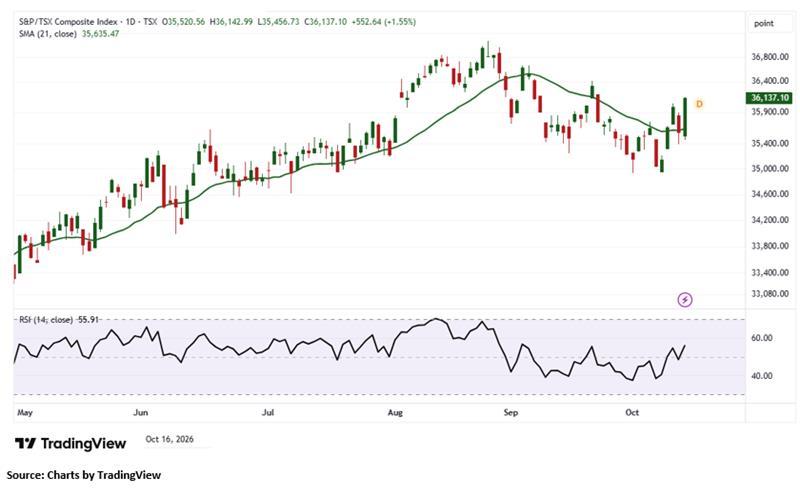
The S&P/TSX Composite index is expected to open on a positive note, supported by strength across the technology and healthcare sectors. However, the index continues to trade below its 21-day Simple Moving Average (SMA), which acts as a key dynamic resistance level and signals persistent technical weakness. Immediate support is positioned near 35,900, a crucial level for sustaining the near-term recovery. A sustained hold above this level could stabilise market sentiment and encourage renewed buying interest, potentially supporting a rebound towards the recent high near 36,400. Conversely, a decisive breakdown below 35,900 could intensify selling pressure, weaken the technical structure, and expose the index to further downside risks.
Global Macro Backdrop
Global financial markets remain focused on the balance between Inflation moderation and economic resilience. The Federal Reserve’s latest policy stance continues to shape expectations for U.S. borrowing costs, with investors assessing whether the trajectory of inflation and employment will allow further monetary easing or require interest rates to remain restrictive for longer.
U.S. Treasury yields remain a key transmission channel for these expectations. Lower yields can support Equity valuations, particularly in growth-oriented and rate-sensitive sectors, while rising yields can tighten financial conditions and increase pressure on companies whose valuations depend on future earnings. The U.S. dollar is another important variable, influencing Commodity prices and international Capital flows.
The global growth outlook remains particularly relevant for Canada because of its exposure to energy and industrial metals. Developments in U.S. consumer demand, European industrial activity and Chinese Manufacturing conditions can affect expectations for oil, copper, nickel and other commodities. China’s construction, infrastructure and manufacturing trends remain especially important for Canadian Mining companies.
In Canada, the Bank of Canada’s policy outlook continues to depend on inflation, employment, household spending and economic growth. Further easing could provide relief to borrowers and support interest-sensitive industries, but a weakening economy could also constrain corporate Revenue and increase Credit risks. The distinction between lower rates resulting from improving inflation and lower rates prompted by deteriorating growth remains important for investors.
As Friday trading approaches, Market Participants will also consider portfolio positioning and any adjustments ahead of the weekend. However, the direction of the session will ultimately depend on actual market developments rather than calendar effects alone.
Canadian Market Focus
The TSX’s performance remains closely connected to the interaction between global commodity markets and North American financial conditions. Energy and Materials stocks provide direct exposure to resource prices, while Financials reflect the outlook for lending, credit quality and the domestic economy.
A stronger commodity environment could help offset weakness in other sectors, particularly if oil and precious metals remain well supported. Conversely, a broad slowdown in global Demand could pressure both resource companies and economically sensitive businesses.
The Canadian dollar remains a significant Factor for corporate earnings. A weaker loonie can increase the Canadian-dollar value of U.S.-dollar revenue for some exporters and resource producers. However, it can also raise the cost of imported equipment, supplies and foreign-currency obligations. Currency effects therefore vary according to each company’s revenue sources, cost base and hedging strategy.
Investors should also monitor corporate fundamentals as the fourth quarter progresses. Production guidance, operating costs, Debt levels, Capital Expenditure and shareholder-return policies can lead to substantial differences in performance among companies exposed to the same macroeconomic environment.
Commodity view — what will move the TSX
- Crude: Crude oil traded above $97 per barrel on Friday and was on track to gain more than 6% for the week amid mounting Supply concerns in the Middle East.
- Gold: Gold climbed toward $4,200 an ounce on Friday, extending gains from the previous session as the recent selloff in equities drove safe-haven demand for Government Bonds and precious metals.
- Silver: Silver strengthened above $57 per ounce on Friday, extending gains from the previous session as the recent selloff in equities drove safe-haven demand for government bonds and precious metals.
- Copper: Copper futures climbed toward $6.60 per pound on Friday, snapping a three-session losing streak as the US dollar weakened amid concerns over a potential slowdown in the AI capital expenditure boom that has supported the American economy and financial markets.
Forex Watch
The Canadian dollar remains closely linked to Crude Oil prices, relative interest-rate expectations and the broader direction of the U.S. dollar.
A stronger U.S. dollar can create headwinds for commodities priced in that currency and affect global risk appetite. A weaker Canadian dollar may benefit exporters and resource producers by increasing the Canadian-dollar value of foreign revenue, but it can also raise costs for businesses that depend on imported equipment or materials.
The relative policy outlooks of the Federal Reserve and Bank of Canada will remain important for CAD/USD. Diverging expectations for interest rates could influence currency movements, cross-border Investment flows and the Earnings outlook for Canadian companies with substantial U.S. exposure.
What to watch: Investors should assess the Canadian dollar alongside oil and metals prices. The combined effect of currency and commodity movements can be more consequential for earnings than either factor considered in isolation.
Key Market Drivers Today
- Crude oil: Global supply conditions, geopolitical risks and demand expectations remain major drivers for Canadian Energy stocks.
- Gold and silver: Precious-metal prices could influence defensive positioning and the performance of Canadian miners.
- Copper and base metals: Industrial-metal trends provide signals about Chinese demand and the global manufacturing cycle.
- Canadian dollar: Currency movements could affect exporters, resource-company revenue and imported input costs.
- Global growth expectations: Developments in the United States, Europe and China remain important for Canadian commodity demand and corporate earnings.
- Corporate earnings and guidance: Production updates, cost trends and capital-allocation decisions may create stock-specific opportunities and risks.
- Friday positioning: Portfolio adjustments ahead of the weekend may affect individual stocks, although the broader market direction will depend on the underlying news and trading conditions.

Market Outlook
The TSX enters Friday’s session with its near-term direction likely to depend on the balance between commodity performance, interest-rate expectations and global economic momentum. Energy and Materials remain key sources of index sensitivity, while Financials and other rate-sensitive sectors will respond to changes in borrowing costs and credit conditions.
A combination of firm commodity prices, stable or declining bond yields and resilient global demand would provide a constructive backdrop for Canadian equities. Conversely, weaker industrial demand, sustained pressure on crude oil or renewed upward pressure on yields could weigh on the benchmark and produce uneven sector performance.
Investors should pay particular attention to crude oil, gold, copper, the Canadian dollar and North American government bond yields. These indicators can help clarify whether the market is being driven primarily by resource-sector momentum, monetary-policy expectations or concerns about economic growth.
Overall, the near-term outlook remains data-dependent. Energy and Materials offer direct exposure to global resource markets, while Financials, Technology, Utilities and Real Estate remain more sensitive to interest rates and credit conditions. A broader advance would be more sustainable if support extended beyond a narrow group of commodity-linked stocks.


 Nov 23, 2026





 Please wait processing your request...