
 NZ
 UK
 US
 AU
 IND

 CA

 Share
 X (Formerly Twitter)
 Whatsapp
 Facebook
 LinkedIn
 Telegram
 Email This Article
 Copy Link
 Summarize with AI
 Chat GPT
 Perplexity

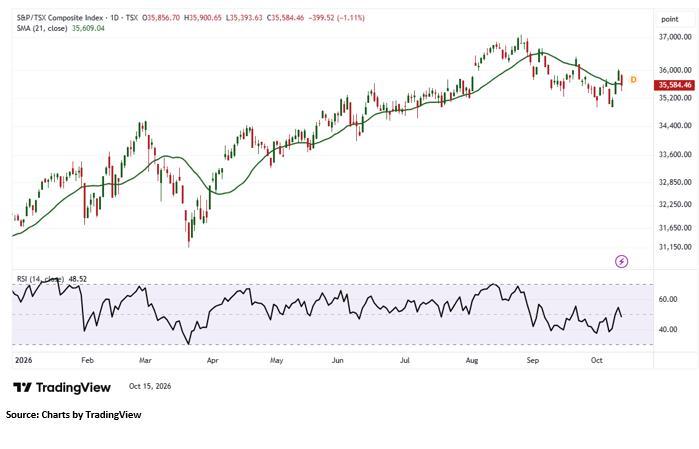
The S&P/TSX Composite index is expected to open on a positive note, supported by strength across the utilities and energy sectors. However, the index continues to trade below its 21-day Simple Moving Average (SMA), which remains a key dynamic resistance level and signals persistent technical weakness. Immediate support is positioned near 35,300, a crucial level for sustaining the near-term recovery. A sustained hold above this support could help stabilise market sentiment and encourage renewed buying interest, potentially supporting a rebound towards the recent high near 35,800. Conversely, a decisive breakdown below 35,300 could intensify selling pressure, weaken the technical structure, and expose the index to further downside risks.
Global Macro Backdrop
Global markets remain focused on whether Inflation is easing sufficiently to give central banks greater flexibility on interest rates without weakening confidence in price stability. The Federal Reserve’s latest policy stance remains an important reference point for investors evaluating the timing and pace of any further monetary easing.
U.S. inflation, employment and consumer-spending trends are key variables for Treasury yields and the U.S. dollar. Evidence of moderating economic activity could strengthen expectations for lower borrowing costs and support Equity valuations. Conversely, persistent inflation or stronger-than-expected growth could keep yields elevated, placing pressure on highly valued Growth Stocks and other rate-sensitive assets.
In Europe, the outlook for industrial activity, Business Investment and consumer Demand remains relevant to global growth expectations. China continues to be a central influence on industrial commodities, particularly copper, nickel and other metals used in manufacturing, construction and infrastructure. Any change in expectations for Chinese demand can have consequences for Canadian Mining companies and the broader Materials sector.
In Canada, the Bank of Canada’s policy outlook remains tied to inflation, employment, household spending and economic growth. Lower borrowing costs could provide relief to indebted households and support interest-sensitive industries, but weaker economic conditions could also constrain consumer demand and increase Credit risks for lenders.
For Canadian equities, the important distinction is between an easing cycle supported by moderating inflation and one prompted by a more pronounced economic slowdown. The former could support valuations; the latter could create pressure on corporate Earnings even as interest rates decline.
Canadian Market Focus
The TSX remains particularly exposed to changes in Commodity prices and global financial conditions because of its significant Energy, Materials and Financials components.
Energy and mining stocks will continue to reflect movements in oil and metals markets, while banks and insurers remain sensitive to the yield curve, lending demand and credit quality. The relative performance of these groups could determine whether strength in resource shares is sufficient to offset weakness elsewhere in the index.
The Canadian dollar is another important Factor for corporate earnings. A weaker loonie can increase the Canadian-dollar value of U.S.-dollar Revenue for some exporters and commodity producers, although it can also raise imported equipment costs and other foreign-currency expenses. Currency movements should therefore be assessed alongside commodity prices and operating costs.
Investors will also be watching company-specific fundamentals as earnings expectations develop through the quarter. Production guidance, Capital spending, Debt levels, cost management and shareholder-return policies could create significant differences in stock performance even when broader market conditions are similar.
Commodity view — what will move the TSX
- Crude: Crude oil fluctuated around $95 a barrel on Thursday as traders weighed mounting shipping risks in the Strait of Hormuz against concerns over weakening global demand.
- Gold: Gold climbed toward $4,150 per ounce on Thursday, recovering from the previous session’s losses as Crude Oil ended its five-day rally, easing pressure across other markets.
- Silver: Silver steadied above $56 per ounce on Thursday after a sharp fall in the previous session, as crude oil ended its five-day rally, easing pressure across other markets. A softer dollar and retreating bond yields also provided support to metals.
- Copper: Copper futures declined toward $6.50 per pound on Thursday, extending losses for a third consecutive session as stronger-than-expected US inflation reinforced expectations of further Federal Reserve rate hikes, dampening the demand outlook for industrial metals.
Forex Watch
The Canadian dollar remains sensitive to oil prices, relative interest-rate expectations and the broader direction of the U.S. dollar.
A stronger U.S. dollar can create headwinds for dollar-denominated commodities and influence global risk appetite. A weaker Canadian dollar can benefit some exporters and resource companies by increasing the translated value of foreign revenue, but it can also raise costs for businesses that rely on imported equipment or materials.
The relative policy outlooks of the Federal Reserve and Bank of Canada remain important for CAD/USD. Any divergence in expectations for borrowing costs could influence currency movements and, in turn, the earnings outlook for companies with substantial cross-border exposure.
For investors, the key is to assess the combined effect of currency and commodity movements rather than treating a weaker or stronger loonie as uniformly positive for Canadian stocks.
Key Market Drivers Today
- Federal Reserve policy outlook: Expectations for the future path of U.S. interest rates remain important for Treasury yields, equity valuations and the U.S. dollar.
- Bank of Canada expectations: Canadian inflation, employment and economic growth continue to shape the outlook for domestic borrowing costs.
- Bond yields: Changes in U.S. and Canadian government yields could influence Financials, Technology, Utilities and Real Estate.
- Crude oil: Global supply, geopolitical risks and demand expectations remain major drivers for Canadian Energy stocks.
- Gold and silver: Precious-metal prices could influence defensive positioning and Canadian mining shares.
- Copper and base metals: Industrial-metal trends provide signals about Chinese demand and the broader Manufacturing cycle.
- Canadian dollar: Currency movements could affect exporter earnings, resource-company revenue and imported input costs.
- Global growth: Developments in the United States, Europe and China remain important for commodity demand and Canadian corporate earnings.
- Corporate fundamentals: Production guidance, operating costs, earnings expectations and capital-allocation decisions may drive stock-specific moves.
Market Outlook
The TSX’s near-term direction remains tied to the interaction between commodity prices, monetary-policy expectations and global economic momentum. Energy and Materials continue to provide the most direct exposure to resource-market developments, while Financials and other rate-sensitive sectors will respond to changes in borrowing costs and credit conditions.
A combination of firm commodity prices, stable or declining bond yields and resilient global demand would offer a constructive backdrop for Canadian equities. Conversely, weaker industrial demand, falling oil prices or renewed upward pressure on yields could weigh on the benchmark and lead to uneven sector performance.
Investors should monitor crude oil, gold, copper, CAD/USD and North American government bond yields for signals about the balance between resource-sector momentum and broader financial conditions. Company-specific earnings and cost trends will remain equally important in determining which stocks outperform.
Overall, the outlook remains data-dependent. Energy and Materials offer exposure to global commodity trends, while Financials, Technology, Utilities and Real Estate remain more sensitive to rates and credit conditions. A sustained market advance would likely require support from more than one area of the TSX, rather than relying exclusively on resource-sector strength.


 Nov 24, 2026





 Please wait processing your request...