
 NZ
 UK
 US
 AU
 IND

 CA

 Share
 X (Formerly Twitter)
 Whatsapp
 Facebook
 LinkedIn
 Telegram
 Email This Article
 Copy Link
 Summarize with AI
 Chat GPT
 Perplexity

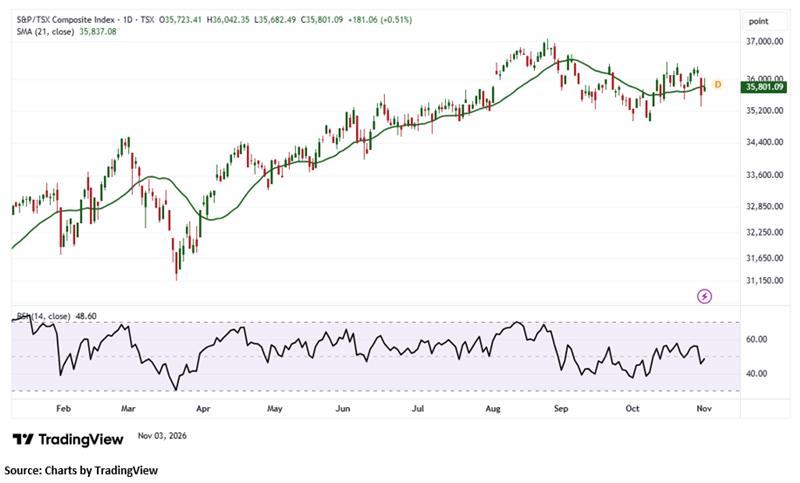
The S&P/TSX Composite index is expected to commence trading on a positive note, supported by strength in the industrials and healthcare sectors. However, from a technical perspective, the index continues to trade below its 21-day Simple Moving Average (SMA), which remains a key dynamic resistance level and may limit the near-term recovery. Immediate support is positioned near 35,600, a crucial level for maintaining the current technical structure. Sustained trading above this level could improve market sentiment and attract fresh buying interest, potentially driving the index towards the recent high near 36,000. Conversely, a decisive break below 35,600 could undermine the recovery attempt, intensify selling pressure, and expose the index to further downside risks.
Global Macro Backdrop
United States — Fed policy and economic resilience
The direction of US Treasury yields and expectations for Federal Reserve policy remain important influences on North American equities. Investors will be assessing whether economic activity, employment conditions and Inflation are consistent with further monetary easing or whether interest rates may need to remain restrictive for longer.
A decline in yields could support Equity valuations, particularly in rate-sensitive technology and growth stocks. Conversely, renewed inflation concerns or stronger-than-expected economic data could push yields higher and create pressure on higher-valuation segments of the market.
For Canadian investors, US economic resilience is also important because the United States is Canada's largest trading partner. Stronger US Demand can support Canadian exporters, manufacturers, energy producers and industrial companies.
China — industrial demand and commodities
China remains a major driver of global demand for crude oil, copper, iron ore and other industrial materials. Investors will continue to monitor signs of improvement or weakness in manufacturing, construction, infrastructure Investment and consumer activity.
Any improvement in Chinese industrial demand could provide support to Canadian Mining and materials companies. On the other hand, weak Manufacturing momentum or uncertainty around the property sector could limit gains in industrial commodities.
Global bonds and risk appetite
Bond-market movements will remain a key indicator of investor confidence. Stable or declining yields generally provide a more supportive environment for equities, while a sharp increase in yields can trigger valuation concerns and encourage a more defensive approach.
Geopolitical developments, trade-policy uncertainty and changes in global growth expectations also remain potential sources of volatility.
Canadian Market Focus
The Canadian market outlook will be influenced by the interaction between domestic monetary policy, US economic conditions and Commodity prices.
The Bank of Canada’s policy outlook remains particularly important for the domestic economy. Investors will assess inflation trends, household spending, employment conditions and housing-market activity to determine how much room policymakers have to adjust interest rates.
A more accommodative interest-rate environment could benefit Canadian banks, utilities, real estate investment trusts and other interest-sensitive businesses. However, the benefits may be offset if weaker economic activity leads to softer Loan growth, rising Credit provisions or pressure on corporate earnings.
The Canadian dollar will also be an important variable. A stronger CAD can reduce the translated value of foreign revenues for some exporters, while a weaker currency can improve the competitiveness of Canadian producers and support the Canadian-dollar value of overseas earnings.
Commodity view — what will move the TSX
- Crude: Crude oil climbed above $98 per barrel on Tuesday, recovering some of the previous session's losses following reports of a US attack on Iran's Qeshm Island.
- Gold: Gold prices fell toward $3,900 per ounce on Tuesday, surrendering gains from the previous session as oil prices rebounded following reports of a US strike on Iran’s Qeshm Island, heightening concerns over renewed inflationary pressures.
- Silver: Silver prices fell toward $49 an ounce on Tuesday, surrendering gains from the previous session as oil prices rebounded following reports of a US strike on Iran’s Qeshm Island, heightening concerns over renewed inflationary pressures.
- Copper: Copper futures slipped toward $6.40 per pound on Tuesday, resuming the decline as renewed selling in technology stocks, driven by lingering concerns over artificial intelligence valuations, weighed on the metal.
Forex Watch
USD/CAD: The Canadian dollar will remain sensitive to the relative outlook for the Federal Reserve and Bank of Canada, movements in US yields and Crude Oil prices. A stronger US dollar could weigh on the loonie, while firmer oil prices and improved global risk appetite could provide support.
US dollar: Broad dollar movements will influence global liquidity, commodity pricing and investor appetite for emerging and developed-market equities. A weaker dollar is often supportive of precious metals and dollar-denominated commodities, although the relationship is not automatic.
Canadian dollar implications: Currency movements can create mixed effects across the TSX. Export-oriented companies may benefit from a weaker CAD through foreign-revenue translation, while businesses dependent on imported equipment and inputs may face higher costs
Key Market Drivers Today
- Federal Reserve outlook: Any change in expectations for US interest rates and the implications for Treasury yields and equity valuations.
- Bank of Canada policy: Domestic inflation, employment, consumer spending and housing-market signals that may influence the Canadian rate outlook.
- Crude oil direction: Global supply-demand expectations, production policy and geopolitical developments affecting energy-market sentiment.
- Gold and precious metals: Real yields, US dollar movements and demand for defensive assets.
- Copper and industrial metals: Evidence of stronger or weaker manufacturing and infrastructure demand, particularly in China.
- USD/CAD movement: Currency sensitivity across Canadian exporters, importers and commodity producers.
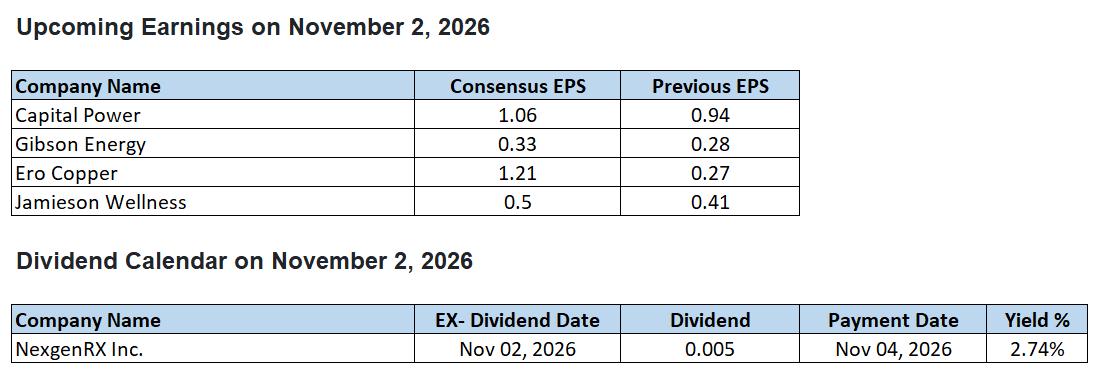
- Corporate earnings: Revenue trends, margins, capital expenditure, Debt levels and forward guidance from TSX-listed companies.
- Global risk sentiment: Bond yields, geopolitical developments and trade-policy uncertainty.
Market Outlook
The November 3 session is likely to be shaped by the balance between global growth expectations, interest-rate sensitivity and commodity-market performance. The energy and materials sectors remain important sources of direction for the TSX Composite, while financials, utilities and real estate will respond more directly to developments in bond yields and the domestic economic outlook.
A supportive combination of stable yields, a constructive commodity backdrop and resilient US demand would provide a favourable setting for Canadian equities. Conversely, renewed inflation concerns, a stronger US dollar, weaker industrial-metal demand or a sharp rise in bond yields could encourage a more cautious market tone.
For investors, the focus should remain on quality earnings, disciplined capital allocation, balance-sheet resilience and companies capable of maintaining Cash Flow through different economic conditions. Rather than relying on a single commodity or macroeconomic signal, today's market assessment should consider the combined direction of oil, gold, copper, the Canadian dollar and global yields.
Overall view: A cautiously balanced outlook is appropriate for the TSX Composite. Commodity performance may provide selective support, but the broader market direction will depend on interest-rate expectations, global economic confidence and the ability of Canadian companies to deliver resilient earnings.


 Nov 23, 2026




 Please wait processing your request...