
 NZ
 UK
 US
 AU
 IND

 CA

 Share
 X (Formerly Twitter)
 Whatsapp
 Facebook
 LinkedIn
 Telegram
 Email This Article
 Copy Link
 Summarize with AI
 Chat GPT
 Perplexity

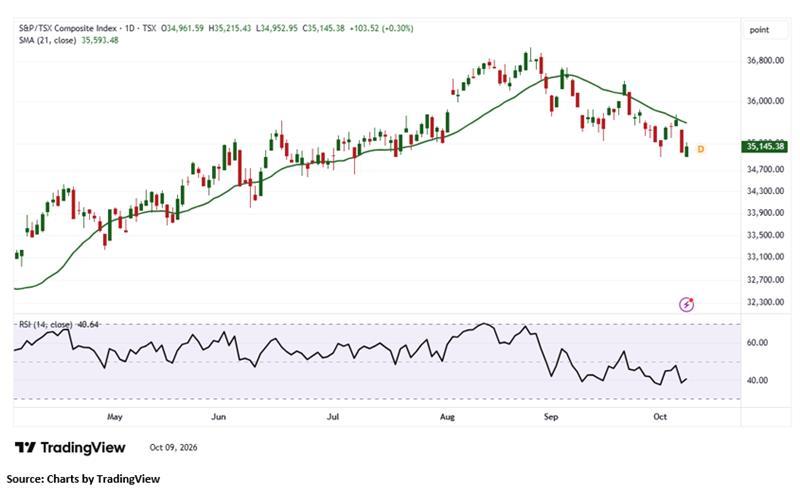
The S&P/TSX Composite index is expected to open on a negative note, weighed down by weakness across the technology and healthcare sectors. Moreover, the index remains below its 21-day Simple Moving Average (SMA), which continues to act as a key dynamic resistance level, signalling persistent technical weakness. Immediate support is positioned near 34,900, a crucial level for maintaining the current technical structure. Sustained trading above this support could help stabilise market sentiment and preserve the broader technical outlook. A successful rebound from 34,900 could attract renewed buying interest and support a recovery towards the recent high near 35,400. Conversely, a decisive break below this level could weaken the technical setup and increase near-term downside risk.
Global Macro Backdrop
Global markets remain focused on the balance between moderating Inflation and the resilience of economic activity. Investors are assessing the implications of the Federal Reserve’s latest policy decision and looking for further indications of how quickly U.S. Monetary Policy may adjust. The outlook for inflation, employment and consumer spending remains important in determining whether borrowing costs ease further or remain restrictive for longer.
U.S. Treasury yields and the U.S. dollar continue to serve as important indicators of changing market expectations. Lower yields could support Equity valuations, particularly in rate-sensitive sectors, while renewed upward pressure on yields could weigh on growth-oriented stocks and tighten financial conditions. For Canadian investors, U.S. market movements remain especially relevant given the close economic and financial links between the two countries.
In Europe, investors remain attentive to economic momentum, industrial activity and the outlook for monetary policy. China continues to be a major variable for global commodities, with Manufacturing demand, infrastructure spending and the effectiveness of economic-support measures influencing expectations for industrial metals and energy.
In Canada, the Bank of Canada’s policy outlook remains tied to domestic inflation, employment, consumer spending and economic growth. Any signs of weakening Demand could strengthen expectations for lower borrowing costs, while persistent inflation could limit the scope for further easing. The resulting rate outlook will remain important for Canadian banks, real estate companies and other interest-sensitive businesses.
Canadian Market Focus
The TSX enters the final Trading session of the week with its performance likely to remain closely connected to commodity-market direction and developments in North American interest rates. Energy and Materials provide substantial exposure to global resource prices, while Financials remain sensitive to domestic Credit conditions, the Yield Curve and the health of Canadian households and businesses.
Investors will also monitor the Canadian dollar as it responds to movements in oil prices, U.S. economic expectations and the relative outlook for the Federal Reserve and Bank of Canada. A weaker loonie can increase the translated value of foreign-currency Earnings for some Canadian exporters and resource producers, although it also raises the domestic cost of imported goods and equipment.
Corporate fundamentals remain important alongside the macroeconomic backdrop. Production costs, Capital allocation, balance-sheet strength and earnings guidance could create meaningful differences in performance within individual TSX sectors, even when companies face similar economic conditions.
Commodity view — what will move the TSX
- Crude: Crude oil prices fell below $91 a barrel on Friday, consolidating after a 3.6% gain in the previous session, amid easing concerns over Middle East Supply disruptions.
- Gold: Gold rose toward $4,200 an ounce on Friday, gaining for a second consecutive session as falling oil prices and bond yields eased pressure on non-yielding metals.
- Silver: Silver rose above $60 an ounce on Friday, rebounding from two-month lows as falling oil prices and bond yields eased pressure on non-yielding metals.
- Copper: Copper futures in the US rose past $6.61 per pound, not too far from the record high of $6.80 touched a month earlier, amid mounting threats to global supply and persistent speculative demand.
Forex Watch
The Canadian dollar remains a key variable for resource producers, exporters and companies with substantial cross-border operations.
The loonie is influenced by oil prices, relative interest-rate expectations and the broader direction of the U.S. dollar. A stronger U.S. dollar can put pressure on commodities priced in that currency, while a weaker Canadian dollar may improve the translated value of overseas earnings for some TSX-listed businesses.
For investors, the key consideration is not simply whether CAD strengthens or weakens, but how currency movements interact with Commodity prices, operating costs and company-specific Revenue exposure.
Key Market Drivers Today
- Federal Reserve outlook: Markets continue to assess the implications of the Fed's latest policy decision and the potential path of future rate adjustments.
- Bank of Canada expectations: Domestic inflation, employment and growth data remain important for the Canadian rate outlook.
- Bond yields: U.S. and Canadian government yields remain critical for equity valuations and rate-sensitive sectors.
- Canadian dollar: CAD movements could influence resource exporters and companies with international operations.
- Global Risk sentiments: U.S., European and Asian equity markets could influence the opening tone in Toronto.
- Fourth Quarter-opening flows: The first trading session of the fourth quarter could see portfolio repositioning and renewed sector allocation following the close of September.
Market Outlook
The TSX's near-term direction remains dependent on the interaction between commodity prices, interest-rate expectations and global economic momentum. Energy and Materials could continue to drive index performance, while Financials will reflect the balance between the prospect of easier monetary policy and concerns about credit quality and economic growth.
A supportive combination of firm commodity prices and easing bond yields would provide a constructive backdrop for Canadian equities. However, weaker global demand, renewed inflation concerns or a sharp increase in yields could complicate the outlook and lead to more selective performance across sectors.
For Friday’s session, investors should pay particular attention to crude oil, gold, copper, the Canadian dollar and movements in North American bond yields. These indicators offer important clues about both the resource-heavy portions of the TSX and the interest-sensitive sectors.
Overall, the outlook remains data-dependent. Energy and Materials offer direct exposure to commodity-market developments, while Financials, Technology, Utilities and Real Estate are more sensitive to the direction of interest rates and the broader economic cycle. Investors should watch for confirmation from market prices and incoming data rather than assume a uniform direction across the Canadian benchmark.


 Nov 23, 2026





 Please wait processing your request...